Google Ads
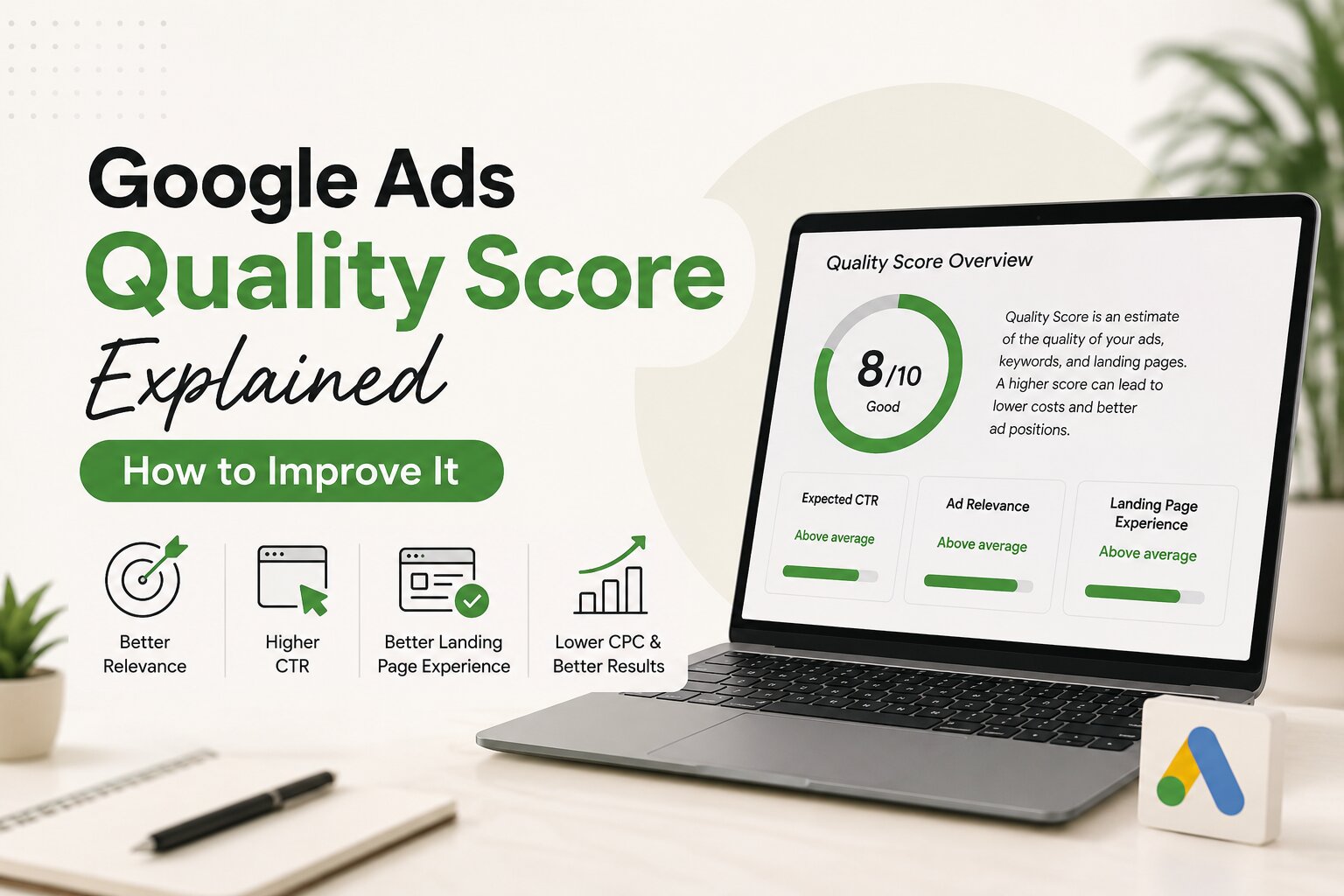
Google Ads Quality Score Explained (How to Improve It)

Category: Google Ads
Google Ads Quality Score Explained (How to Improve It)
If you've ever wondered why your competitors consistently outrank your ads while paying less per click, the answer often comes down to one important metric—Google Ads Quality Score.
Many advertisers focus solely on increasing their bids, believing that spending more money guarantees better ad positions. In reality, Google rewards advertisers who provide a better experience for users. That's where Quality Score comes into play.
A higher Quality Score can help you reduce your cost per click (CPC), improve your ad rankings, increase click-through rates (CTR), and ultimately generate more leads without increasing your advertising budget.
If you're new to Google Ads, you may also want to read our comprehensive Google Ads Setup Guide for Beginners before optimizing your campaigns.
Whether you're running search campaigns for a local business or managing large-scale PPC accounts, understanding Quality Score is essential for maximizing your return on investment.
What Is Google Ads Quality Score?
Google Ads Quality Score is a rating from 1 to 10 that estimates the quality and relevance of your keywords, ads, and landing pages.
It is Google's way of determining how useful your ad will be to someone searching for a particular keyword.
Generally:
| Quality Score | Meaning |
|---|---|
| 1-3 | Poor |
| 4-6 | Average |
| 7-10 | Good to Excellent |
A higher score tells Google that your ad is highly relevant to the user's search query, making Google more likely to display your ad in better positions while charging a lower CPC.
Although Quality Score itself isn't directly used during every auction, the factors behind it significantly influence Ad Rank, which determines your ad position.
If you're struggling with poor campaign performance, our Google Ads Management Services can help optimize every aspect of your campaigns for better results.
Why Does Quality Score Matter?
Many advertisers ignore Quality Score because they believe bidding higher solves everything.
Unfortunately, that's an expensive mistake.
A good Quality Score offers several benefits:
- Lower Cost Per Click (CPC)
- Higher Ad Rank
- Better Click-Through Rate
- Improved Conversion Rate
- Lower Cost Per Acquisition (CPA)
- Better Return on Ad Spend (ROAS)
For example:
Advertiser A
- Max CPC: ₹80
- Quality Score: 9
Advertiser B
- Max CPC: ₹120
- Quality Score: 4
Even though Advertiser B bids significantly more, Advertiser A can still achieve a better ad position because Google values relevance more than bid amount alone.
This is one of the many reasons why simply increasing your bids isn't always the right solution. If your campaigns are spending money without generating quality leads, check out our guide on Why Your Google Ads Are Not Converting (Fix These Issues).
The Three Components of Quality Score
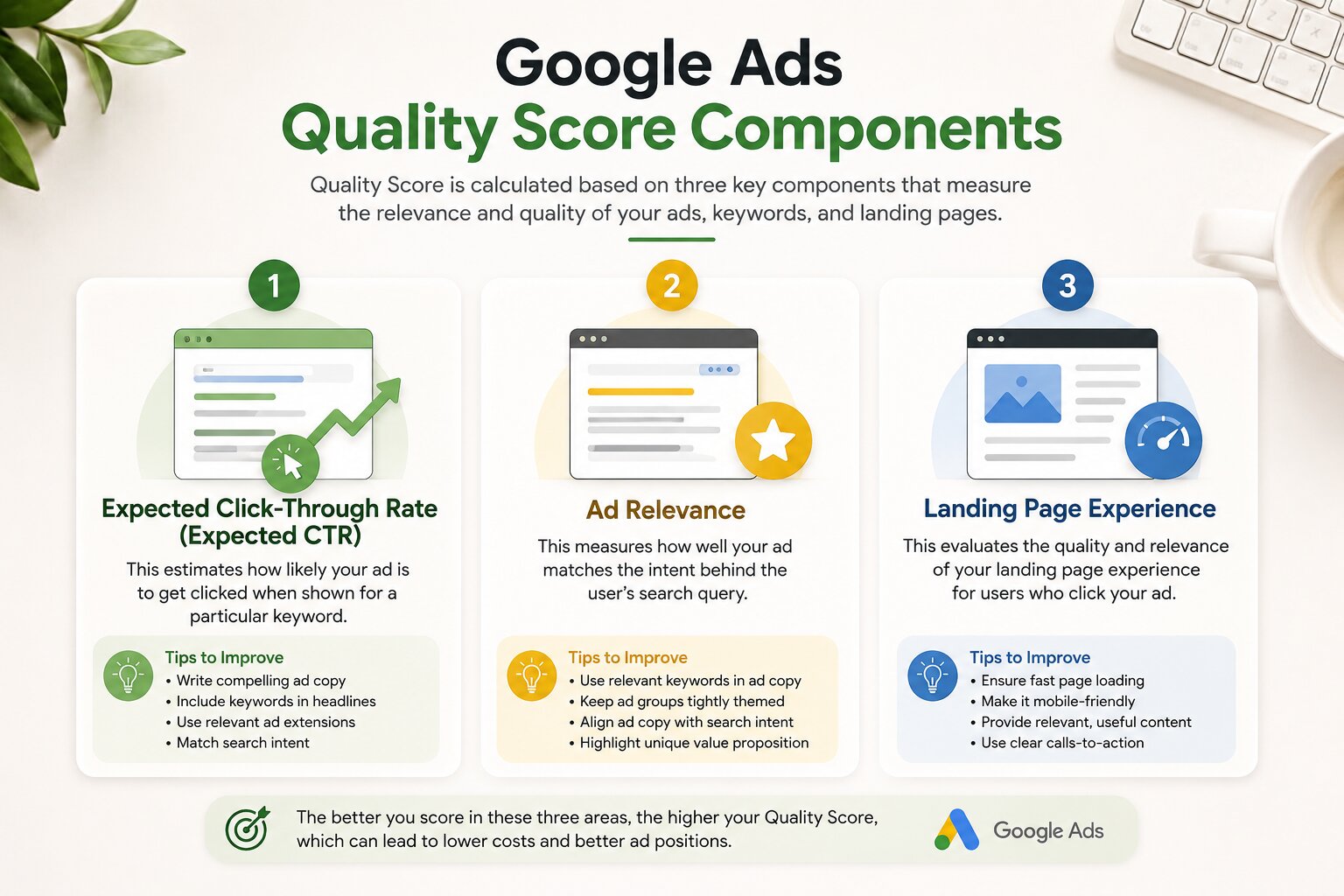
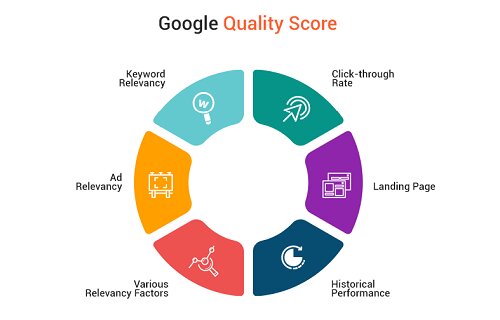
Quality Score is primarily determined by three factors.
1. Expected Click-Through Rate (Expected CTR)
Expected CTR estimates how likely users are to click on your ad when it appears.
Google compares your historical performance with similar advertisers and predicts future click behavior.
A higher CTR usually signals that your ad is relevant and engaging.
Ways to Improve Expected CTR
- Write compelling headlines.
- Include your primary keyword naturally.
- Highlight unique selling points.
- Add promotional offers.
- Use clear calls-to-action.
- Utilize all available ad assets (formerly extensions).
Example:
Instead of:
Digital Marketing Agency
Use:
Google Ads Management Agency | Increase Leads & Reduce CPC
This gives users a stronger reason to click.
2. Ad Relevance
Ad Relevance measures how closely your ad matches the keyword being searched.
Imagine someone searches:
"Google Ads Consultant"
But your ad headline says:
"Digital Marketing Services"
While technically related, it isn't specific enough.
A much better headline would be:
- Google Ads Consultant
- Certified Google Ads Expert
- Hire a Google Ads Specialist
The closer your keyword appears naturally within the ad copy, the better your Ad Relevance.
This is also why organizing campaigns into tightly themed ad groups is considered a Google Ads best practice.
3. Landing Page Experience
Even if users click your ad, Google wants to ensure they land on a page that delivers what was promised.
Your landing page should:
- Match the search intent.
- Load quickly.
- Work perfectly on mobile devices.
- Be easy to navigate.
- Clearly explain your offer.
- Include strong trust signals.
- Have an obvious call-to-action.
For instance, if your keyword is:
Google Ads Agency
Don't send visitors to your homepage.
Instead, direct them to your dedicated Google Ads Services page where they can immediately learn about your services and request a consultation.
How to Check Your Google Ads Quality Score
Finding your Quality Score inside Google Ads is straightforward.
- Log into your Google Ads account.
- Navigate to your campaign.
- Open the Keywords tab.
- Click Columns.
- Select Modify Columns.
- Under Quality Score, enable:
- Quality Score
- Expected CTR
- Landing Page Experience
- Ad Relevance
- Save the changes.
You'll now be able to identify which keywords require optimization.
Rather than trying to improve every keyword at once, focus first on your highest-volume and highest-spending keywords.
What Is Considered a Good Quality Score?
While every industry is different, here's a useful benchmark:
| Quality Score | Recommendation |
|---|---|
| 1-3 | Needs Immediate Improvement |
| 4-5 | Below Average |
| 6-7 | Good |
| 8-10 | Excellent |
Don't panic if every keyword isn't scoring a perfect 10.
Many competitive industries naturally average between 6 and 8, and that's perfectly acceptable.
Instead of chasing perfection, focus on continuous improvements that positively impact campaign performance.
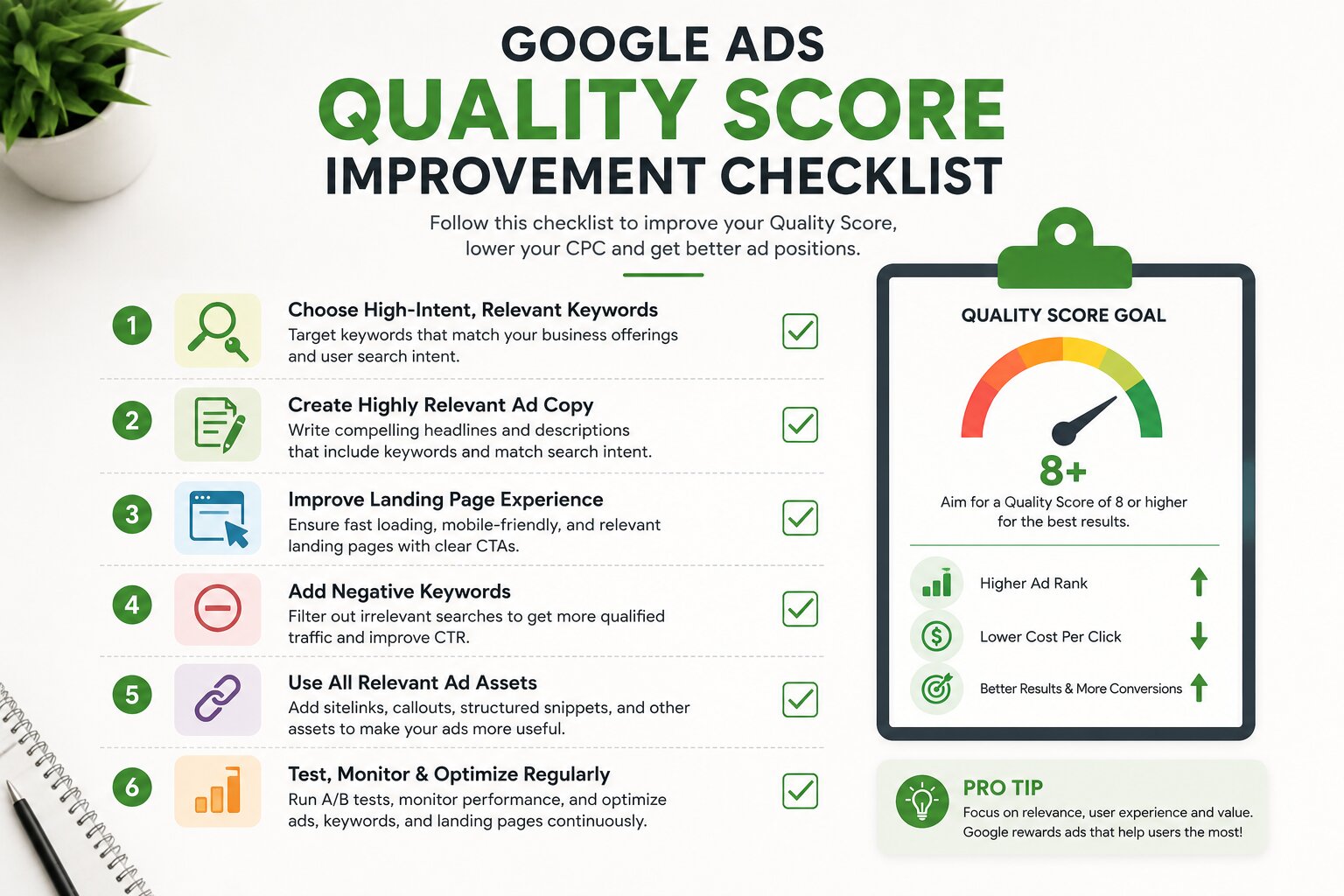
10 Proven Ways to Improve Your Google Ads Quality Score
1. Create Smaller, Highly Focused Ad Groups
One of the biggest mistakes advertisers make is placing dozens of unrelated keywords into a single ad group.
For example:
Bad Ad Group
- Google Ads Agency
- SEO Company
- Facebook Ads
- PPC Services
- Social Media Marketing
Instead, separate these into dedicated ad groups so every keyword has highly relevant ads.
If you're also running campaigns across multiple platforms, our Meta Ads Services and SEO Services help ensure each channel has its own optimized strategy.
This simple restructuring often leads to noticeable improvements in both Ad Relevance and Expected CTR.
2. Include Keywords Naturally in Your Headlines
Your target keyword should appear naturally in:
- Headline 1
- Headline 2 (where appropriate)
- Description
- Display Path
Avoid keyword stuffing.
Google values readability just as much as keyword relevance.
For example, instead of repeating "Google Ads Agency" multiple times, write clear, benefit-driven copy that incorporates the keyword where it makes sense.
3. Write Ads That Match Search Intent
One of the easiest ways to improve your Quality Score is to ensure your ads closely match what users are actually searching for.
For example:
Search Query: "Google Ads Management for Small Business"
A generic ad like:
Digital Marketing Services
is unlikely to perform as well as:
Google Ads Management for Small Businesses
Get More Qualified Leads with Certified PPC Experts
The closer your ad aligns with the user's search intent, the higher your expected CTR and ad relevance are likely to be.
4. Improve Your Landing Page Experience
Your landing page plays a significant role in Quality Score. Even the best-written ads won't perform well if visitors land on a slow, confusing, or irrelevant page.
Here are a few best practices:
- Ensure the page loads in under 3 seconds.
- Make the page mobile-friendly.
- Use a clear and compelling headline.
- Keep messaging consistent with your ad copy.
- Add testimonials, reviews, and trust badges.
- Include a prominent call-to-action above the fold.
- Avoid unnecessary pop-ups that interrupt the user experience.
If you're sending paid traffic to your website, it's worth reviewing your landing pages regularly. You can also explore Scale With Clicks to see how we structure high-converting service pages.
5. Add Negative Keywords
Negative keywords prevent your ads from showing for irrelevant searches.
For example, if you're offering premium Google Ads management services, you may want to exclude terms like:
- Free
- Jobs
- Course
- Salary
- Training
- Internship
Filtering out irrelevant traffic improves your click-through rate over time, which can positively impact your Quality Score.
6. Use All Relevant Ad Assets
Google rewards advertisers who provide more useful information within their ads.
Make use of ad assets such as:
- Sitelinks
- Callouts
- Structured Snippets
- Call Extensions
- Location Extensions
- Image Assets (where applicable)
These assets make your ads more informative and increase the likelihood of users clicking on them.
7. Continuously Test Your Ad Copy
Avoid relying on a single ad indefinitely.
Create multiple variations by testing:
- Different headlines
- Calls-to-action
- Value propositions
- Numbers and statistics
- Emotional triggers
- Offers
Google Ads will automatically favor better-performing ads, helping improve expected CTR over time.
8. Focus on High-Intent Keywords
Not all keywords are equally valuable.
Someone searching for:
What is Google Ads?
is likely in the research phase.
Whereas someone searching:
Google Ads Agency Near Me
is much closer to making a purchasing decision.
Prioritizing commercial-intent keywords often results in higher CTRs, better conversions, and stronger Quality Scores.
9. Pause Poor-Performing Keywords
Regularly review your keyword performance and pause keywords that consistently show:
- Low CTR
- Poor Quality Score
- High CPC
- No conversions
Instead of spreading your budget across underperforming keywords, allocate more spend to those driving meaningful results.
If reducing wasted spend is one of your goals, don't miss our guide on How to Reduce Cost Per Click in Google Ads (2026 Guide).
10. Monitor Performance Regularly
Quality Score isn't something you optimize once and forget.
Set aside time every month to review:
- Keyword Quality Scores
- Search terms report
- CTR
- Conversion rate
- Landing page performance
- Ad relevance
Small, consistent improvements often produce better long-term results than making large, infrequent changes.
Common Mistakes That Lower Quality Score
Many advertisers unknowingly hurt their Quality Score by making avoidable mistakes.
Here are some of the most common ones:
- Sending all traffic to the homepage instead of dedicated landing pages.
- Using the same ad copy across multiple ad groups.
- Ignoring search intent.
- Not adding negative keywords.
- Poor website speed.
- Weak or generic headlines.
- Low mobile usability.
- Rarely reviewing campaign performance.
- Stuffing too many unrelated keywords into a single ad group.
- Focusing only on bids instead of relevance.
Avoiding these mistakes can significantly improve your campaign efficiency over time.
For more pitfalls to avoid, check out our article on 7 Costly Google Ads Mistakes That Are Wasting Your Budget.
Myths About Google Ads Quality Score
Myth 1: Higher bids automatically improve Quality Score.
Reality: Quality Score is based on relevance and user experience, not your bid amount.
Myth 2: Every keyword needs a Quality Score of 10.
Reality: A score of 6–8 is perfectly healthy in many competitive industries.
Myth 3: Quality Score directly determines your ad position.
Reality: Google uses multiple signals during the auction, including bid, expected impact of assets, and ad quality. Quality Score is a useful diagnostic metric, but it's not the sole ranking factor.
Final Thoughts
Google Ads Quality Score isn't just another metric inside your account—it reflects how relevant and helpful your ads are to users.
Improving your Quality Score can lead to:
- Lower cost per click
- Better ad positions
- Higher click-through rates
- More qualified traffic
- Increased conversions
- Better return on ad spend
The best part is that improving Quality Score doesn't always require increasing your budget. By focusing on relevant keywords, compelling ad copy, well-structured campaigns, and optimized landing pages, you can achieve stronger performance while keeping costs under control.
If you'd like expert assistance with campaign optimization, keyword research, landing page recommendations, or ongoing PPC management, explore our Google Ads Services or visit Scale With Click to learn more about how we help businesses grow through performance marketing.
Frequently Asked Questions (FAQs)
1. What is a good Google Ads Quality Score?
A Quality Score between 7 and 10 is generally considered good. However, scores between 6 and 8 are common in competitive industries and can still deliver strong campaign performance.
2. Does Quality Score affect CPC?
Yes. A higher Quality Score often results in a lower cost per click because Google rewards relevant ads with better auction efficiency.
3. Can I improve Quality Score without increasing my budget?
Absolutely. Improving ad relevance, expected CTR, landing page experience, and campaign structure can increase Quality Score without requiring additional ad spend.
4. How often should I review Quality Score?
It's a good practice to review your Quality Score at least once a month, especially for high-spending campaigns and important keywords.
5. Does Quality Score affect conversions?
Not directly. However, the improvements you make to increase Quality Score—such as better ads and more relevant landing pages—often lead to higher conversion rates.
6. Should I optimize every keyword?
Start with keywords that generate the highest impressions, clicks, or spend. Improving the performance of your most valuable keywords typically has the greatest impact on overall campaign results.
If you found this guide helpful, be sure to explore our other Google Ads resources for more actionable tips, strategies, and optimization techniques.