SEO
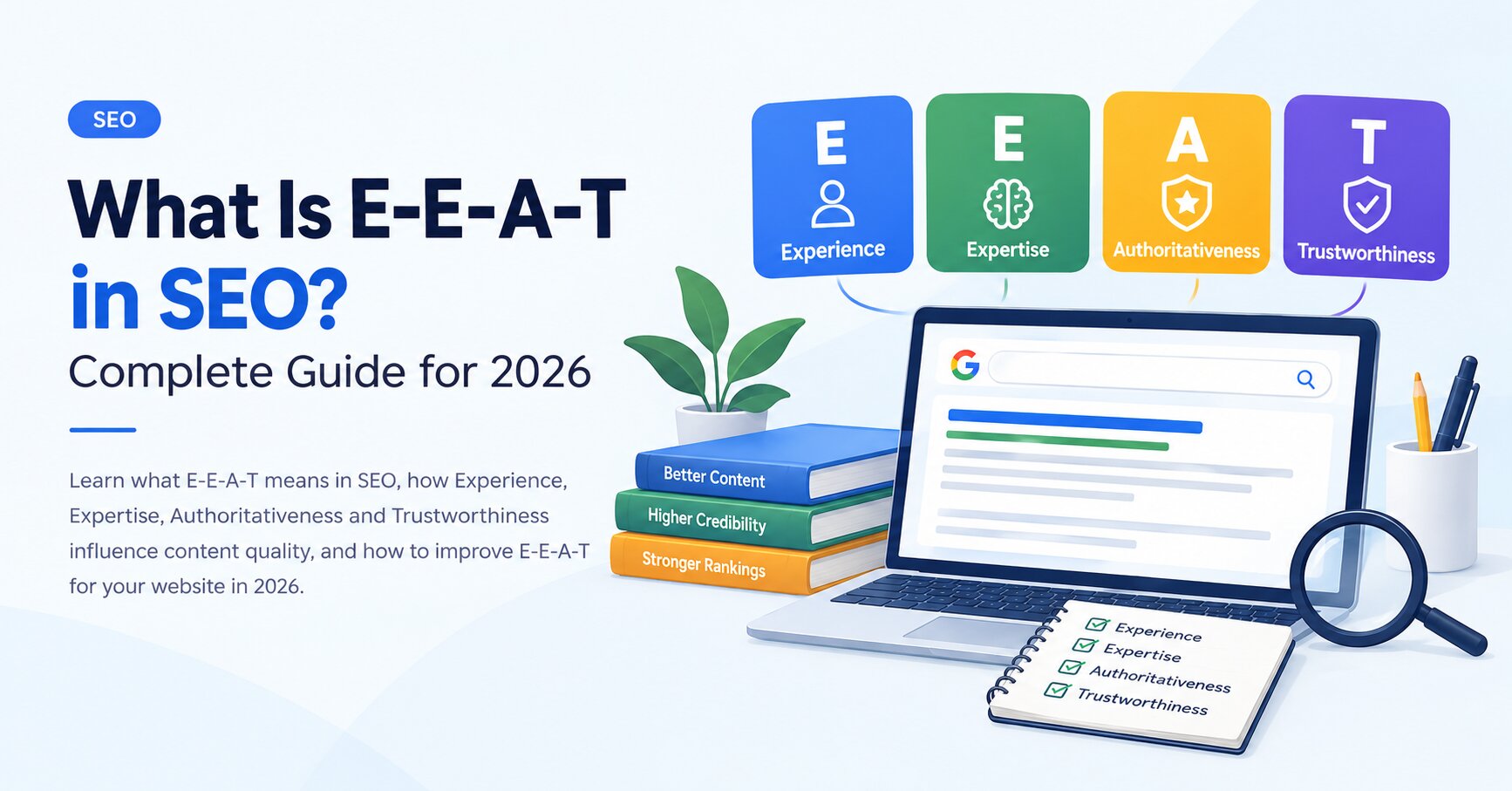
What Is E-E-A-T in SEO? Complete Guide for 2026

Category: SEO
What Is E-E-A-T in SEO? Complete Guide for 2026
If you've been working on SEO for a while, you've probably come across the term E-E-A-T. It appears frequently in discussions about Google's search algorithms, content quality, helpful content, and website credibility.
But what does E-E-A-T actually mean?
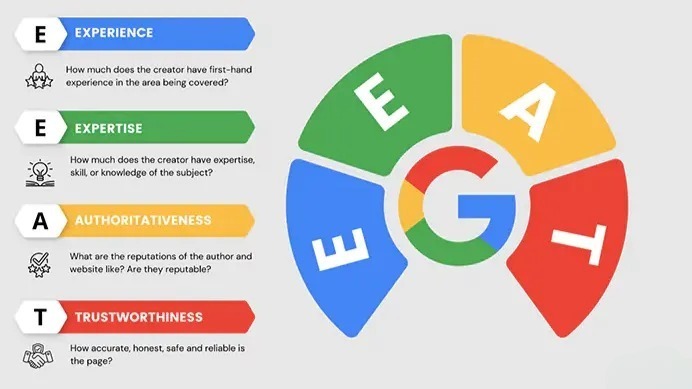
E-E-A-T stands for Experience, Expertise, Authoritativeness, and Trustworthiness. Google uses these concepts to help its systems understand whether content appears useful, reliable, and created by people or organizations with appropriate knowledge and experience.
E-E-A-T is particularly important when you're publishing content in competitive industries where readers need reliable information before making a decision.
However, there's an important point that is often misunderstood: E-E-A-T is not a single Google ranking factor or a score that you can check inside Google Search Console.
Instead, it is a useful framework for creating content and websites that demonstrate genuine experience, knowledge, credibility, and trust.
In this guide, we'll explain what E-E-A-T means in SEO, why it matters in 2026, how Google evaluates these signals, and what you can do to improve E-E-A-T on your website.
What Is E-E-A-T in SEO?
E-E-A-T in SEO stands for:
- Experience
- Expertise
- Authoritativeness
- Trustworthiness
Google introduced the additional "E" for Experience in December 2022. The idea was to better recognize content based on first-hand experience, such as someone actually using a product, visiting a location, testing a service, or sharing genuine experience with a particular subject.
These four concepts work together, but they aren't necessarily equally important for every piece of content.
For example, someone searching for a restaurant review may value first-hand experience heavily. Someone searching for medical information may expect information from qualified professionals and authoritative sources.
Google's current guidance states that trust is the most important aspect of E-E-A-T, while experience, expertise, and authoritativeness contribute to establishing that trust.
So rather than trying to "optimize for E-E-A-T" as if it were a technical ranking setting, website owners should focus on making their content genuinely useful, accurate, transparent, and trustworthy.
What Does E-E-A-T Stand For?
Let's break down each part of E-E-A-T.
1. Experience
Experience refers to first-hand involvement with the subject you're writing about.
This is one of the biggest differences between generic content and content that feels genuinely useful.
For example, imagine two articles about Google Ads.
The first article simply explains what Google Ads is by repeating information found on several other websites.
The second article explains how the author actually managed campaigns, what problems they encountered, how conversion tracking was fixed, what changes improved performance, and what lessons they learned.
The second article demonstrates experience.
This doesn't mean every article needs personal stories. But where first-hand knowledge is relevant, showing evidence of actual experience can make content much more valuable.
Examples include:
- Original screenshots
- Campaign examples
- Case studies
- Product testing
- Real-world results
- Before-and-after comparisons
- Original research
- Practical examples
- Lessons learned from actual projects
For businesses, this is a major opportunity.
Instead of writing generic statements such as "SEO can increase organic traffic," explain what you actually did, what changed, and what the results were.
2. Expertise
Expertise is about demonstrating knowledge and competence in a particular subject.
A website doesn't necessarily need an internationally recognized expert behind every article. The appropriate level of expertise depends on the topic.
For example, an experienced PPC professional writing about Google Ads can demonstrate practical expertise through:
- Campaign strategies
- Account structures
- Optimization methods
- Conversion tracking experience
- Real examples
- Industry-specific insights
- Detailed explanations
Similarly, an accountant writing about taxation can demonstrate professional expertise through appropriate qualifications, experience, and accurate information.
One of the easiest ways to strengthen expertise is to make the person behind the content clear.
Consider adding:
- Author name
- Author bio
- Relevant experience
- Professional background
- Links to author profiles
- Editorial/review information where appropriate
Google specifically recommends making it clear who created the content and providing relevant information about the author when appropriate.
3. Authoritativeness
Authoritativeness is about how strongly a website, organization, or individual is recognized as a reliable source on a particular topic.
Authority isn't created by simply adding the word "expert" to an author bio.
It develops over time.
Some factors that can contribute to perceived authority include:
- High-quality content
- Relevant backlinks
- Industry mentions
- Original research
- Case studies
- Expert contributions
- Strong author profiles
- Positive brand reputation
- Consistent topical coverage
- References from credible sources
For example, a digital marketing agency that consistently publishes detailed information about Google Ads, Meta Ads, conversion tracking, SEO, and landing page optimization can gradually establish stronger topical authority around performance marketing.
This is also where a well-planned internal linking strategy becomes useful.
Instead of publishing hundreds of unrelated articles, create connected content around your core subjects.
For example:
Google Ads
→ Google Ads setup → Google Ads conversion tracking → Google Ads CPC optimization → Google Ads mistakes → Search vs Performance Max → Google Ads strategy for local businesses
Each article supports the broader topic while helping readers discover related information.
If you're working on your site's existing content, our guide on optimizing existing blog posts for SEO covers practical ways to refresh outdated articles, improve internal linking, strengthen content depth, and improve overall usefulness.
4. Trustworthiness
Trust is arguably the most important part of E-E-A-T.
A website can have expert writers and plenty of backlinks, but if visitors don't trust the website, the content becomes much less useful.
Trust can be strengthened through:
- Accurate information
- Transparent authorship
- Clear contact information
- About Us pages
- Secure website connections
- Clear business information
- Privacy policies
- Terms and conditions
- Transparent pricing where appropriate
- Genuine reviews and testimonials
- Reliable citations
- Correct claims
- Updated information
- Easy ways to contact the business
For businesses, your website should answer a simple question:
"Why should I trust this company?"
Don't make visitors search for the answer.
Why Is E-E-A-T Important for SEO in 2026?
Search has changed significantly.
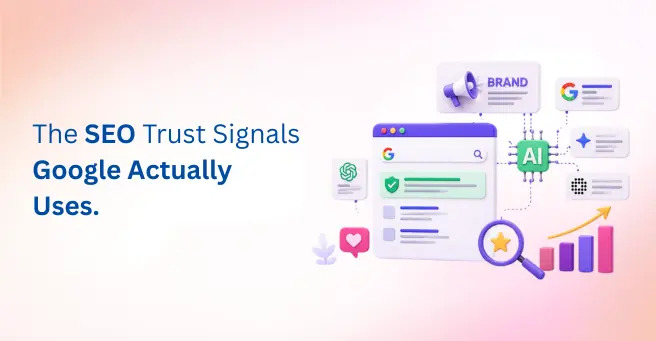
Users aren't only relying on traditional blue search results anymore. They increasingly interact with AI-powered search experiences, summaries, forums, videos, social platforms, and other information sources.
Google's current guidance continues to emphasize unique, useful, people-first content, including for newer generative AI search experiences.
That makes genuine knowledge and original information increasingly valuable.
Think about it this way:
If ten websites publish essentially the same generic article about "How to Run Google Ads," there isn't much reason for a search engine or user to prefer one over another.
But if one article includes:
- Original campaign examples
- Actual screenshots
- First-hand lessons
- Data
- Case studies
- Expert commentary
- Practical recommendations
it provides something that generic AI-generated or rewritten content cannot easily reproduce.
This is why E-E-A-T and SEO should be considered together with overall content quality rather than as separate activities.
Is E-E-A-T a Google Ranking Factor?
This is one of the most common E-E-A-T questions.
The short answer is no—not as a single ranking factor or score.
Google explicitly explains that E-E-A-T itself isn't a specific ranking factor. Instead, its automated systems use a variety of signals that help identify useful and reliable content.
Search Quality Raters also use E-E-A-T concepts when evaluating search results, but their ratings don't directly determine where an individual page ranks.
So you shouldn't think:
"I need an E-E-A-T score of 90."
There is no official E-E-A-T score to optimize for.
Instead, think:
"How can I make this website and its content more useful, credible, experienced, and trustworthy?"
That's a much more productive SEO approach.
How to Improve E-E-A-T on Your Website
Here are some practical E-E-A-T best practices you can implement.
1. Add Clear Author Information
Every article doesn't necessarily require a lengthy biography, but readers should be able to understand who created the content.
Include:
- Author name
- Short bio
- Relevant experience
- Author page
- Professional profile where relevant
For specialist topics, consider adding an expert reviewer when appropriate.
2. Show First-Hand Experience
Don't just tell readers what they should do.
Show them.
For example, instead of:
"Internal links are important for SEO."
You could explain:
"We added contextual internal links between related Google Ads and conversion tracking articles so readers could move naturally between setup, optimization, and measurement topics."
Specific examples make content more useful.
3. Publish Original Information
Original information is one of the strongest ways to differentiate your content.
Consider publishing:
- Case studies
- Surveys
- Experiments
- Industry data
- Original screenshots
- Campaign results
- Customer research
- Detailed comparisons
Google's people-first guidance specifically encourages original information, research, analysis, and substantial value beyond what already exists in search results.
4. Keep Content Updated
Old information can quickly become unreliable.
This is especially important for SEO, advertising, technology, finance, software, and other rapidly changing subjects.
Review older articles regularly and update:
- Statistics
- Screenshots
- Platform features
- Examples
- Links
- Dates
- Recommendations
- Outdated terminology
Don't change the publication date simply to make an old article look new. Update it when the content has genuinely been improved.
5. Cite Reliable Sources
When making important factual claims, reference credible sources.
For SEO topics, this could include:
- Google Search Central
- Official documentation
- Government sources
- Research organizations
- Industry studies
- Original research
For example, Google's own documentation explains that its systems aim to prioritize helpful, reliable, people-first content and provides specific guidance around E-E-A-T.
6. Build Relevant Topical Coverage
Don't create random articles simply because they have search volume.
Build content around topics that are genuinely relevant to your business.
For a digital marketing agency, a strong content structure could include:
SEO → technical SEO, on-page SEO, content optimization, internal linking
Google Ads → campaign setup, keywords, bidding, conversion tracking, Performance Max
Meta Ads → targeting, creative strategy, retargeting, Conversion API, campaign optimization
This helps users—and potentially search systems—understand what your website is actually about.
7. Strengthen Your Website's Trust Signals
Your website should make your business easy to verify.
Consider having:
- About page
- Contact page
- Business information
- Author pages
- Privacy policy
- Terms and conditions
- Case studies
- Testimonials
- Client examples
- Social profiles
- Clear service information
Your SEO strategy shouldn't stop at blog posts. The entire website contributes to how visitors perceive your business.
If you want to improve your website's organic visibility, you can also explore our SEO services for a broader approach covering content and on-page optimization.
E-E-A-T and AI-Generated Content
AI has changed how quickly content can be produced.
But producing more content isn't automatically better SEO.
Google's guidance focuses on the quality and usefulness of content rather than simply whether AI was involved in creating it. However, using automation to produce large amounts of content primarily to manipulate search rankings is not aligned with Google's guidance.
The practical lesson is simple:
Use AI as a tool, not as a substitute for expertise.
AI can help with:
- Research organization
- Outlining
- Editing
- Brainstorming
- Content formatting
- Identifying gaps
But the final content should still contain genuine insight, accurate information, original examples, and appropriate human review.
If ten websites publish the same AI-generated explanation, none has created a meaningful competitive advantage.
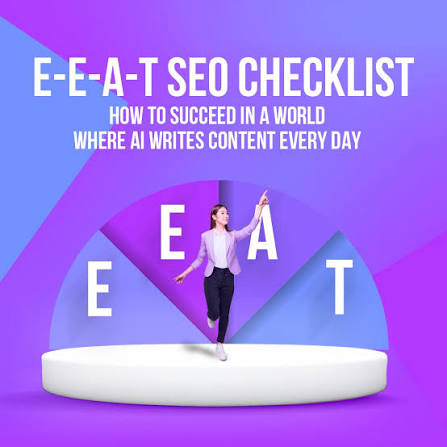
E-E-A-T Checklist for SEO
Before publishing an article, ask:
Experience
- Does the article demonstrate first-hand knowledge?
- Are there real examples or practical insights?
- Can we include original screenshots, data, or case studies?
Expertise
- Is the information accurate?
- Does the author understand the subject?
- Is the author's background clear?
Authoritativeness
- Is the website genuinely relevant to this topic?
- Are there credible references?
- Does the site have supporting content around the subject?
Trustworthiness
- Is the information transparent and accurate?
- Can visitors identify the author or business?
- Are important claims supported?
- Is the website easy to verify and contact?
Content Quality
- Does the article answer the user's actual question?
- Does it provide something beyond existing search results?
- Is it easy to read?
- Is the information current?
- Does it avoid unnecessary filler?
Final Thoughts
E-E-A-T in SEO isn't about finding a secret optimization trick.
It's about creating a website that deserves to be trusted.
Experience shows that you've actually worked with the subject. Expertise demonstrates that you understand it. Authoritativeness shows that others can recognize your credibility. Trustworthiness brings everything together.
For businesses investing in SEO in 2026, this means moving away from publishing content simply because a keyword has search volume.
Instead, create content based on real knowledge, customer questions, practical experience, original research, and useful insights.
And don't forget the rest of your SEO foundation.
Strong E-E-A-T works best alongside technically sound pages, useful content, effective internal linking, good page experience, and a website that clearly communicates who you are and what you do. Google's current guidance also emphasizes that overall page experience matters rather than focusing on a single metric or signal.
If you're building a long-term SEO strategy, start with one simple question before publishing every article:
"Would I still create this content if Google didn't exist?"
If the answer is yes because your audience genuinely needs it, you're probably moving in the right direction.
FAQs About E-E-A-T in SEO
What does E-E-A-T stand for?
E-E-A-T stands for Experience, Expertise, Authoritativeness, and Trustworthiness. It is a framework Google uses in its quality guidance to describe important aspects of high-quality, reliable content.
Is E-E-A-T a ranking factor?
E-E-A-T is not a single Google ranking factor or measurable score. Google uses many signals to identify useful and reliable content, and E-E-A-T provides a useful framework for evaluating content quality.
How can I improve E-E-A-T?
You can improve E-E-A-T by demonstrating first-hand experience, publishing accurate information, using qualified authors, adding original research and case studies, citing reliable sources, maintaining updated content, and strengthening website trust signals.
Does AI-generated content hurt E-E-A-T?
Not automatically. Google's guidance focuses on whether content is useful and high quality rather than simply how it was produced. However, mass-producing low-value content primarily to manipulate search rankings is not aligned with Google's people-first approach.
Is E-E-A-T important for every website?
E-E-A-T concepts are useful across websites, although the level and type of evidence needed varies by topic. They become particularly important for topics where inaccurate information could significantly affect people's health, finances, safety, or well-being.
Does E-E-A-T help with AI search?
Strong E-E-A-T principles align with the broader goal of producing unique, useful, trustworthy information. As search increasingly incorporates AI-generated experiences, original and credible content remains important.