Digital Marketing
How to Create High-Converting Ad Creatives That Drive Clicks and Sales

Category: Digital Marketing
How to Create High-Converting Ad Creatives That Drive Clicks and Sales
Running ads without compelling creatives is one of the fastest ways to waste your advertising budget. You can target the right audience, optimize bidding strategies, and choose the perfect campaign objective—but if your creative fails to grab attention, your campaign will struggle to generate clicks and conversions.
Whether you're advertising on Google, Facebook, Instagram, LinkedIn, or YouTube, your ad creative is the first interaction potential customers have with your brand. It determines whether they stop scrolling, click your ad, or ignore it completely.
In this guide, you'll learn exactly how to create high-converting ad creatives that increase engagement, improve click-through rates (CTR), reduce cost per acquisition (CPA), and generate more qualified leads.
If you're already running paid campaigns, you may also want to read our guide on Why Your Google Ads Are Not Converting (Fix These Issues) to identify common conversion blockers.
Why Ad Creatives Matter More Than Ever
Digital advertising has become increasingly competitive. Every platform is flooded with content competing for users' attention.
Modern advertising algorithms reward creatives that generate higher engagement. Better creatives often result in:
- Higher Click-Through Rate (CTR)
- Lower Cost Per Click (CPC)
- Better Quality Scores (Google Ads)
- Improved Relevance Scores (Meta Ads)
- Lower Cost Per Lead
- Higher Return on Ad Spend (ROAS)
Even the best audience targeting cannot compensate for poor creative quality.
Before increasing your advertising budget, ensure your creatives are optimized.
If you're just getting started, check out our Google Ads Setup Guide for Beginners to build a solid campaign foundation.
The Anatomy of a High-Converting Ad Creative
Every successful ad follows a simple psychological framework.
Instead of focusing only on design, think about how users process information.
Your creative should answer these questions within the first few seconds:
- Why should I stop scrolling?
- What's in it for me?
- Can I trust this brand?
- What should I do next?
Let's break this down.
1. Start with a Powerful Hook
The first three seconds determine whether someone engages with your ad.
Your opening should immediately capture attention.
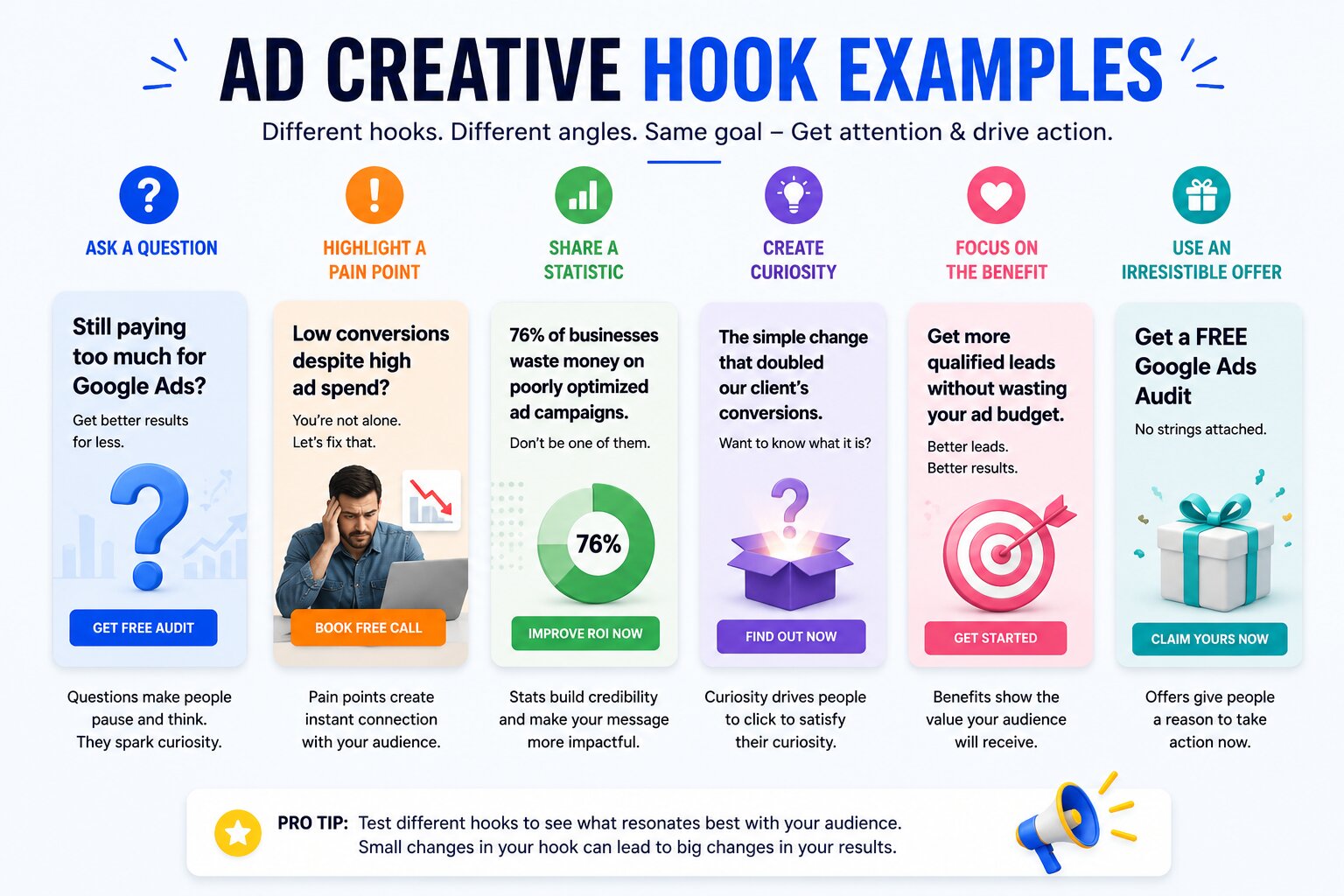
Examples include:
Ask a Question
- Still paying too much for Google Ads?
- Struggling to generate quality leads?
- Why are your competitors getting cheaper clicks?
Highlight a Pain Point
- Stop wasting your advertising budget.
- Low conversions despite high traffic?
- Your ads aren't the problem—your creatives are.
Present an Interesting Statistic
- Businesses lose thousands every month due to poor ad creatives.
- Top-performing creatives can improve CTR by over 40%.
- Most users decide whether to engage with an ad within seconds.
Create Curiosity
- One simple change doubled this campaign's conversion rate.
- The creative strategy most advertisers ignore.
- Why some ads outperform others with the same budget.
2. Focus on Benefits Instead of Features
One of the biggest advertising mistakes is talking too much about your business.
People don't care about your company.
They care about solving their problems.
Instead of saying:
❌ We provide Google Ads Management.
Say:
✅ Generate more qualified leads while reducing wasted ad spend.
Instead of:
❌ Experienced PPC Agency
Say:
✅ Scale your business with campaigns designed to maximize ROI.
Benefits always outperform features.
3. Use Clear and Simple Messaging
Great ad creatives are incredibly easy to understand.
Avoid:
- Technical jargon
- Long paragraphs
- Multiple offers
- Complex explanations
Aim for:
- One headline
- One offer
- One CTA
- One objective
The simpler your creative, the higher the chances people will understand it quickly.
The Best Creative Formula
Many high-performing advertisers use this framework:
Hook
Grab attention.
↓
Problem
Highlight the user's challenge.
↓
Solution
Present your product or service.
↓
Proof
Show reviews, testimonials, numbers, or results.
↓
Call to Action
Tell users exactly what to do next.
This simple structure works across:
- Google Display Ads
- Facebook Ads
- Instagram Ads
- LinkedIn Ads
- YouTube Ads
- Remarketing Campaigns
Design Principles That Increase Conversions
Design should support your message—not overpower it.
Here are the most important design principles.
Keep It Clean
Avoid clutter.
Too many elements reduce focus.
Instead, use:
- Plenty of white space
- One primary headline
- One focal image
- One CTA button
Minimalist creatives often outperform overcrowded designs.
Use High-Quality Images
Blurry or generic stock photos reduce trust instantly.
Instead, use:
- Product photos
- Team photos
- Customer images
- Lifestyle visuals
- Real project screenshots
People connect better with authentic visuals than polished stock imagery.
Choose Readable Fonts
Many advertisers use stylish fonts that become unreadable on mobile devices.
Instead:
- Use bold headings.
- Keep font sizes large.
- Limit yourself to two font families.
- Ensure sufficient contrast between text and background.
Remember that most users will view your ads on smartphones.
Follow Brand Consistency
Your creatives should look like they belong to your business.
Maintain consistency in:
- Colors
- Typography
- Logo placement
- Tone of voice
- CTA style
Consistent branding builds recognition and trust over time.
Write Headlines That Earn Clicks
Your headline is often the most important part of your ad.
Here are some proven headline formulas.
Problem + Solution
Reduce Your Google Ads Cost Without Losing Leads
Number-Based
7 Ways to Improve Your Ad Performance
Question
Why Aren't Your Ads Converting?
Benefit
Generate More Qualified Leads Every Month
Curiosity
The Advertising Strategy Most Businesses Miss
Offer
Get a Free Google Ads Audit Today
Social Proof
Trusted by 100+ Businesses Across India
The Role of Emotional Triggers
People rarely make buying decisions using logic alone.
Successful creatives appeal to emotions such as:
- Trust
- Security
- Success
- Fear of Missing Out (FOMO)
- Curiosity
- Confidence
- Relief
For example:
Instead of saying:
"We manage Google Ads."
Say:
"Stop wasting your advertising budget and start generating leads that actually convert."
The second statement creates a stronger emotional response.
Create Different Creatives for Different Funnel Stages
Not every audience is ready to buy immediately.
Your creatives should align with where users are in the customer journey.
Top of Funnel (Awareness)
Objective:
Educate and attract attention.
Creative examples:
- Industry insights
- Short educational videos
- Tips
- Infographics
- Problem awareness
Middle of Funnel (Consideration)
Objective:
Build trust.
Creative examples:
- Testimonials
- Case studies
- Before-and-after results
- Client success stories
- Product demonstrations
For inspiration on improving campaign performance, explore our guide on How to Reduce Cost Per Click in Google Ads.
Bottom of Funnel (Conversion)
Objective:
Generate leads or sales.
Creative examples:
- Limited-time offers
- Free consultations
- Free audits
- Discounts
- Demo bookings
These creatives should include a strong, action-oriented CTA and remove as much friction as possible.
Optimize Creatives for Mobile First
More than half of paid ad traffic comes from mobile devices.
When designing creatives:
- Keep text concise.
- Use vertical formats where appropriate.
- Ensure key information is visible without zooming.
- Place the headline where it's immediately noticeable.
- Make CTA buttons easy to identify.
Always preview your ads on mobile before publishing.
Match Creatives with Landing Pages
One of the biggest reasons campaigns underperform is inconsistency between the ad and the landing page.
If your ad promises:
Free Google Ads Audit
Your landing page should immediately reinforce that same offer—not introduce a different service or message.
A consistent user journey improves trust, Quality Score, and conversion rates.
Before launching campaigns, it's also worth reviewing your website experience. Learn more about our Google Ads Management Services to ensure your campaigns are set up for success.
A/B Test Every Creative
Even experienced advertisers can't accurately predict which creative will perform best.
The most successful campaigns rely on continuous testing rather than assumptions.
Instead of making multiple changes at once, test one element at a time so you know exactly what influenced performance.
Elements worth testing include:
- Headlines
- Primary ad copy
- Images
- Videos
- CTA buttons
- Color schemes
- Offers
- Landing pages
- Ad formats (Carousel vs Single Image vs Video)
Run each variation long enough to collect statistically significant data before deciding on a winner.
Pro Tip: Create at least 3–5 creative variations for every ad set. This gives advertising algorithms more opportunities to find the highest-performing combination.
Creative Testing Matrix
A structured testing process makes it easier to identify what resonates with your audience.
| Element | Version A | Version B |
|---|---|---|
| Headline | Save More on Google Ads | Reduce Your Cost Per Lead |
| Image | Product Screenshot | Lifestyle Image |
| CTA | Get Free Audit | Book Free Consultation |
| Offer | Free Audit | 30-Minute Strategy Call |
| Format | Static Image | Short Video |
Document your results and continue refining your creatives over time.
Platform-Specific Creative Best Practices
Every advertising platform has its own audience behavior and creative preferences. Designing a single creative and using it everywhere rarely delivers the best results.
Google Display Ads
For Google Display campaigns:
- Use high-resolution images.
- Keep headlines concise.
- Highlight a clear value proposition.
- Include a visible CTA.
- Design responsive assets for different placements.
If you're planning Display campaigns, don't miss our guide on How Much Should You Spend on Google Ads in 2026? to allocate your budget effectively.
Google Search Ads
Search campaigns don't use images, so your copy has to do all the work.
Focus on:
- Keyword-rich headlines
- Strong unique selling propositions
- Clear CTAs
- Relevant ad extensions
- Landing page alignment
Remember, relevance between keyword, ad copy, and landing page has a direct impact on Quality Score.
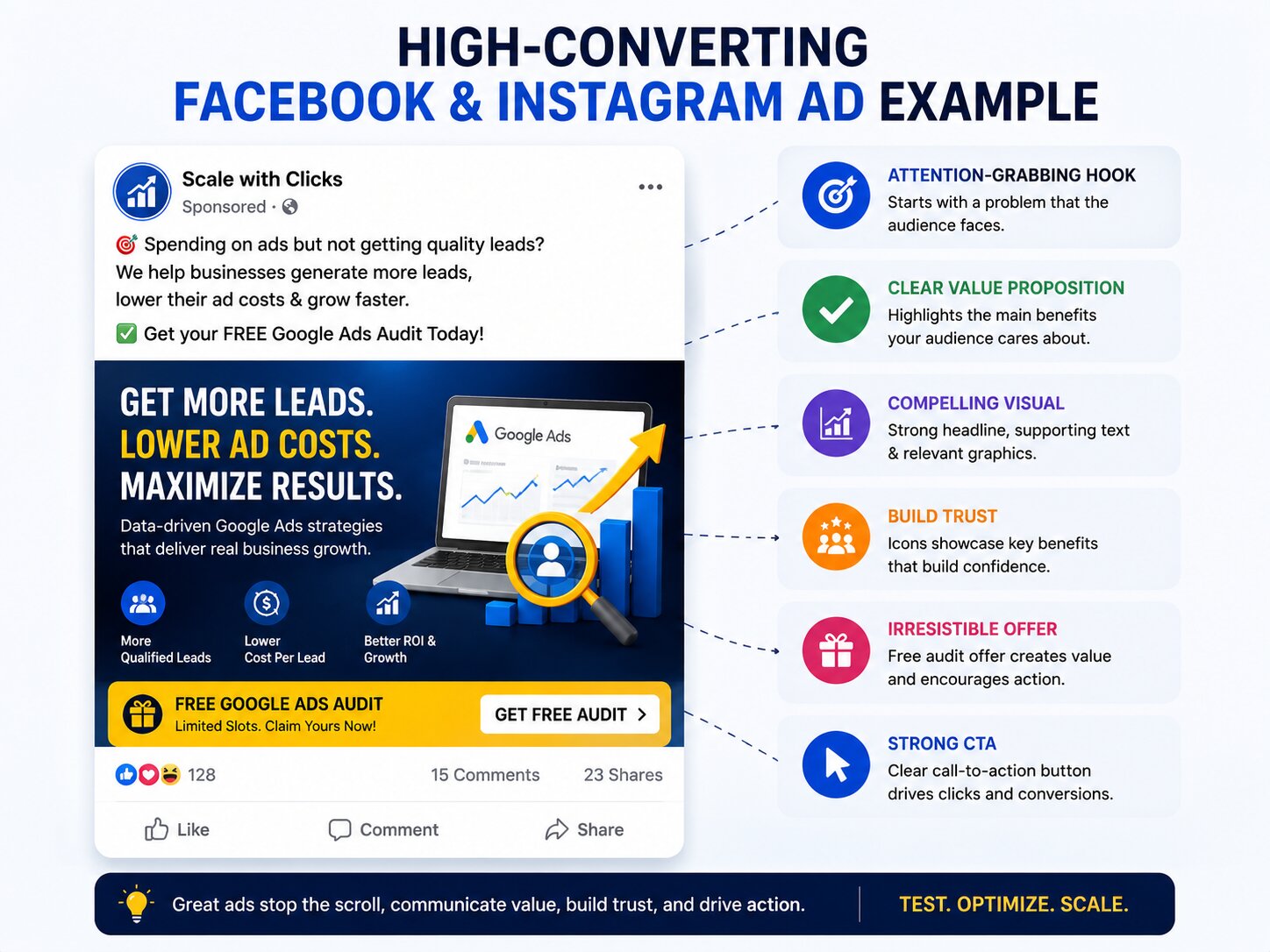
Meta (Facebook & Instagram) Ads
Meta users scroll quickly, so your creative has only a few seconds to grab attention.
Best practices include:
- Use vertical formats (4:5 or 9:16).
- Start videos with a strong visual hook.
- Keep on-screen text minimal.
- Show the product or service early.
- Include captions for video ads.
- Use authentic customer imagery whenever possible.
If you're running Meta campaigns alongside Google Ads, our Meta Ads Management Services can help you build a cross-platform strategy.
LinkedIn Ads
LinkedIn audiences are primarily professionals and decision-makers.
Your creatives should emphasize:
- Business outcomes
- Industry expertise
- Data-driven results
- Thought leadership
- Professional design
Avoid overly promotional messaging. Educational content often performs better.
YouTube Ads
Video is one of the most effective advertising formats, but viewers decide very quickly whether to continue watching.
Tips for YouTube creatives:
- Capture attention within the first five seconds.
- Brand your message early.
- Keep videos concise.
- Focus on one key message.
- End with a clear CTA.
Use Social Proof Whenever Possible
People trust other people more than advertisements.
Including proof in your creatives can significantly improve conversion rates.
Examples of social proof include:
- Customer reviews
- Google ratings
- Testimonials
- Client logos
- Awards
- Industry certifications
- Performance statistics
- Before-and-after case studies
For example:
- Trusted by 150+ businesses
- ₹50M+ managed in ad spend
- 4.9-star client rating
- 500+ successful campaigns
These elements help reduce uncertainty and build credibility.
Keep Your Call-to-Action Clear
Never assume users know what to do next.
Every ad should include a single, specific call-to-action.
Examples include:
- Book a Free Consultation
- Get a Free Website Audit
- Request a Quote
- Download the Guide
- Contact Our Team
- Start Your Free Trial
- Schedule a Demo
Avoid using multiple CTAs within the same creative, as they can confuse users and reduce conversions.
Common Ad Creative Mistakes to Avoid
Even well-targeted campaigns can underperform because of avoidable creative mistakes.
Here are some of the most common ones:
Using Generic Stock Images
Generic visuals rarely capture attention or build trust.
Instead, use original images of your products, team, customers, or work whenever possible.
Too Much Text
Large blocks of text overwhelm users.
Keep your messaging concise and focus on one core idea.
Weak Headlines
Your headline should immediately communicate value.
If it doesn't encourage users to stop scrolling, the rest of your creative won't matter.
No Clear CTA
A creative without a clear next step often leads to lower conversion rates.
Tell users exactly what you want them to do.
Inconsistent Messaging
If your ad promotes one offer but your landing page focuses on something else, users are more likely to leave without converting.
Maintain consistency from the ad to the landing page.
Ignoring Mobile Users
Designing only for desktop can hurt performance.
Always preview creatives on mobile devices before launching campaigns.
Not Testing Creatives
Running the same creative for months often leads to ad fatigue.
Refresh your creatives regularly and continue testing new ideas.
For additional optimization tips, read 7 Costly Google Ads Mistakes That Are Wasting Your Budget to avoid common pitfalls beyond creative design.
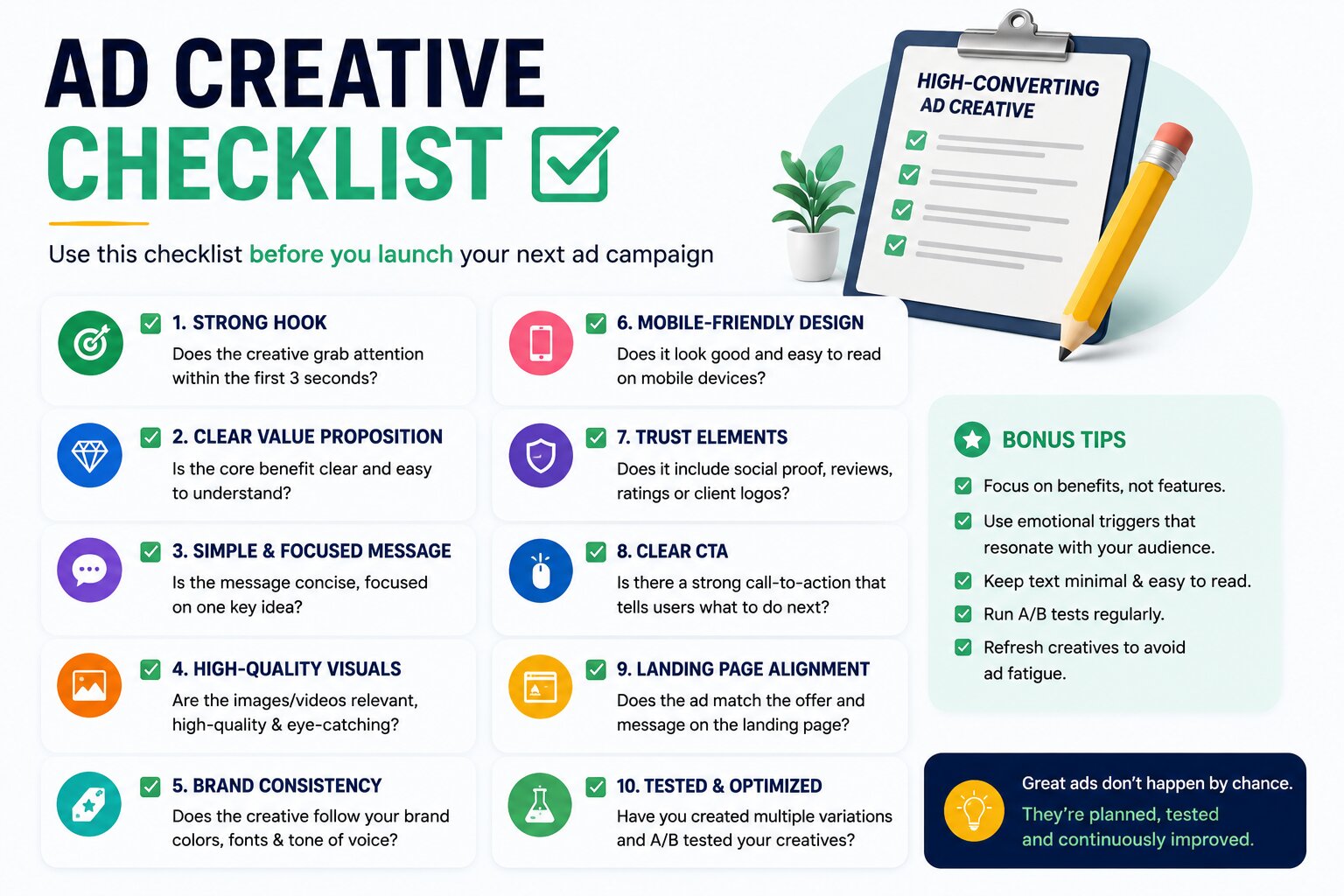
High-Converting Ad Creative Checklist
Before publishing your next campaign, review this checklist:
- ✔ Strong attention-grabbing headline
- ✔ Clear value proposition
- ✔ One primary message
- ✔ High-quality visuals
- ✔ Consistent branding
- ✔ Readable typography
- ✔ Mobile-friendly design
- ✔ Trust-building elements
- ✔ Single call-to-action
- ✔ Landing page matches the offer
- ✔ Multiple creative variations prepared for testing
Using this checklist can help improve campaign performance and reduce wasted ad spend.
Final Thoughts
Creating high-converting ad creatives isn't about using flashy graphics or clever slogans—it's about understanding your audience and communicating value clearly.
The best-performing ads combine compelling visuals, concise messaging, emotional appeal, and a strong call-to-action while maintaining consistency from the first impression to the landing page.
Remember that optimization is an ongoing process. Test new ideas regularly, analyze performance data, and refine your creatives based on real user behavior rather than assumptions.
If you're looking to improve your advertising performance across Google Ads or Meta Ads, our team can help you create campaigns backed by strategic targeting, persuasive creatives, and conversion-focused landing pages.
Explore our Google Ads Management Services, Meta Ads Management Services, or visit our Scale With Clicks to learn how Scale with Clicks helps businesses generate measurable growth through performance marketing.
Frequently Asked Questions (FAQs)
What makes an ad creative high-converting?
A high-converting ad creative captures attention quickly, communicates a clear value proposition, builds trust, and encourages users to take a specific action through a compelling call-to-action.
Which type of ad creative performs best?
There's no universal winner. Depending on your audience and platform, static images, videos, carousel ads, or user-generated content (UGC) may perform best. Continuous A/B testing is the only reliable way to identify top-performing creatives.
How often should I refresh my ad creatives?
A good practice is to review creative performance every 3–6 weeks. If you notice declining CTR, increasing CPC, or reduced engagement, it may be time to introduce fresh creatives.
Should I use videos or images in my ads?
Both can be effective. Videos are excellent for storytelling and demonstrations, while images often work well for straightforward offers. Test both formats to determine what resonates with your audience.
How important is the landing page?
A highly optimized landing page is just as important as the creative itself. Even the best ad won't convert if users land on a confusing or irrelevant page.
Can I use the same creative on every advertising platform?
It's not recommended. Each platform has different user behavior, ad placements, and creative specifications. Tailor your creatives for platforms like Google Ads, Facebook, Instagram, LinkedIn, and YouTube to maximize performance.
What metrics should I track to evaluate ad creatives?
Key metrics include:
- Click-Through Rate (CTR)
- Conversion Rate
- Cost Per Click (CPC)
- Cost Per Acquisition (CPA)
- Return on Ad Spend (ROAS)
- Engagement Rate
- Quality Score (Google Ads)
- Frequency (Meta Ads)
Tracking these metrics helps you identify winning creatives and optimize future campaigns.