Google Ads
How to Improve Google Ads Quality Score - 3 to 8+

Category: Google Ads
How to Improve Google Ads Quality Score: 3 to 8+
If your Google Ads keywords are stuck at a Quality Score of 3, 4, or 5, simply increasing your bids usually isn't the answer.
Quality Score is Google's way of giving advertisers a diagnostic view of how relevant and useful their ads, keywords, and landing pages are. The score ranges from 1 to 10, and improving the factors behind the score can help create a better experience for people searching on Google.
The good news is that a low Quality Score isn't permanent.
In many accounts, the biggest improvements come from fixing a few basic problems: poorly grouped keywords, generic ad copy, irrelevant search terms, weak landing pages, and a mismatch between what someone searches for and what they see after clicking.
In this guide, we'll look at how to improve Google Ads Quality Score from around 3 to 8+ using practical changes you can make inside your account.
What Is Google Ads Quality Score?
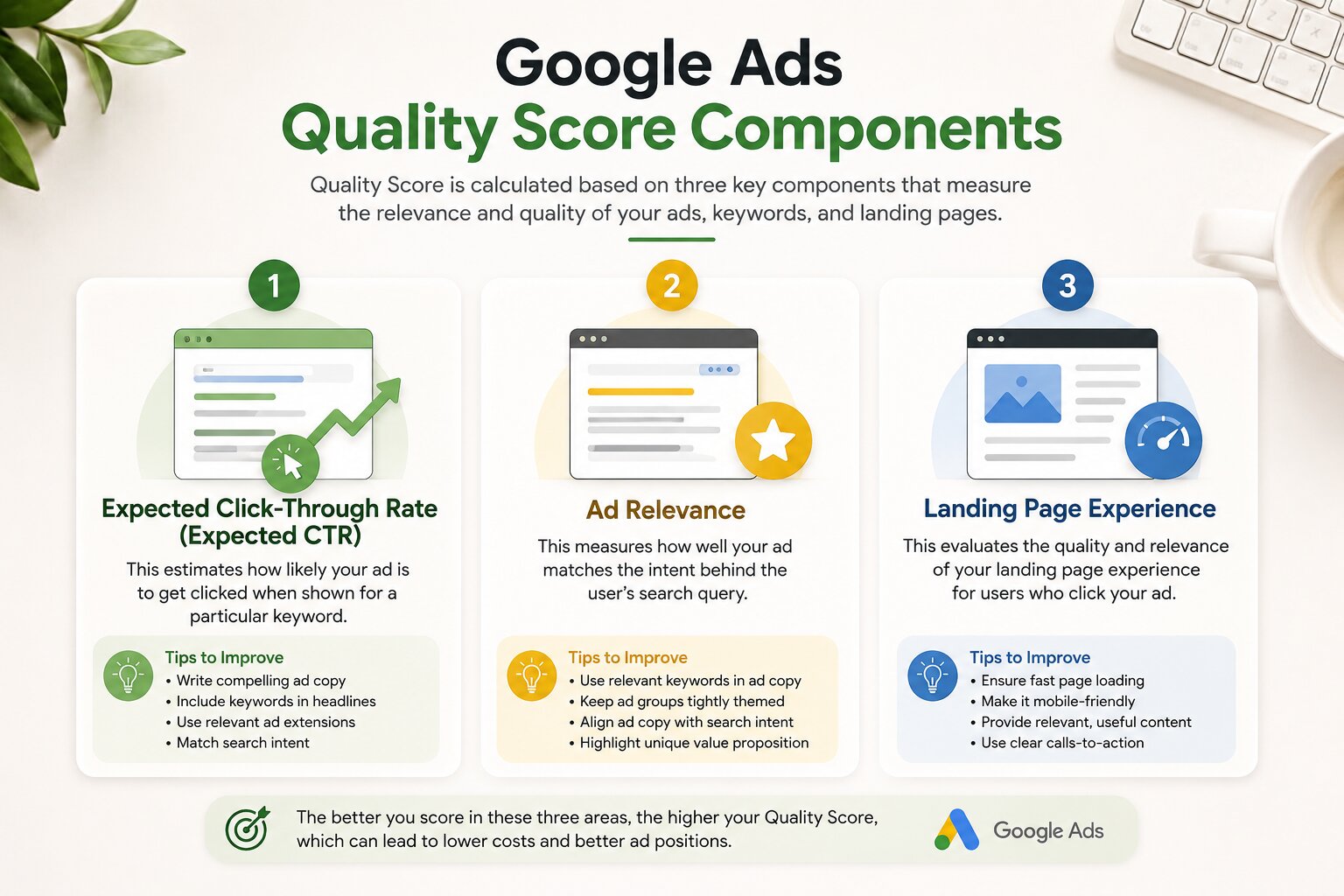
Google Ads Quality Score is a rating from 1 to 10 that provides a diagnostic indication of the quality and relevance of a keyword's ads and landing page experience.
It is primarily associated with three components:
- Expected click-through rate (CTR)
- Ad relevance
- Landing page experience
Each component can be shown as Below average, Average, or Above average.
For example, if a keyword has a Quality Score of 3 and its ad relevance is "Below average," changing the bidding strategy isn't likely to solve the underlying problem. You need to look at the relationship between the keyword, ad, and landing page.
It is also important not to treat Quality Score as the ultimate campaign KPI. A keyword with a Quality Score of 8 isn't automatically more profitable than one with a score of 6.
The real objective is to attract the right searches, generate qualified clicks, and turn those clicks into meaningful business results.
If you want a deeper explanation of how the score works, read our guide on Google Ads Quality Score and how to improve it.
What Does a Quality Score of 3 Actually Mean?
A Quality Score of 3 generally indicates that Google sees room for improvement in the overall experience associated with that keyword.
However, don't immediately assume that every part of your account is broken.
Look at the individual components.
For example:
| Quality Score | Expected CTR | Ad Relevance | Landing Page |
|---|---|---|---|
| 3 | Below average | Below average | Average |
| 5 | Average | Below average | Average |
| 6 | Average | Average | Average |
| 7 | Above average | Average | Above average |
| 8+ | Above average | Above average | Above average |
This isn't a formula used by Google to calculate the score. It is simply a practical way to think about where optimization opportunities may exist.
If your Quality Score is low, start with the component marked Below average instead of changing everything at once.
1. Build Tightly Themed Ad Groups
One of the most common reasons for poor ad relevance is putting too many unrelated keywords into the same ad group.
For example, imagine an ad group containing:
- google ads agency
- google ads management
- seo agency
- facebook ads agency
- social media marketing
- digital marketing company
These keywords may all belong to the same general business, but they don't represent exactly the same search intent.
The resulting ad usually becomes generic.
Instead, create tightly themed groups.
Example
Ad Group: Google Ads Agency
- google ads agency
- google ads management agency
- ppc agency
- google ads company
The ad can then speak specifically about Google Ads management.
A separate ad group can be created for SEO-related searches, another for Meta advertising, and so on.
This makes it easier to create ads that closely match what people are searching for.
If you're rebuilding your account structure, our guide on creating a Google Ads campaign structure for higher ROI can help.
2. Match Your Ad Copy to Search Intent
This is one of the fastest areas to investigate when Quality Score is low.
Imagine someone searches:
"google ads management agency"
And your ad headline says:
"Grow Your Business Online"
The message isn't necessarily wrong, but it is too broad.
A more relevant message could be:
"Google Ads Management Agency"
followed by a benefit such as:
"Generate More Qualified Leads"
The goal isn't to force keywords into every headline.
The goal is to make the ad immediately understandable.
When someone sees your ad, they should be able to answer three questions quickly:
- Is this relevant to what I searched?
- Does this business offer what I need?
- Why should I click this ad?
Good Google Ads copy connects the search query, the customer's problem, and your solution.
3. Improve Expected CTR
Expected CTR is one of the three major Quality Score components.
It represents Google's estimate of how likely your ad is to receive a click when shown for a particular search.
Improving expected CTR starts with writing ads that actually give people a reason to click.
Instead of writing generic statements such as:
"Professional Digital Marketing Services"
consider communicating a more specific benefit:
"Generate More Leads With Google Ads"
or:
"Google Ads Management Focused On Qualified Leads"
You can test:
- Different value propositions
- Stronger calls to action
- Specific services
- Pricing or offers where appropriate
- Numbers and proof points
- Industry-specific messaging
- Different headline combinations
Don't make the ad misleading just to increase CTR.
A high CTR from the wrong audience isn't useful if those clicks never become customers.
Google itself recommends balancing CTR improvements with the quality of the traffic and the business outcomes those clicks generate.
4. Make Your Landing Page Match the Ad
This is where many advertisers lose the connection.
Suppose someone searches:
"Google Ads agency for ecommerce"
Your ad talks about ecommerce Google Ads management.
But clicking the ad takes the user to a generic homepage containing information about SEO, social media, branding, web development, and several other services.
The visitor now has to figure out where to go.
That's unnecessary friction.
Instead, send the user to a page that directly addresses the service they searched for.
For example, someone searching for Google Ads management should ideally reach a dedicated Google Ads management service page rather than being forced to navigate through your entire website.
Your landing page should have:
- A clear headline
- Relevant information
- Consistent messaging
- A visible CTA
- Easy navigation
- Mobile-friendly design
- Fast loading performance
- Trust signals
- Relevant supporting information
The important concept is message match.
The keyword, advertisement, and landing page should feel like parts of the same conversation.
5. Improve Landing Page Experience
A relevant landing page is only part of the equation.
You also need to make the page useful and easy to use.
Look at the page from the perspective of someone who has never visited your website.
Can they understand the offer within a few seconds?
Can they find the CTA?
Does the page work properly on a phone?
Does the page load quickly?
Is the information actually relevant to the keyword that triggered the ad?
For lead generation campaigns, don't make visitors search for your contact form.
For ecommerce campaigns, don't make customers click through several unrelated pages before finding the product.
For service businesses, explain the service clearly and make the next step obvious.
Landing page optimization is not just about Quality Score. It can also have a direct impact on conversion performance.
If you're trying to improve conversion performance as well, our guide on Google Ads conversion rate benchmarks and optimization is worth reviewing.
6. Use Negative Keywords
Negative keywords are one of the simplest ways to reduce irrelevant traffic.
Suppose you're selling professional Google Ads management.
Your ads might accidentally receive searches such as:
- google ads course
- google ads jobs
- google ads internship
- google ads certification
- google ads free
- google ads tutorial
These searches may have little or no commercial value for your business.
Adding appropriate negative keywords can help prevent your ads from appearing for searches that don't match your offer.
Check your Search Terms report regularly.
Don't only look at the keywords you intentionally added.
Look at the actual searches triggering your ads.
You may discover irrelevant themes that you hadn't considered when building the campaign.
For more examples, read our guide covering common Google Ads mistakes that waste advertising budgets.
7. Write Better Responsive Search Ads
Responsive Search Ads give Google multiple headlines and descriptions that can be combined according to the context of the auction.
Don't use every headline variation to repeat the same keyword.
Instead, create a mix of:
Keyword-focused headlines
- Google Ads Management
- Google Ads Agency
- PPC Management Services
Benefit-focused headlines
- Generate More Qualified Leads
- Reduce Wasted Ad Spend
- Improve PPC Performance
Trust or differentiation headlines
- Performance-Focused PPC
- Conversion Tracking Included
- Data-Driven Campaign Management
CTA-focused headlines
- Get a Google Ads Audit
- Request a Strategy Call
- Start Growing With PPC
This gives your ads a broader set of messages to work with while keeping the overall theme consistent.
For more information about building campaigns correctly, see our guide to Google Ads campaign structure.
8. Improve Your Keyword Strategy
Sometimes the problem isn't the ad.
The keyword itself may simply be too broad or poorly aligned with the business.
For example, a company selling Google Ads management services may find it difficult to generate qualified leads from broad informational searches such as:
"what is google ads"
That doesn't mean informational keywords are always useless. They simply have a different intent from someone searching:
"hire google ads agency"
or:
"google ads management services"
Understand the intent behind your keywords.
Look for terms showing:
- Commercial intent
- Service intent
- Purchase intent
- Location intent
- Problem-solving intent
Then make sure the ad and landing page support that intent.
9. Don't Try to Force Every Keyword to a Quality Score of 10
This is an important point.
A Quality Score of 10 looks great in an account, but it shouldn't become the sole goal of campaign optimization.
You might have a keyword with a Quality Score of 7 that generates excellent leads at an acceptable CPA.
Another keyword could have a Quality Score of 9 but generate almost no business.
Which one deserves more attention?
Look at the complete picture:
- Conversions
- Conversion rate
- Cost per conversion
- Lead quality
- Revenue
- ROAS
- Search terms
- CTR
- CPC
Quality Score should help you identify areas where the user experience may be improved.
It shouldn't replace actual business performance as the main objective.
10. Fix Conversion Tracking Before Making Big Decisions
Quality Score and conversion tracking measure different things, but both matter when optimizing Google Ads.
If your conversion tracking is broken, you may believe a campaign isn't working when it actually is.
Or you may scale a campaign because Google is counting low-value actions as conversions.
Track the actions that matter to your business, such as:
- Lead form submissions
- Phone calls
- Purchases
- Appointment bookings
- Qualified leads
- Revenue
- Important button clicks
For more information, read our Google Tag Manager guide for beginners.
A clean measurement setup gives you a much better foundation for campaign optimization.
A Practical 3-to-8+ Quality Score Checklist
If your account currently contains many keywords with Quality Scores around 3–5, work through this process.
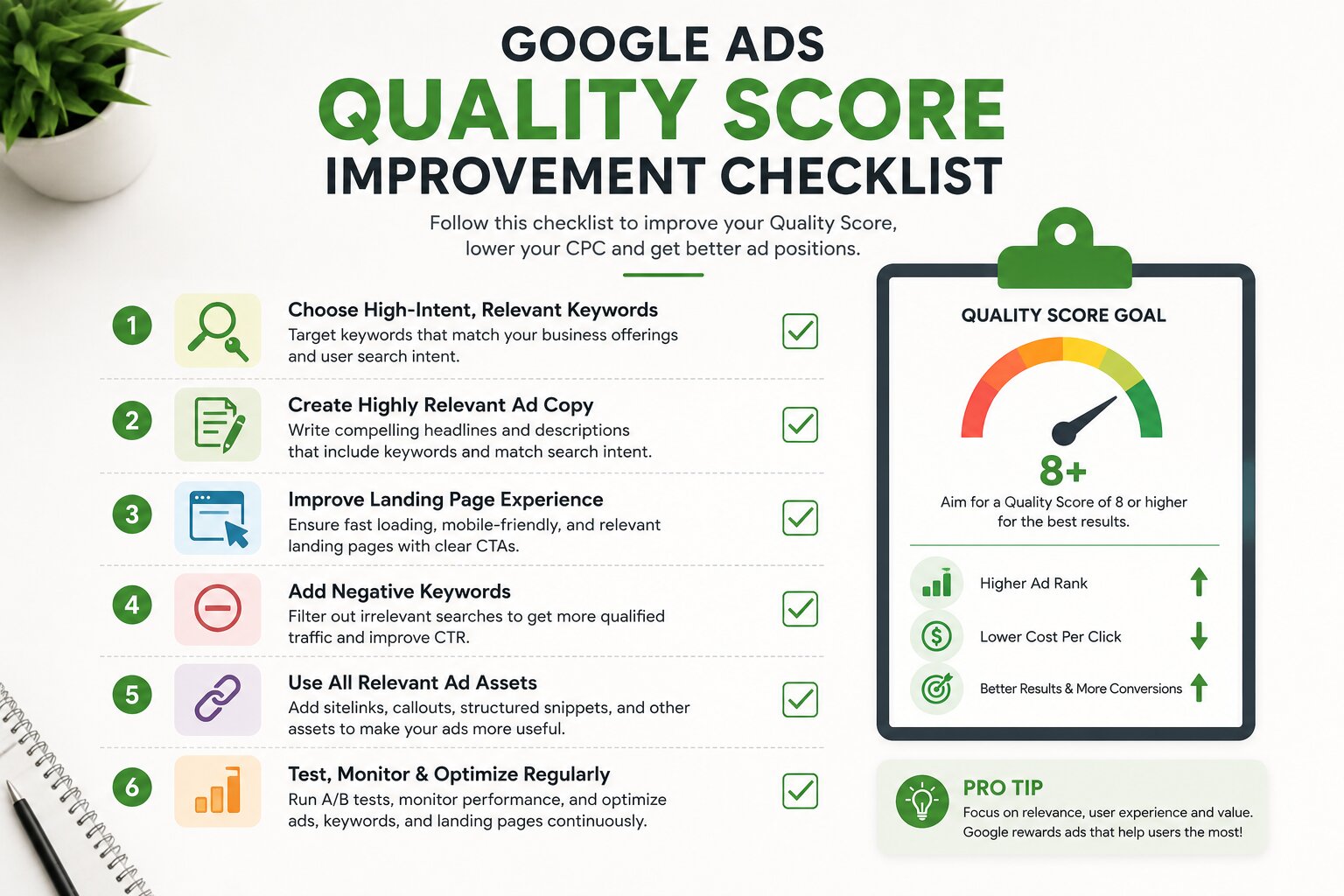
Step 1: Find the problem keywords
Sort your keyword report by Quality Score.
Start with keywords that have:
- High spend
- High impressions
- Significant clicks
- Commercial value
- Poor Quality Score
Step 2: Check the three components
Look at:
- Expected CTR
- Ad relevance
- Landing page experience
Find the component marked Below average.
Step 3: Fix the biggest issue first
If Ad Relevance is poor:
- Tighten your ad group
- Improve keyword-to-ad alignment
- Rewrite the ad
If Expected CTR is poor:
- Improve your value proposition
- Test stronger headlines
- Make your CTA more relevant
- Review search intent
If Landing Page Experience is poor:
- Improve message match
- Make the page more useful
- Improve mobile usability
- Improve page speed
- Make the CTA easier to find
Step 4: Review search terms
Remove irrelevant traffic with negative keywords.
Step 5: Give the changes time
Don't make ten changes today and check the score tomorrow expecting a perfect 10.
Quality optimization should be treated as an ongoing process.
Common Mistakes That Keep Quality Score Low
If your Quality Score isn't improving, check whether you're making one of these mistakes:
- Sending every keyword to the homepage
- Using one generic ad for unrelated keywords
- Ignoring search intent
- Using overly broad keywords
- Not reviewing search terms
- Failing to add negative keywords
- Writing keyword-stuffed ads
- Having a slow or difficult landing page
- Ignoring mobile users
- Optimizing only for CTR
- Changing campaigns too frequently
- Focusing on Quality Score instead of actual business performance
Fixing these issues can improve the overall quality of the experience you're providing to searchers.
Final Thoughts
Improving Google Ads Quality Score from 3 to 8+ isn't about finding a secret Google Ads setting.
It comes down to making the entire search journey more relevant.
The keyword should represent what the user wants.
The ad should clearly respond to that intent.
The landing page should deliver what the ad promised.
And your conversion tracking should tell you whether those clicks are actually producing business results.
Start by identifying your lowest Quality Score keywords, check the three components, and fix the biggest weakness first.
You don't need to rebuild your entire Google Ads account overnight.
Small improvements to keyword targeting, ad relevance, search intent, negative keywords, and landing pages can add up over time.
If managing all of these elements is taking too much time, Google Ads management services from Scale With Clicks can help businesses build, optimize, and measure campaigns with a focus on qualified leads and revenue rather than clicks alone.
You can also explore Scale With Clicks to learn more about Google Ads, Meta Ads, SEO, conversion tracking, and performance marketing services.
Frequently Asked Questions
What is a good Google Ads Quality Score?
There is no universal score that guarantees good campaign performance. In practical account management, scores around 7–10 are often viewed as strong, but the more important question is whether the underlying ads and landing pages are relevant and whether the campaign produces valuable results.
Can I improve Quality Score from 3 to 8?
Yes, Quality Score can change as the underlying ad quality and performance signals change. Focus on the specific component marked Below average instead of trying to increase the number directly.
Does increasing my Google Ads budget improve Quality Score?
No. Increasing your budget does not directly improve Quality Score. Quality Score is primarily a diagnostic assessment related to expected CTR, ad relevance, and landing page experience.
Does a higher Quality Score mean lower CPC?
Higher-quality ads can contribute to better auction outcomes and may result in lower CPCs in some circumstances. However, CPC also depends on factors such as competition, auction context, and bidding.
How often should I check Quality Score?
For actively managed campaigns, review it regularly rather than treating it as a one-time setup task. Monthly reviews can be useful for stable accounts, while high-spend or rapidly changing campaigns may need more frequent analysis.
Should I pause every keyword with a Quality Score below 5?
Not necessarily.
Look at the keyword's business value, conversions, search terms, cost, and other performance metrics first. A low Quality Score can indicate an optimization opportunity, but it isn't by itself a reason to pause a keyword.