Facebook Ads
How to Scale Facebook Ads Without Increasing CPA

Category: Facebook Ads
Scaling Facebook Ads sounds simple: increase the budget, get more conversions, and grow the business.
In reality, that's often where things start going wrong.
A campaign might generate leads at a $30 CPA when you're spending $100 per day. Increase the budget too aggressively, and suddenly the CPA moves to $40, $50, or even higher. The campaign is spending more, but the efficiency you worked so hard to achieve starts disappearing.
The solution isn't to avoid scaling. It's to scale Facebook Ads in a controlled way while giving Meta enough room to find additional customers without destroying the economics of the campaign.
This guide explains how to scale Facebook Ads without increasing CPA, including budget scaling, creative testing, audience expansion, retargeting, campaign structure, and conversion tracking.
If you're managing campaigns for a lead generation or ecommerce business, these principles can also be applied to your broader Meta Ads strategy.
What Does Scaling Facebook Ads Actually Mean?
Scaling Facebook Ads means increasing the amount of business you generate from your campaigns without allowing your acquisition costs to rise disproportionately.
There are two common ways to scale:
Vertical scaling
Vertical scaling means increasing the budget of an existing campaign or ad set.
For example:
- $100/day → $120/day
- $120/day → $150/day
- $150/day → $200/day
The objective is to get more conversions from an existing setup.
Horizontal scaling
Horizontal scaling means finding additional opportunities rather than simply putting more money into the same campaign.
This can include:
- Testing new creatives
- Expanding audiences
- Testing new angles
- Introducing new products
- Testing different placements
- Creating additional campaigns
- Expanding into new markets
In many accounts, horizontal scaling can create additional volume without putting all the pressure on one campaign.
The strongest approach is usually a combination of both.
Why Does CPA Increase When You Scale Facebook Ads?
Before trying to fix rising CPA, it helps to understand why it happens.
The first reason is audience saturation.
Your campaign may initially reach the people most likely to convert. As you increase spending, Meta has to find additional people within the available audience. Those users may be less likely to purchase or submit a lead.
Creative fatigue can create another problem.
An ad that worked extremely well for three weeks may gradually lose effectiveness because the same audience has seen it multiple times. CTR can fall, CPM can increase, and CPA can move upward.
Another issue is making too many changes at once.
If you increase the budget, change the creative, modify targeting, change the conversion event, and restructure the campaign at the same time, it becomes difficult to determine what actually affected performance.
This is why scaling should be treated as a process rather than a single action.
1. Make Sure Your Tracking Is Reliable Before Scaling
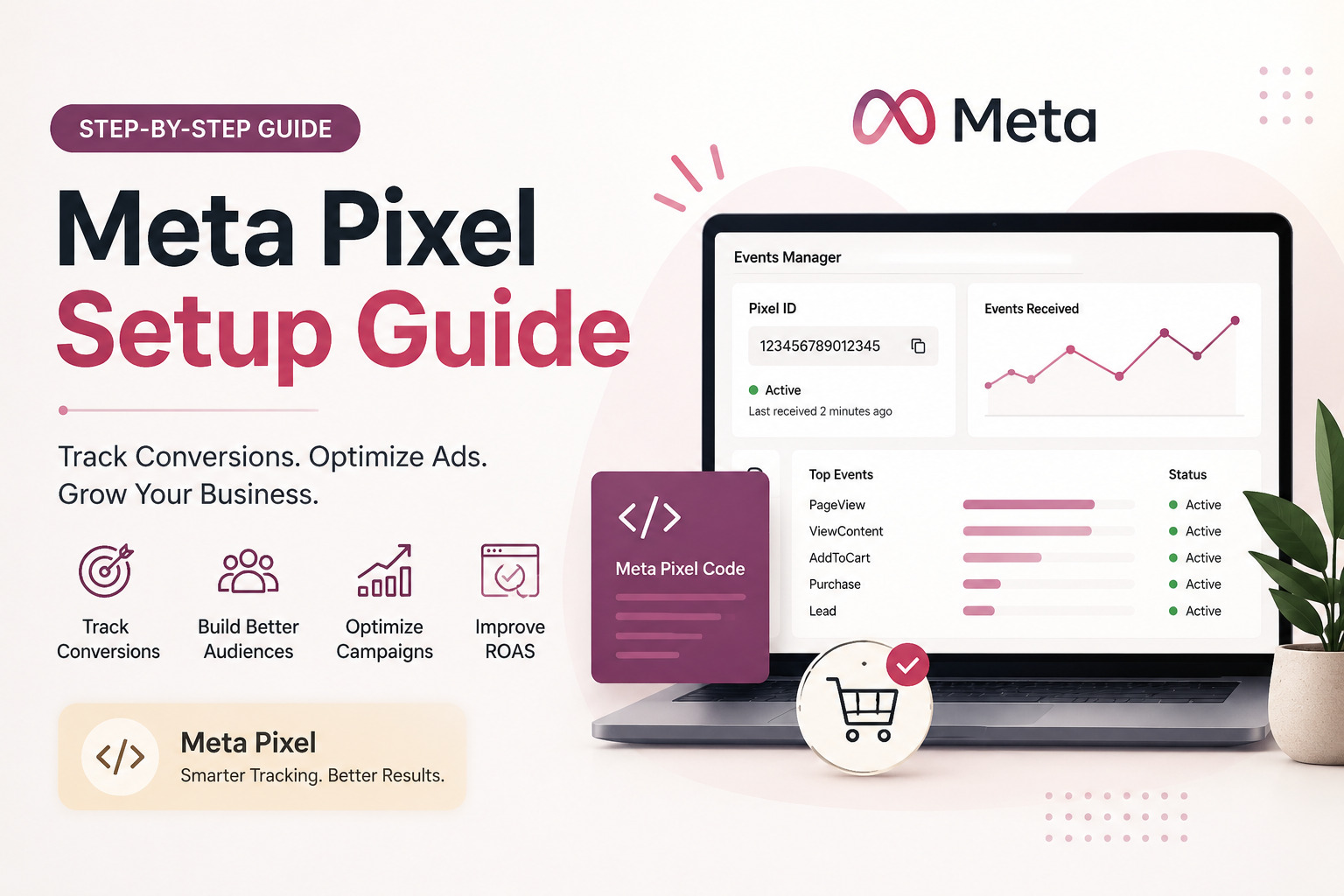
Before increasing your Facebook Ads budget, make sure the data you're using to make decisions is trustworthy.
For lead generation campaigns, track meaningful actions such as:
- Lead form submissions
- Qualified leads
- Phone calls
- WhatsApp enquiries
- Booked appointments
- Sales
For ecommerce campaigns, your tracking should include events such as:
- View Content
- Add to Cart
- Initiate Checkout
- Purchase
Don't scale based only on clicks or traffic.
A campaign can have a low CPC and high CTR while producing poor-quality leads or very little revenue.
This is where conversion tracking becomes particularly important. If the platform receives accurate conversion signals, you have a much stronger foundation for optimization.
2. Don't Double Your Budget Overnight
One of the most common Facebook Ads scaling mistakes is making aggressive budget increases.
Imagine a campaign is spending $100/day and consistently generating conversions at an acceptable CPA.
Instead of immediately moving it to $200/day, consider smaller increases and monitor what happens.
For example:
$100 → $120 → $145 → $175 → $200
The exact percentage isn't a universal rule. The important part is avoiding unnecessary shocks to a campaign that is already producing stable results.
After each meaningful change, monitor:
- CPA
- Conversion volume
- CPM
- CTR
- Conversion rate
- Frequency
- Lead or purchase quality
Don't judge the campaign based on a few hours of data.
Daily performance can fluctuate because of auction conditions, demand, seasonality, and normal statistical variation.
The goal is to identify a sustainable spending level rather than chase one unusually good day.
3. Scale the Creative Before You Run Out of Good Ads
Creative is one of the biggest constraints when scaling Meta campaigns.
You can have a large audience and plenty of budget, but if your ads aren't compelling, additional spend won't solve the problem.
Instead of creating ten slightly different versions of the same advertisement, develop different creative angles.
For example, a skincare brand could test:
- Customer testimonial
- Before-and-after concept
- Product demonstration
- Problem/solution video
- Founder story
- UGC-style video
- Educational content
- Product comparison
The objective isn't simply to make more ads.
It's to create more reasons for different people to care about the product or service.
Meta's own testing guidance emphasizes isolating variables when conducting controlled tests so that performance differences can be understood more clearly.
This principle is useful for Facebook Ads as well: don't change everything simultaneously and then try to guess what worked.
4. Build a Creative Testing System

Don't wait until your existing ads stop working before producing new creatives.
A better approach is to have a continuous creative pipeline.
For example:
Week 1: Launch 3 new concepts Week 2: Analyze performance Week 3: Produce variations of promising concepts Week 4: Introduce another batch of new concepts
Your testing framework could look like this:
Test the hook
Change the first few seconds of a video or the opening line of the ad.
Test the problem
Focus on a different customer pain point.
Test the offer
Experiment with the way the offer or benefit is presented.
Test the format
Try Reels, static images, carousels, UGC-style videos, or demonstrations.
Test the CTA
Compare different calls to action depending on the customer journey.
This creates more opportunities to scale without relying on one winning advertisement forever.
5. Expand the Audience Carefully
At some point, increasing the budget on the same audience may become inefficient.
This is where audience expansion becomes important.
Depending on the account and campaign objective, you can test:
- Broad audiences
- Lookalike audiences
- Customer lists
- Website visitors
- Engaged users
- Video viewers
- Previous purchasers
- Geographic expansion
- New demographic segments
Don't assume that the smallest audience is automatically the most profitable.
A narrow audience can produce good results initially but become difficult to scale because there simply aren't enough potential customers.
Broad targeting can sometimes provide Meta with more room to find users who are likely to complete the desired conversion action.
The important point is to judge audiences by actual conversion and business results, not by audience size alone.
6. Use Retargeting to Capture Missed Opportunities
Not everyone who interacts with your business will convert on their first visit.
Someone may:
- Watch your video
- Visit your website
- View a product
- Add something to their cart
- Open a lead form
- Interact with your Instagram account
- Leave without taking action
Retargeting allows you to communicate with these people again.
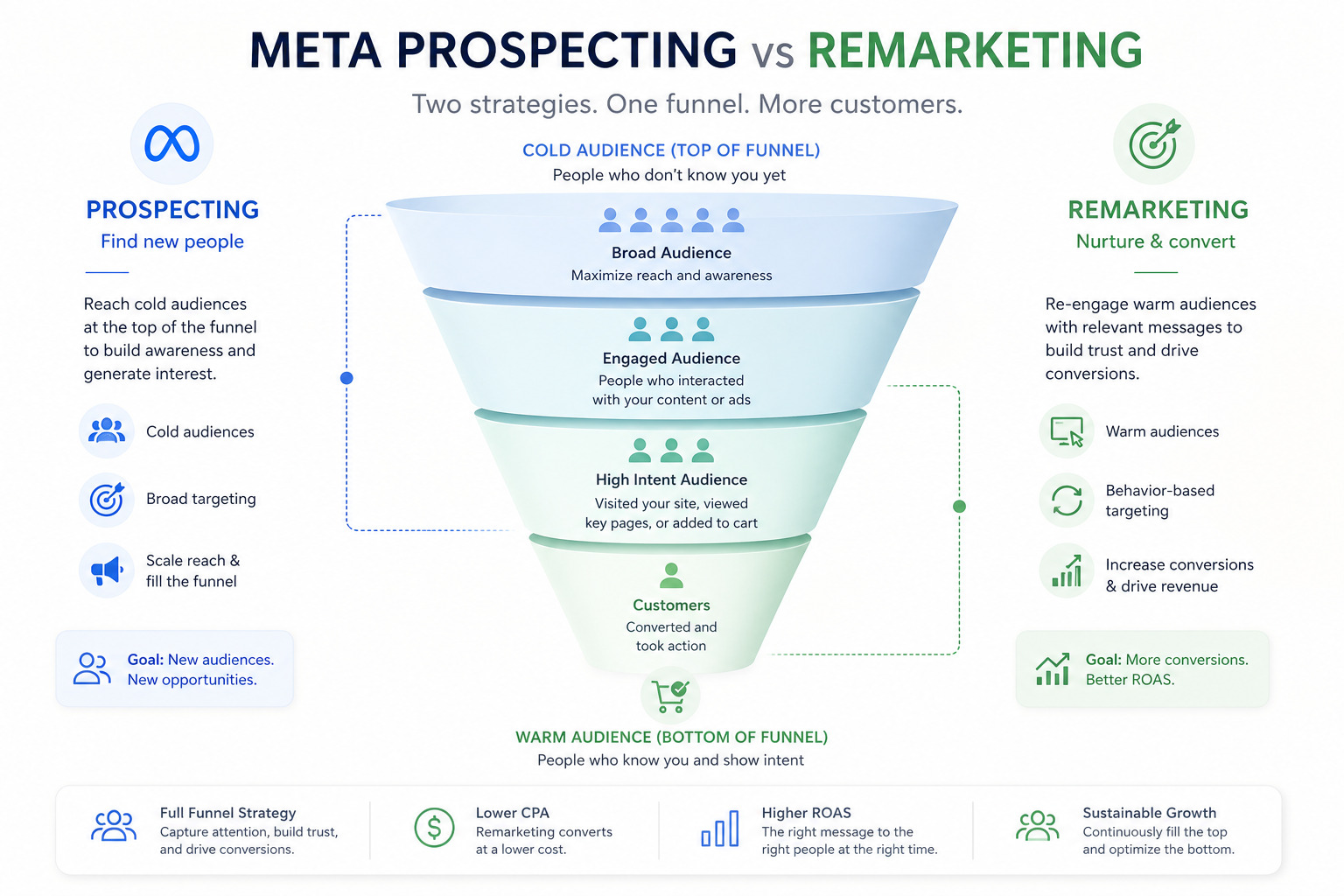
A simple structure could include:
Cold audience → Website/landing page → Retargeting → Conversion
Your retargeting message should also be different from your prospecting message.
For example, a cold audience may need to understand:
What is this product and why should I care?
A retargeting audience may instead need:
Why should I choose this product instead of the alternatives?
This distinction can make your advertising more relevant at different stages of the buying journey.
You can also read our guide on the best retargeting audiences for Meta Ads for a deeper look at audience segmentation.
7. Don't Scale a Campaign With Weak Conversion Quality
This is particularly important for lead generation.
Suppose Campaign A generates 100 leads at $20 each.
Campaign B generates 60 leads at $30 each.
At first glance, Campaign A looks better.
But imagine that only 10% of Campaign A's leads are qualified while 40% of Campaign B's leads become genuine sales opportunities.
The cheaper CPA isn't necessarily producing the better business result.
This is why you should monitor metrics beyond platform-reported CPA:
- Cost per qualified lead
- Lead-to-opportunity rate
- Opportunity-to-sale rate
- Revenue per lead
- Customer acquisition cost
- Return on ad spend
For service businesses, cost per qualified lead can be much more meaningful than cost per form submission.
Scaling should ultimately be based on business economics, not just the Ads Manager dashboard.
8. Improve the Landing Page Before Increasing Ad Spend
Sometimes rising CPA isn't actually an advertising problem.
Your ads may be generating plenty of high-quality traffic, but the landing page isn't converting.
Look at:
- Page speed
- Headline
- Offer clarity
- CTA visibility
- Form length
- Trust signals
- Reviews
- Testimonials
- Pricing information
- Mobile experience
- Message match between ad and landing page
If your ad promises one thing and the landing page communicates something completely different, you create unnecessary friction.
This is why landing page optimization should be part of your scaling strategy.
A 20% improvement in conversion rate can have a major impact on acquisition costs without requiring cheaper traffic.
9. Don't Ignore Frequency and Creative Fatigue
As spending increases, frequency can rise, particularly in smaller audiences.
If people repeatedly see the same advertisement, performance can eventually decline.
Watch for patterns such as:
- CTR falling
- CPM increasing
- Frequency increasing
- Engagement declining
- CPA trending upward
Don't automatically kill a campaign because frequency increased.
Instead, look at the entire picture.
If conversion performance remains healthy, frequency alone may not be a reason to make a change.
But if rising frequency appears alongside declining engagement and worsening CPA, it may be time to introduce fresh creative or broaden the audience.
10. Scale Horizontally With New Angles
One of the most effective ways to increase spend without putting all the pressure on an existing campaign is to create additional opportunities.
For example, if one campaign currently focuses on:
"Get More Leads"
you could test a completely different positioning:
"Reduce Your Cost Per Qualified Lead"
Or:
"Stop Wasting Budget on Low-Quality Leads"
The product hasn't changed.
The marketing angle has.
Different customers respond to different motivations. One person may care about price, another about convenience, another about speed, and another about results.
Finding these angles can create additional demand without simply increasing spend against the same message.
11. Keep Your Campaign Structure Simple
Scaling doesn't mean creating dozens of campaigns.
Overcomplicated account structures can fragment data and make optimization more difficult.
Instead, build a structure where each campaign has a clear purpose.
For example:
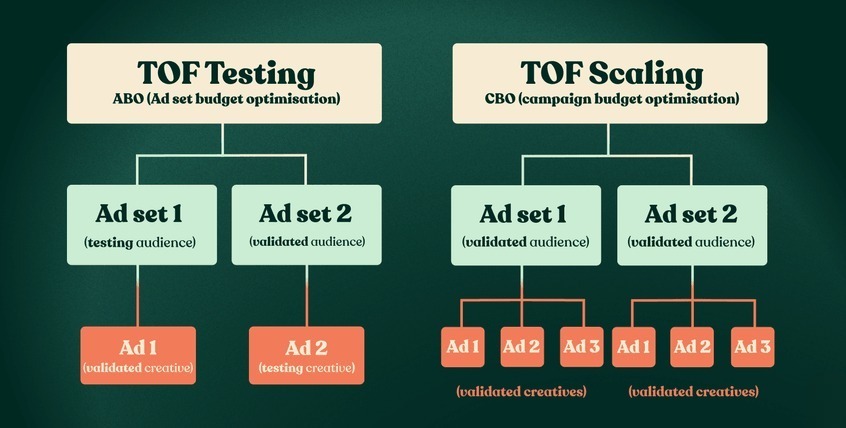
Campaign 1 — Prospecting
New potential customers.
Campaign 2 — Retargeting
People who have already interacted with your brand.
Campaign 3 — Testing
New creative, audiences, offers, or messaging.
The exact structure should depend on the account's size, objective, geography, product range, and conversion volume.
There isn't one Facebook Ads campaign structure that works for every business.
The goal is to create enough separation to understand performance without unnecessarily splitting your budget.
12. Know When Not to Scale
This is just as important as knowing how to scale.
Don't increase budget simply because:
- You have unused marketing budget
- The campaign had one excellent day
- Your client wants more leads immediately
- CTR looks good
- CPC is low
First ask whether the campaign has demonstrated reasonably consistent performance.
If CPA has already been rising for several days, adding more budget may simply amplify the problem.
Instead, investigate the bottleneck.
Is it:
Audience → Creative → Offer → Landing Page → Tracking → Sales process?
Fix the constraint before adding more fuel.
A Practical Facebook Ads Scaling Framework
Here's a simple framework you can use when scaling a campaign.
Step 1: Establish the baseline
Record:
- Current spend
- CPA
- Conversion volume
- CTR
- CPM
- Conversion rate
- Lead quality or revenue
Step 2: Increase budget gradually
Make a controlled budget adjustment rather than making several large changes at once.
Step 3: Monitor performance
Watch both short-term movement and the broader trend.
Step 4: Introduce new creative
Don't wait until every existing ad is exhausted.
Step 5: Expand audiences
Test broader targeting, new markets, lookalikes, or new customer segments where appropriate.
Step 6: Improve the conversion experience
Optimize your landing page, form, checkout process, or sales process.
Step 7: Scale what works
Continue putting budget behind combinations of audience, creative, offer, and conversion experience that produce sustainable business results.
Final Thoughts
Scaling Facebook Ads without increasing CPA isn't about finding one secret setting inside Meta Ads Manager.
It's about building enough capacity around the campaign to handle additional spend.
That means having:
- Reliable conversion tracking
- Strong creative
- Multiple creative angles
- Sufficient audience size
- A clear retargeting strategy
- A strong landing page
- A simple campaign structure
- Consistent testing
- Quality-focused measurement
Most importantly, don't treat scaling as simply "increase the budget."
Think of it as increasing the number of profitable opportunities your advertising system can generate.
When the audience, creative, offer, landing page, tracking, and sales process are working together, increasing ad spend becomes much more predictable.
If you need help building or scaling campaigns, you can learn more about Scale With Clicks and our Meta Ads management services.
For businesses that already have campaigns running but aren't sure where the next stage of growth should come from, a structured account and conversion review can help identify whether the biggest opportunity is creative, targeting, tracking, landing pages, or budget allocation.
FAQs
How quickly should I increase my Facebook Ads budget?
There is no universal percentage that works for every campaign. Budget increases should depend on conversion volume, campaign stability, audience size, and business economics. Make controlled changes and monitor the resulting trend rather than reacting to a few hours of data.
Why does CPA increase when I increase my Facebook Ads budget?
CPA can increase when additional spending reaches less responsive users, audiences become saturated, creative performance declines, or the campaign's conversion rate changes. It can also happen when the landing page or sales process becomes the bottleneck.
Should I increase budget or create a new Facebook campaign?
It depends on the situation. If the existing campaign has stable performance and enough room to grow, increasing budget may make sense. If you're testing a new market, creative angle, product, or audience, a separate testing structure may provide cleaner data.
How do I scale Facebook Ads without losing performance?
Focus on controlled budget increases, continuous creative testing, audience expansion, retargeting, accurate conversion tracking, and improving the post-click experience. Measure qualified leads or revenue rather than relying only on platform CPA.
What is more important than CPA when scaling Facebook Ads?
For lead generation, qualified lead cost and downstream sales performance can be more useful than raw CPA. For ecommerce, revenue, contribution margin, customer acquisition cost, and ROAS can provide a better picture of whether additional spending is actually profitable.