Facebook Ads
Best Retargeting Audiences in Meta Ads - 2026 Guide

Category: Facebook Ads
Best Retargeting Audiences in Meta Ads: 2026 Guide
Retargeting is one of the most useful parts of Meta advertising because you are not trying to convince a complete stranger to notice your business.
The people in your retargeting audiences have already done something.
They may have visited your website, viewed a product, interacted with your Instagram profile, watched your video, added something to their cart, or submitted an enquiry without becoming a customer.
That previous interaction gives you an advantage.
Instead of showing the same introductory advertisement to everyone, you can show a more relevant message based on what someone has already done.
In 2026, this is even more important because Meta's advertising system relies heavily on its machine-learning and conversion signals. Retargeting should therefore not mean creating dozens of tiny audiences. The goal is to identify the audiences that show meaningful intent and give Meta enough quality data to optimize delivery.
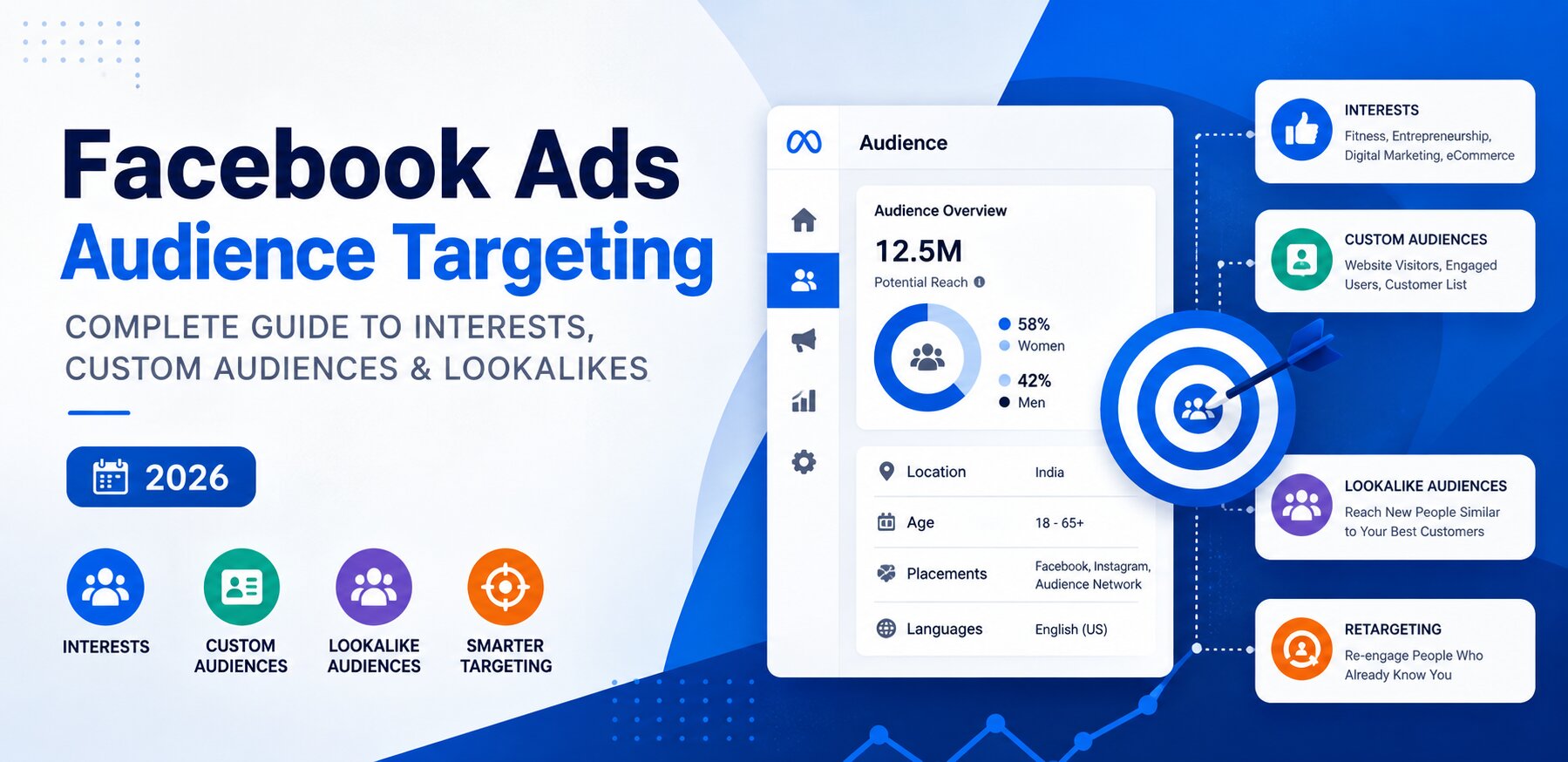
If you're still deciding how different Facebook and Meta audiences work, our Facebook Ads Audience Targeting Guide covers broad, interest, Custom and Lookalike Audiences in more detail.
What Are Retargeting Audiences in Meta Ads?
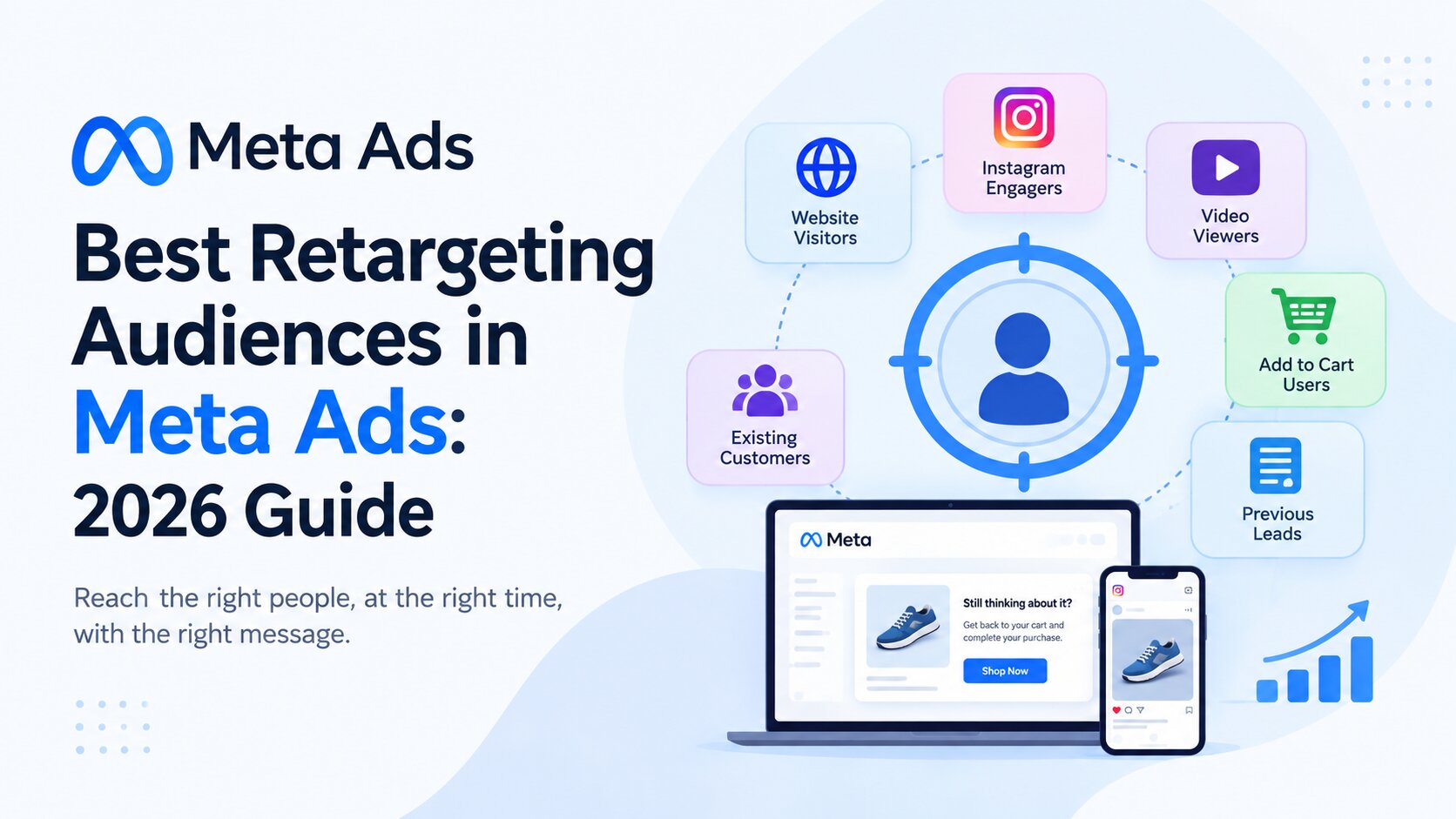
Retargeting audiences are groups of people who have previously interacted with your business and can potentially be shown another advertisement.
These audiences can come from several sources, including:
- Website visitors
- Product or service page visitors
- Instagram engagement
- Facebook engagement
- Video viewers
- Customer lists
- Previous leads
- Add to Cart users
- Initiate Checkout users
- Existing customers
- App users
Meta Custom Audiences are particularly useful for this because they allow advertisers to build audiences from different types of first-party interactions.
For example, imagine someone visits your website after clicking a Meta ad.
They read your service page but don't submit the enquiry form.
Instead of losing that visitor completely, you can create a retargeting audience and show them another advertisement later.
The second ad could highlight a case study, testimonial, offer, free consultation or another reason to take the next step.
That's the basic idea behind Facebook Ads retargeting.
Why Retargeting Works
Someone who has already interacted with your business is generally at a different stage of the buying journey from someone who has never heard of you.
Consider these two people:
Person A: Has never heard of your company.
Person B: Visited your website, read your service page and spent several minutes researching your offer.
Showing exactly the same advertisement to both people isn't always the best use of your budget.
Person A needs awareness and education.
Person B may only need a reason to come back and convert.
This is why retargeting campaigns can be particularly valuable for businesses with longer decision-making cycles, high-ticket services and ecommerce stores.
However, retargeting isn't automatically profitable. Poor tracking, excessive frequency, weak creative and badly structured audiences can quickly reduce performance.
For a broader look at this problem, see Why Your Facebook Ads Are Not Converting.
10 Best Retargeting Audiences in Meta Ads
Not every business needs all ten audiences below. The right combination depends on your website traffic, sales cycle, budget and conversion volume.
1. Website Visitors
Website visitors are usually the first retargeting audience advertisers should consider.
You can create an audience of people who visited your website during a specific period, such as:
- 7 days
- 14 days
- 30 days
- 60 days
- 90 days
- 180 days
A 30-day website visitor audience can work well for many businesses, but don't automatically use 30 days for everything.
A short buying cycle may benefit from a 7- or 14-day audience.
A business selling expensive services may need a longer window.
For example:
0–7 days: High-intent recent visitors
8–30 days: Warm visitors still considering the offer
31–90 days: Older prospects who may need additional nurturing
The important thing is to match the retargeting window with your actual customer journey.
2. Product or Service Page Visitors
This is often more valuable than retargeting every website visitor.
Someone who visits your homepage could be researching your company.
Someone who visits a specific product or service page has demonstrated a much clearer interest.
For example, a digital marketing agency could create audiences for people who visited:
- Meta Ads service page
- Google Ads service page
- SEO service page
- Conversion tracking service page
The advertisement can then be tailored to the specific service they viewed.
Instead of saying:
"We provide digital marketing services."
you can say:
"Still struggling to generate qualified leads from Meta Ads?"
The second message is much more relevant to someone who already explored your Meta Ads service.
If you want to explore professional campaign management, you can also link naturally to your Meta Ads Management Services page.
3. Instagram Engagement Audience
Instagram engagement is another important source of retargeting audiences.
Someone may interact with your business without ever visiting your website.
They might:
- Visit your Instagram profile
- Watch your Reels
- Like a post
- Comment
- Save content
- Share a post
- Send a message
- Interact with your profile
These people have already shown some level of interest.
For businesses that generate a significant amount of organic Instagram engagement, ignoring this audience means leaving valuable warm traffic unused.
You can create a retargeting campaign specifically for engaged Instagram users and show them content designed to move them closer to a conversion.
For example:
First interaction: Educational Reel
Retargeting: Case study
Next step: Consultation or enquiry
This turns organic engagement into another layer of your paid advertising funnel.
4. Facebook Page Engagement Audience
Facebook engagement can also be used for retargeting.
This is particularly useful for businesses that still receive meaningful activity on Facebook through:
- Posts
- Videos
- Reels
- Comments
- Page visits
- Other interactions
The audience may be smaller than your website audience, but it can still be valuable.
One important point: don't judge an audience only by its size.
A 10,000-person audience with strong buying intent can be more useful than a 500,000-person audience with very weak engagement.
5. Video Viewers
Video viewers are an underrated retargeting audience.
Someone who watches a meaningful portion of your video has already consumed your content.
You can build audiences based on people who watched your videos and then move them into another stage of your funnel.
For example:
Video 1: "3 mistakes businesses make with Meta Ads"
↓
Retarget viewers: "See how we fix these problems for businesses"
↓
CTA: Book a consultation
This approach is particularly useful when your business relies on education before conversion.
You don't have to immediately ask a cold viewer to buy.
First, give them useful information.
Then retarget the people who showed enough interest to keep watching.
6. Add to Cart Audience
For ecommerce businesses, Add to Cart users are among the most valuable retargeting audiences.
These people have already taken a strong action.
They didn't just browse.
They showed enough interest to add a product to their cart.
A simple ecommerce funnel could look like:
Product View → Add to Cart → Checkout → Purchase
Each stage can have a different retargeting strategy.
For Add to Cart users who haven't purchased, your ads could focus on:
- Product benefits
- Reviews
- Customer testimonials
- Shipping information
- Product demonstrations
- Limited-time offers
- Frequently asked questions
Avoid assuming that everyone needs a discount.
Sometimes the visitor simply needs more confidence before buying.
7. Initiate Checkout Audience
Initiate Checkout users are usually even closer to the purchase than Add to Cart users.
If someone has started the checkout process but hasn't completed the purchase, you should treat them differently from someone who only viewed a product.
This audience deserves high-priority retargeting.
For example:
Product View: Educational/product-focused creative
Add to Cart: Benefits + social proof
Initiate Checkout: Purchase-focused reminder
Existing Customer: Cross-sell or upsell
The closer someone gets to conversion, the more specific your message can become.
8. Previous Leads
For lead-generation businesses, previous leads can become a powerful retargeting audience.
Consider someone who:
- Filled out a form
- Requested a quote
- Downloaded a resource
- Started a consultation request
- Sent a WhatsApp enquiry
- Contacted the business
Not every lead becomes a customer immediately.
Some need additional information.
Some are comparing competitors.
Some aren't ready yet.
Instead of treating every lead as permanently lost, you can create campaigns that keep your business in front of them.
For example, a B2B company could retarget previous leads with:
- Case studies
- Customer results
- Industry insights
- Product demonstrations
- New services
- Consultation offers
This can be especially useful when the sales cycle takes weeks or months.
9. Existing Customers
Retargeting isn't only about recovering lost customers.
Existing customers can also be valuable advertising audiences.
Once someone has purchased from you, you can promote:
- Related products
- Upgrades
- Premium services
- Repeat purchases
- Subscriptions
- Accessories
- New launches
For ecommerce, this could mean recommending a complementary product.
For a service business, it could mean promoting another relevant service.
However, make sure existing customers are excluded from campaigns where the objective is acquiring new customers.
Otherwise, you can end up paying to advertise the same introductory offer to people who have already converted.
Audience exclusions are an important part of building an efficient Meta Ads account.
10. High-Intent Custom Audiences
The strongest retargeting setup often comes from combining signals rather than treating every interaction equally.
For example, you could create audiences such as:
High Intent
Website visitors + product/service page visitors
Very High Intent
Add to Cart + Initiate Checkout
Engaged
Instagram engagement + video viewers
Lead Nurturing
Previous leads who haven't become customers
This gives you a much clearer funnel.
Instead of having one massive "Retargeting Audience", you can tailor the message to the user's actual level of intent.
How Long Should Your Retargeting Window Be?
There is no universal retargeting window.
The correct window depends on your buying cycle.
A practical starting point is:
| Audience | Suggested Window |
|---|---|
| Product/Service Visitors | 7–30 days |
| Website Visitors | 30–60 days |
| Add to Cart | 7–14 days |
| Initiate Checkout | 3–14 days |
| Video Viewers | 30–90 days |
| Instagram Engagers | 30–90 days |
| Previous Leads | 30–180 days |
| Existing Customers | 90–180+ days |
These aren't rules.
Use your actual customer journey and performance data to adjust them.
A person shopping for a ₹1,000 product may decide within a few days.
A company choosing a marketing agency could take several weeks.
Your retargeting strategy should reflect that difference.
Don't Put Every Retargeting Audience Into One Ad Set
One of the most common mistakes is creating one giant retargeting audience containing:
- Website visitors
- Instagram engagers
- Video viewers
- Add to Cart users
- Customers
- Previous leads
This removes useful distinctions between different levels of intent.
A person who watched 50% of a video isn't necessarily as valuable as someone who reached checkout.
A better approach is to group audiences based on intent and available volume.
For example:
Ad Set 1 — High Intent
- Add to Cart
- Initiate Checkout
- Product viewers
Ad Set 2 — Warm
- Website visitors
- Service page visitors
- Instagram engagers
Ad Set 3 — Nurturing
- Video viewers
- Older website visitors
- Previous leads
You don't need to create all three if your budget is small.
In fact, splitting a small audience too much can make campaigns difficult to optimize.
Your recommended Meta Ads campaign structure for 2026 explains why keeping campaign structures simple is often better than creating dozens of ad sets.
Retargeting Creative Matters as Much as the Audience
A strong retargeting audience cannot fix weak creative.
The advertisement should acknowledge where the user is in the buying journey.
For example:
Website Visitor
Message: "Still comparing your options?"
Product Viewer
Message: "Take another look at what makes this product different."
Add to Cart
Message: "Your cart is still waiting."
Previous Lead
Message: "Still looking for a better way to solve [problem]?"
Existing Customer
Message: "Ready to take the next step?"
The best retargeting creative doesn't necessarily feel like an advertisement.
It should feel like the next logical step in the conversation.
Tracking Is the Foundation of Retargeting
Your retargeting strategy is only as reliable as your tracking setup.
If Meta cannot properly receive website events, your audiences and optimization signals can suffer.
Before launching retargeting campaigns, verify:
- Meta Pixel is installed correctly
- Important events are firing
- Purchase/Lead events are configured correctly
- Event parameters are being passed correctly
- Conversion events aren't duplicated
- Customer exclusions are working
- Conversions are being attributed correctly
If you haven't implemented the Pixel yet, see our Meta Pixel Setup Guide.
For more advanced tracking, our Meta Conversion API Guide explains how server-side event tracking can complement browser-based tracking.
You can also explore our Conversion Tracking Services if tracking is creating problems across your advertising campaigns.
Common Retargeting Mistakes
1. Retargeting Everyone
Not every visitor deserves the same message.
Segment audiences according to intent where the available volume makes it practical.
2. Using Extremely Short Windows
If your sales cycle is long, a 7-day audience may exclude valuable prospects too quickly.
3. Showing the Same Ad Repeatedly
Repeated exposure to the same creative can cause fatigue.
Refresh your hooks, visuals and offers when performance starts declining.
4. Forgetting Customer Exclusions
If the campaign is designed to acquire new customers, exclude people who have already converted.
5. Ignoring Frequency
High frequency with falling CTR and conversions can be a sign that your audience is becoming saturated.
6. Creating Too Many Tiny Audiences
More audiences do not automatically mean better targeting.
Meta's systems need sufficient data to optimize effectively.
7. Ignoring Tracking
If your Pixel or event setup is inaccurate, your retargeting strategy can be built on incomplete information.
A Practical Meta Retargeting Strategy for 2026
For most businesses, you don't need an incredibly complicated funnel.
Start with three levels:
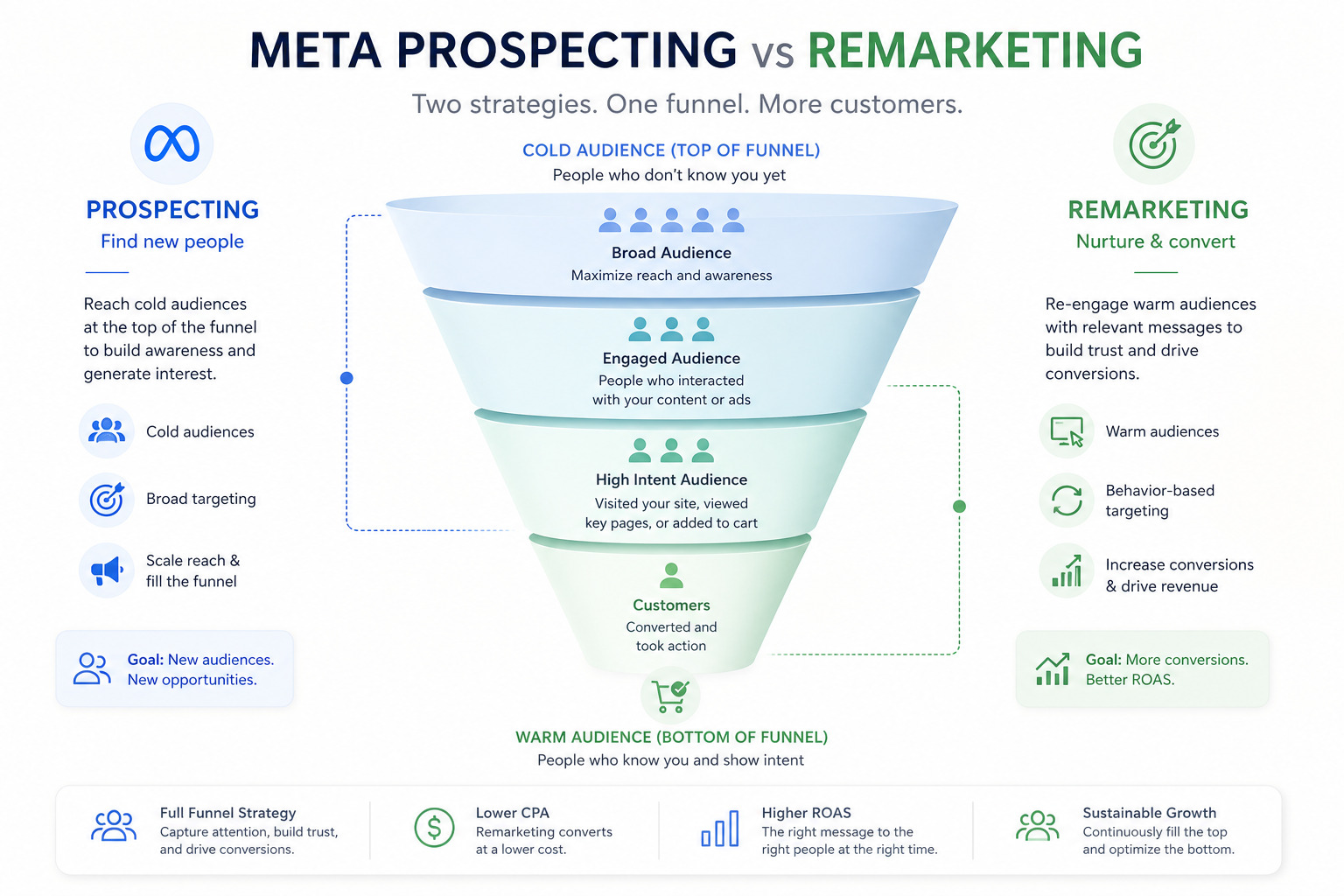
Cold Audience
Broad / Advantage+ / Lookalike
↓
Warm Audience
Website visitors + Instagram/Facebook engagement + video viewers
↓
Hot Audience
Product viewers + Add to Cart + Initiate Checkout + high-intent leads
↓
Customer
Purchase/Lead completed
Then use exclusions to move people through the funnel.
For example, once someone purchases, remove them from acquisition and abandoned-cart campaigns.
If your business has enough traffic and conversion volume, you can gradually create more specific segments.
If your audience is small, keep the structure simple.
Final Thoughts
The best retargeting audiences in Meta Ads are not necessarily the biggest ones.
They are the audiences that show meaningful intent.
Website visitors can be useful for building a warm pool. Instagram engagers and video viewers help you reconnect with people who interacted with your content. Product viewers, Add to Cart users and checkout users can provide much stronger purchase signals. Previous leads and existing customers can also become valuable audiences when the message is appropriate.
The biggest improvement usually comes from connecting the audience, message and stage of the buying journey.
Don't just ask:
"Who can I retarget?"
Ask:
"What did this person do, what does that tell me about their intent, and what should they see next?"
That shift can make your Meta Ads retargeting strategy far more effective.
If you want to build a structured retargeting system around your campaigns, explore Scale With Clicks and our Meta Ads Management Services.
Frequently Asked Questions
What is the best retargeting audience in Meta Ads?
There isn't one audience that works for every business. High-intent audiences such as Add to Cart, Initiate Checkout, product viewers and qualified leads are often valuable when sufficient volume exists. Website visitors and social media engagers are useful for broader retargeting.
How many days should I retarget website visitors?
A 30-day audience is a reasonable starting point for many businesses, but the ideal window depends on the sales cycle. Shorter windows can work for quick purchases, while longer windows may be appropriate for high-ticket or B2B services.
Can I retarget Instagram followers on Meta Ads?
Yes. Instagram engagement can be used to create Custom Audiences for retargeting. This allows you to reach people who have interacted with your Instagram content or profile.
Should I retarget Add to Cart users separately?
Usually, yes, when there is enough audience volume. Add to Cart users have demonstrated stronger intent than someone who simply visited a homepage, so they can justify different creative and offers.
Should existing customers be excluded from retargeting?
For customer-acquisition campaigns, generally yes. Existing customers can instead be placed into separate campaigns for repeat purchases, upsells, cross-sells or new services.
Is retargeting still effective in 2026?
Yes, but the strategy has changed. Accurate first-party data, strong conversion tracking, relevant creative, sensible audience segmentation and appropriate exclusions are more important than creating a large number of manually segmented audiences.