Google Ads
Responsive Search Ads Best Practices for Better CTR (2026)

Category: Google Ads
Responsive Search Ads Best Practices for Better CTR (2026)
Getting impressions on Google Ads is easy. Getting the right people to click your ads is where the real challenge begins.
If your Search campaign is receiving impressions but your click-through rate (CTR) is lower than expected, the problem may not always be your keywords or bids. In many cases, the issue is the ad itself.
Your headlines may be too generic. Your descriptions may not explain the benefit clearly. Your ads may not match search intent. Or you may be giving Google too few unique assets to work with.
This is where Responsive Search Ads (RSAs) can make a major difference.
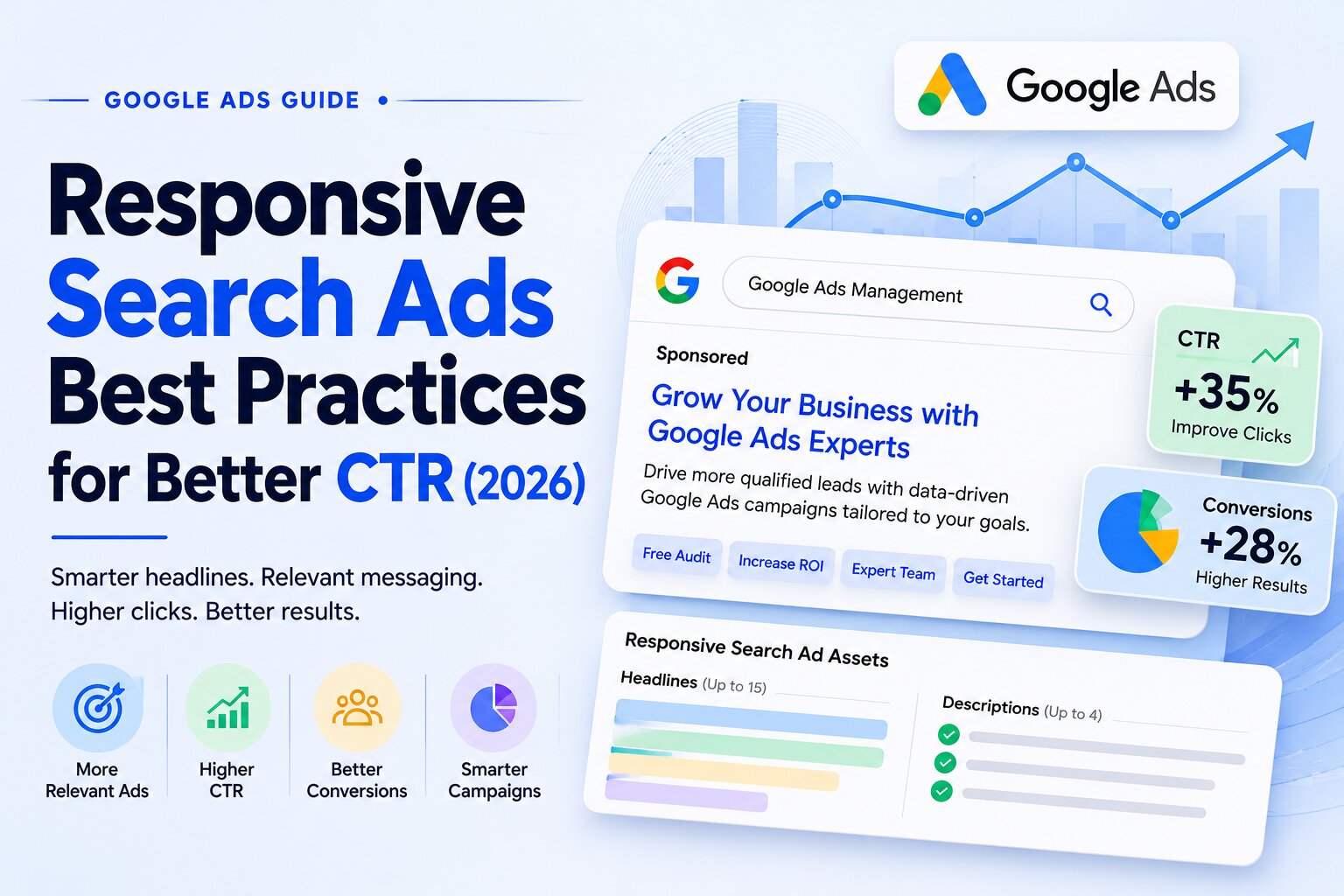
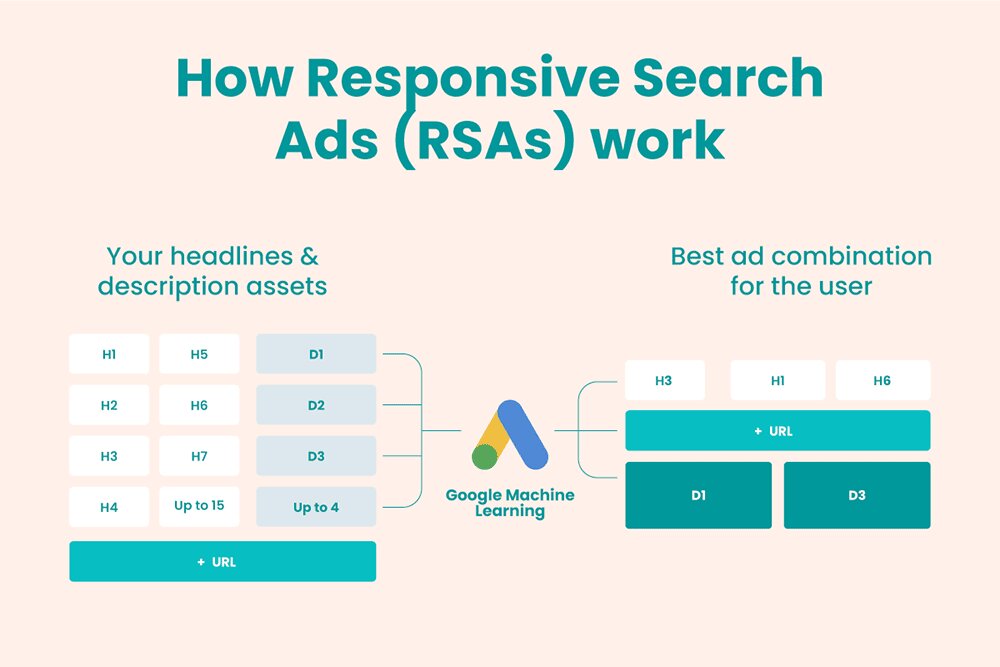
Responsive Search Ads allow you to provide multiple headlines and descriptions, which Google can combine into different ad variations based on the search query and other signals. Google currently allows up to 15 headlines and 4 descriptions in a single RSA.
But simply filling every available field isn't enough.
You need a strategy behind those headlines and descriptions.
In this guide, we'll cover the most effective responsive search ads best practices for 2026, including how to write better headlines, use keywords naturally, improve Ad Strength, handle pinning, match search intent, and optimize RSAs for better CTR and conversions.
What Are Responsive Search Ads?
Responsive Search Ads are Google's flexible Search ad format where you provide multiple headlines and descriptions instead of creating just one fixed ad.
Google then tests different combinations of these assets and learns which combinations are more relevant to different searches.
For example, suppose you're running ads for a Google Ads agency.
You might create headlines such as:
- Google Ads Management
- Get More Leads From Google Ads
- Google Ads Experts
- Reduce Wasted Ad Spend
- Performance-Focused PPC
- Free Google Ads Audit
- Scale Your Business With PPC
Google can combine these assets in different ways depending on the search and available ad space.
The goal is simple: show a more relevant message to the person searching.
Google recommends providing multiple unique headlines and descriptions because more useful assets give the system more combinations to work with.
If you're still building your first Search campaign, start with a proper account structure rather than jumping straight into ad copy. Our guide on Google Ads setup for beginners can help you understand the fundamentals first.
Why CTR Matters in Google Ads
CTR is calculated by dividing clicks by impressions.
CTR = Clicks ÷ Impressions × 100
For example, if your ad receives 100 clicks from 2,000 impressions:
100 ÷ 2,000 × 100 = 5% CTR
A higher CTR generally indicates that your ad is attracting attention and is relevant to the searches triggering it.
However, don't make the mistake of chasing CTR alone.
A high CTR isn't useful if those clicks don't generate leads, purchases, calls, or other valuable actions.
For example:
Ad A
Cheap Digital Marketing Services – Click Now
This could generate curiosity and clicks.
But:
Ad B
Google Ads Management for B2B Companies
may attract fewer clicks while generating significantly better leads.
The goal isn't simply more clicks.
The goal is more qualified clicks that can turn into business results.
This is why CTR should be evaluated alongside conversion rate, cost per conversion, search terms, CPC and overall campaign profitability.
15 Responsive Search Ads Best Practices for 2026
1. Use at Least 8–10 Unique Headlines
One of the most important RSA best practices is to provide enough headline variations.
Google recommends providing at least 8–10 headlines, while allowing up to 15.
Don't create ten versions of the same headline.
For example:
- Best Google Ads Agency
- Top Google Ads Agency
- Leading Google Ads Agency
- Professional Google Ads Agency
These technically look different but communicate almost exactly the same thing.
Instead, give Google different ideas to work with:
- Google Ads Management
- Generate More Qualified Leads
- Reduce Wasted Ad Spend
- Google Ads Experts
- Improve Your PPC ROI
- Free Google Ads Audit
- Certified PPC Specialists
- Scale With Better Campaigns
- Data-Driven Google Ads
- Get More From Your Ad Budget
Each headline introduces a different selling point.
That's the kind of variety that makes responsive search ads more useful.
2. Include Your Main Keyword Naturally
Your primary keyword should appear naturally in your ad copy.
If your ad group targets:
Google Ads Management
you could use headlines such as:
Google Ads Management
Expert Google Ads Management
Google Ads Management Services
But don't force the keyword into every headline.
Google's current guidance recommends including relevant keywords in headlines while also maintaining unique headlines that communicate benefits, features and other useful information.
A simple structure is:
- 2–3 keyword-focused headlines
- 3–5 benefit-focused headlines
- 2–3 credibility-focused headlines
- 2–3 offer or CTA-focused headlines
This gives you relevance without making the ad sound robotic.
3. Match the Ad With Search Intent
This is one of the biggest factors advertisers overlook.
Someone searching:
"What is Google Ads?"
has very different intent from someone searching:
"Hire Google Ads agency"
The first person may be researching.
The second person may be ready to speak with an agency.
Your ad should reflect that difference.
For transactional searches, focus on:
- Results
- Pricing
- Benefits
- Experience
- Offers
- Trust
- Calls to action
For example:
Hire Google Ads Experts Generate More Qualified Leads Book a Free Strategy Call
This is much more appropriate for commercial intent than something generic like:
Learn About Online Advertising
Understanding search intent is also important when selecting keywords. If you're attracting irrelevant traffic, our guide on Costly Google Ads mistakes covers several common targeting and optimization problems.
4. Focus on Benefits Instead of Just Features
Many advertisers write ads that describe what they do without explaining why the customer should care.
For example:
Google Ads Management Services PPC Campaign Management Keyword Research Campaign Optimization
These describe services.
But they don't provide much motivation to click.
A stronger approach would be:
Generate More Qualified Leads Reduce Wasted Ad Spend Improve Your PPC ROI Scale Profitable Campaigns
The second approach connects the service with the outcome.
Whenever possible, answer the question:
"What's in it for the customer?"
5. Use Numbers Where They Make Sense
Numbers can make headlines more specific.
For example:
10+ Years of PPC Experience
5,000+ Leads Generated
10X ROAS Achieved
24/7 Campaign Monitoring
Only use numbers that are accurate and supportable.
Avoid adding numbers simply because they look attractive.
Specific claims can make an ad stand out, but credibility matters more than clever copy.
6. Add Strong Calls to Action
Your ad should make the next step obvious.
Examples include:
- Get a Free Audit
- Book a Strategy Call
- Request a Consultation
- Get Started Today
- Talk to a PPC Expert
- Get Your Campaign Reviewed
- Request a Free Proposal
Don't put the same CTA into every headline.
Instead, use your available assets to test different ways of encouraging action.
7. Make Your Descriptions Do More Work
You can add up to four descriptions to a Responsive Search Ad, with each description supporting up to 90 characters.
Don't simply repeat your headlines.
Use descriptions to explain:
- What you offer
- Who you help
- Your key differentiator
- Your offer
- Why someone should choose you
- What the user should do next
For example:
Get more qualified leads with data-driven Google Ads campaigns built around your business goals.
Another:
Reduce wasted spend with better keyword targeting, conversion tracking and ongoing campaign optimization.
Each description should add something new.
8. Don't Overuse Keyword Insertion
Dynamic Keyword Insertion can be useful, but it isn't automatically better than manually written headlines.
Keyword insertion can help make an ad more relevant to the user's search, but it can also produce awkward messaging if your keyword list isn't tightly controlled.
For example, a headline dynamically inserting:
Google Ads Agency
may work well.
But if your keyword list contains broad or unexpected terms, the resulting headline could become confusing.
Use keyword insertion selectively and preview the possible variations before relying on it.
9. Be Careful With Headline Pinning
Pinning allows you to force a headline or description into a specific position.
It can be useful when certain messaging must always appear.
For example:
Headline 1: Google Ads Management
You might pin that headline if having the service name in the first position is important.
However, excessive pinning limits the combinations Google can test.
Google specifically notes that pinning isn't recommended for most advertisers because it reduces the number of combinations available.
A better approach is often a hybrid strategy:
- Pin only essential messaging.
- Leave most headlines unpinned.
- If you need to pin, consider having multiple unique headlines available for that position.
Don't pin everything simply because you want your ad to look a certain way.
10. Don't Write Every Headline Around the Same Keyword
This is a common RSA mistake.
Imagine your headlines are:
- Google Ads Agency
- Best Google Ads Agency
- Professional Google Ads Agency
- Google Ads Agency Services
- Expert Google Ads Agency
You've technically supplied five headlines, but you've given Google very little variety.
Instead, mix different themes.
Keyword
Google Ads Management
Benefit
Generate More Qualified Leads
Pain Point
Stop Wasting Ad Budget
Trust
Experienced PPC Specialists
Offer
Get a Free Google Ads Audit
CTA
Book a Strategy Call
This gives Google much more useful material to combine.
11. Match Your Landing Page to the Ad
Your ad shouldn't promise something the landing page doesn't deliver.
Suppose your headline says:
Free Google Ads Audit
but the landing page only says:
Welcome to Our Digital Marketing Agency
That's a mismatch.
The user clicked expecting an audit and immediately has to figure out where to go.
Instead, the landing page should reinforce the same message.
If your ad promotes Google Ads management, send users to a relevant Google Ads service page rather than a completely unrelated page.
Google also recommends ensuring the promotions and products mentioned in the ad are represented on the website or landing page.
12. Improve Your Ad Strength, But Don't Obsess Over It
Ad Strength provides feedback about your responsive search ad assets and their potential effectiveness.
Google recommends aiming for Good or Excellent Ad Strength and adding more unique headlines and descriptions where appropriate.
But remember:
Ad Strength isn't the same thing as campaign profitability.
An ad can have Excellent Ad Strength and still generate poor-quality leads.
Use Ad Strength as a diagnostic tool, not as your ultimate KPI.
Your real performance indicators should include:
- CTR
- Conversion rate
- Cost per conversion
- Conversion value
- ROAS
- Qualified leads
- Sales
13. Use Ad Assets Alongside Your RSA
Don't treat your headlines and descriptions as the only elements that matter.
Use relevant assets such as:
- Sitelinks
- Callouts
- Structured snippets
- Image assets
- Call assets
- Location assets
- Business name
- Logo
Google currently recommends using multiple relevant asset types, and its RSA guidance recommends having at least six sitelinks available across the account, campaign or ad group where possible.
These assets can give users additional information and more ways to interact with your business.
14. Review Search Terms Regularly
Even excellent ad copy can't fix irrelevant searches.
Your Search Terms report can reveal queries that:
- Don't match your offer
- Have low commercial intent
- Generate clicks without conversions
- Are unrelated to your business
- Should be added as negative keywords
For example, a company offering paid Google Ads management might want to exclude searches related to:
- Google Ads jobs
- Google Ads course
- Google Ads certification
- Free Google Ads
- Google Ads salary
The exact exclusions depend on the business and campaign.
Regular search-term analysis can improve traffic quality and help your CTR become more meaningful over time.
15. Test and Refresh Your RSA Assets
Don't create an RSA and forget about it.
Review performance regularly and look for:
- Low-performing headlines
- Repetitive messaging
- Weak descriptions
- Poor search-term relevance
- Declining CTR
- Changes in conversion rate
- New customer objections
- New offers or promotions
Google provides asset and combination reporting that can help advertisers understand how different combinations are being served.
However, avoid changing everything every few days.
Give your campaigns enough data to identify meaningful patterns before making major decisions.
A Simple Responsive Search Ad Structure
If you're unsure how to build your first RSA, try this structure.
Headlines 1–3: Core Message
- Google Ads Management
- Google Ads Experts
- PPC Management Services
Headlines 4–6: Benefits
- Generate More Qualified Leads
- Reduce Wasted Ad Spend
- Improve Your PPC ROI
Headlines 7–9: Differentiators
- Data-Driven Campaigns
- Conversion-Focused PPC
- Experienced Google Ads Team
Headlines 10–12: Offer & CTA
- Get a Free Google Ads Audit
- Book a Strategy Call
- Start Growing With PPC
Descriptions
Description 1:
Generate more qualified leads with Google Ads campaigns built around your goals and target audience.
Description 2:
Improve campaign performance with smarter targeting, conversion tracking and ongoing optimization.
This structure gives you a mix of relevance, benefits, differentiation and action without making every asset sound the same.
How to Improve RSA CTR Without Increasing Your Budget
If your CTR is low, increasing your daily budget isn't necessarily the answer.
Start with the basics.
1. Review your search terms
Find out what people are actually searching for.
2. Improve your headlines
Make them more specific to the keyword and search intent.
3. Highlight a stronger benefit
Give users a reason to choose your business.
4. Improve your descriptions
Use the descriptions to overcome objections and explain your offer.
5. Add relevant ad assets
Sitelinks, callouts and other assets can make your ad more useful.
6. Improve landing page relevance
Make sure the page continues the conversation started by the ad.
7. Review conversion data
A higher CTR isn't necessarily better if conversion quality declines.
If you're seeing clicks but not enough leads or sales, the issue may extend beyond your RSA copy. Our guide on why Google Ads campaigns don't convert covers common problems involving targeting, landing pages, tracking and campaign structure.
Common Responsive Search Ads Mistakes to Avoid
Here are some mistakes that can limit RSA performance:
Writing 15 Nearly Identical Headlines
More assets aren't automatically better. More unique assets are better.
Keyword Stuffing
Repeating your keyword in every headline can make your ads sound unnatural.
Pinning Everything
Excessive pinning reduces Google's ability to test combinations.
Using Generic CTAs
"Click Here" doesn't explain why the user should click.
Ignoring Search Intent
An informational search requires different messaging from a high-intent commercial search.
Sending All Traffic to the Homepage
A relevant landing page usually provides a better experience than a generic homepage.
Optimizing for CTR Alone
A high CTR doesn't matter much if your clicks don't generate business.
Ignoring Conversion Tracking
Without reliable conversion data, you're essentially optimizing based on incomplete information.
If your tracking needs work, see our guide on how to set up conversion tracking in Google Ads or explore our conversion tracking services.
Responsive Search Ads Best Practices: Quick Checklist
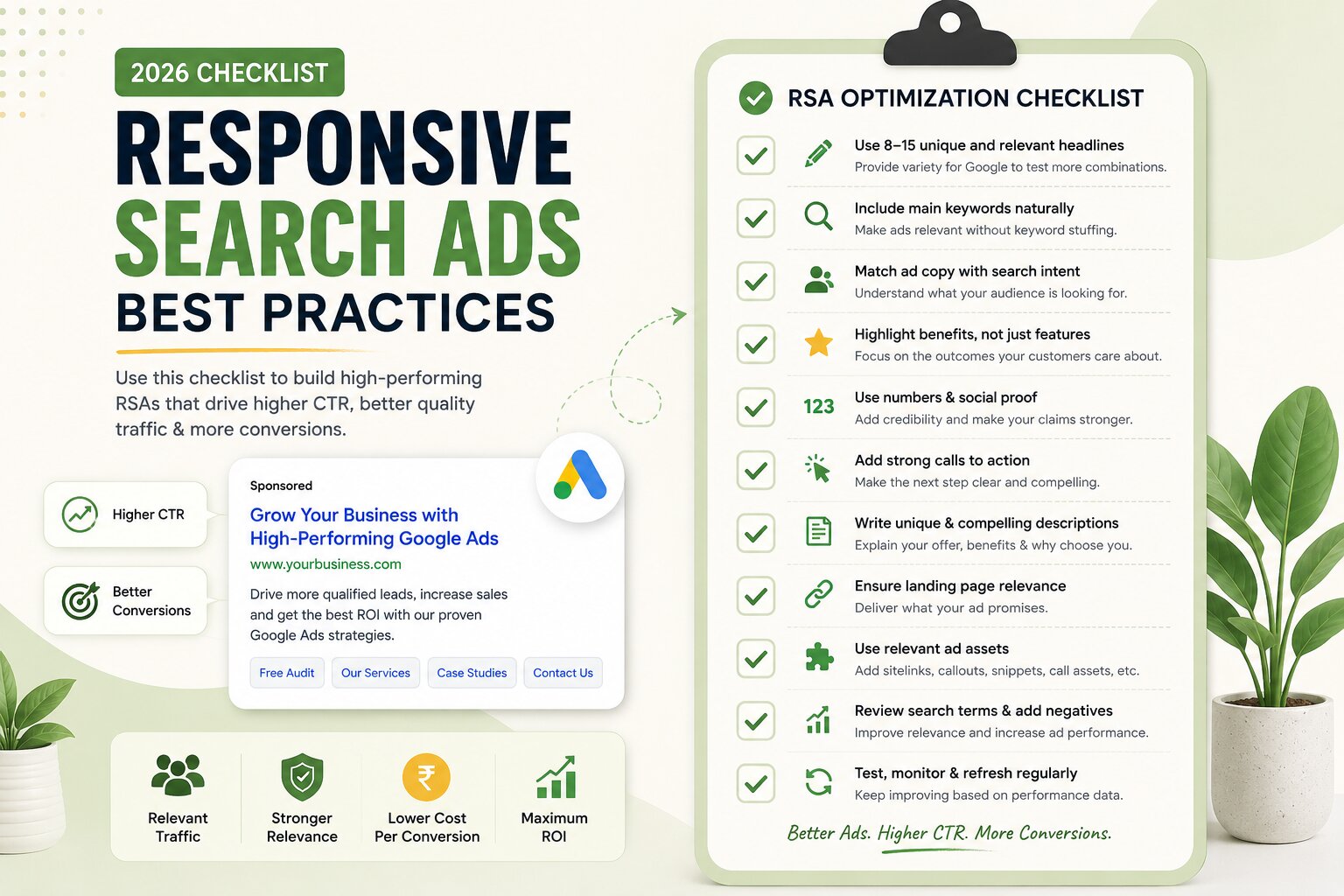
Before publishing an RSA, check the following:
- Use 8–10+ unique headlines
- Include important keywords naturally
- Add different benefits and selling points
- Include relevant calls to action
- Write unique descriptions
- Avoid unnecessary keyword repetition
- Keep pinning to a minimum
- Aim for Good or Excellent Ad Strength
- Match the ad with the landing page
- Add relevant ad assets
- Review search terms regularly
- Track conversions correctly
- Monitor CTR and conversion rate
- Test new messaging over time
Final Thoughts
Responsive Search Ads give advertisers much more flexibility than traditional fixed-text ads, but the flexibility only helps when the assets are written with a clear strategy.
The best approach isn't to fill all 15 headlines with variations of the same keyword.
Instead, build a balanced set of assets around search intent, relevance, benefits, differentiation and action.
Use your keywords where they make sense. Give Google enough unique headlines and descriptions to test. Avoid excessive pinning. Make your landing page match the promise in the ad. And most importantly, judge success by conversions and business results—not CTR alone.
Google Ads is increasingly automated, but that doesn't mean advertisers can simply upload generic copy and walk away.
Strong account structure, relevant messaging, accurate conversion tracking and continuous optimization still matter.
If you want to improve your overall PPC performance, you can explore Scale With Clicks or learn more about our Google Ads management services.
The goal isn't just to get more people to click.
It's to get the right people to click—and turn those clicks into measurable business results.
Frequently Asked Questions
What is a good CTR for Responsive Search Ads?
There isn't one universal CTR benchmark for every Google Ads campaign. CTR varies significantly by industry, keyword intent, competition, location and campaign type. Instead of comparing your number with a generic benchmark, monitor changes in CTR alongside conversion rate and cost per conversion.
How many headlines should I use in a Responsive Search Ad?
Google allows up to 15 headlines. A practical starting point is 8–10 or more unique headlines, with additional high-quality assets added when they provide genuinely different messaging.
Should I pin headlines in Responsive Search Ads?
Usually, keep most assets unpinned so Google has more combinations to test. Pinning can make sense when specific messaging must appear in a particular position, such as required disclaimers or essential information.
Does Ad Strength improve CTR?
Ad Strength is a useful indicator of the diversity and relevance of your RSA assets, but it isn't a guarantee of higher CTR or conversions. It should be used alongside actual campaign performance data.
How can I improve my Google Ads CTR?
Start by improving keyword-to-ad relevance, matching search intent, writing benefit-driven headlines, using strong CTAs, adding relevant assets and reviewing search terms. Also make sure your landing page matches the promise made in your ad.
Should I focus on CTR or conversions?
Conversions should generally be more important than CTR when your objective is leads or sales. A lower-CTR ad can be more valuable if it generates higher-quality leads at a lower cost.