Google Ads
Complete Google Ads Keyword Match Types Guide (2026)

Category: Google Ads
Complete Google Ads Keyword Match Types Guide (2026)
Google Ads has evolved significantly over the past few years. With machine learning becoming smarter and automation playing a larger role, many advertisers assume that keyword match types no longer matter. That couldn't be further from the truth.
Choosing the right keyword match type can be the difference between generating qualified leads at a low cost or wasting your advertising budget on irrelevant clicks.
Whether you're managing campaigns for a local business, an eCommerce store, or a B2B company, understanding how keyword match types work is essential for building profitable campaigns.
If you're just getting started with Google Ads, you may also find our Google Ads Setup Guide for Beginners helpful before diving deeper into keyword targeting.
What Are Google Ads Keyword Match Types?
Keyword match types tell Google how closely a user's search query must match your keyword before your ad becomes eligible to appear.
Think of match types as filters.
A broader filter gives you more reach but can bring irrelevant traffic.
A tighter filter gives you more control but may limit your reach.
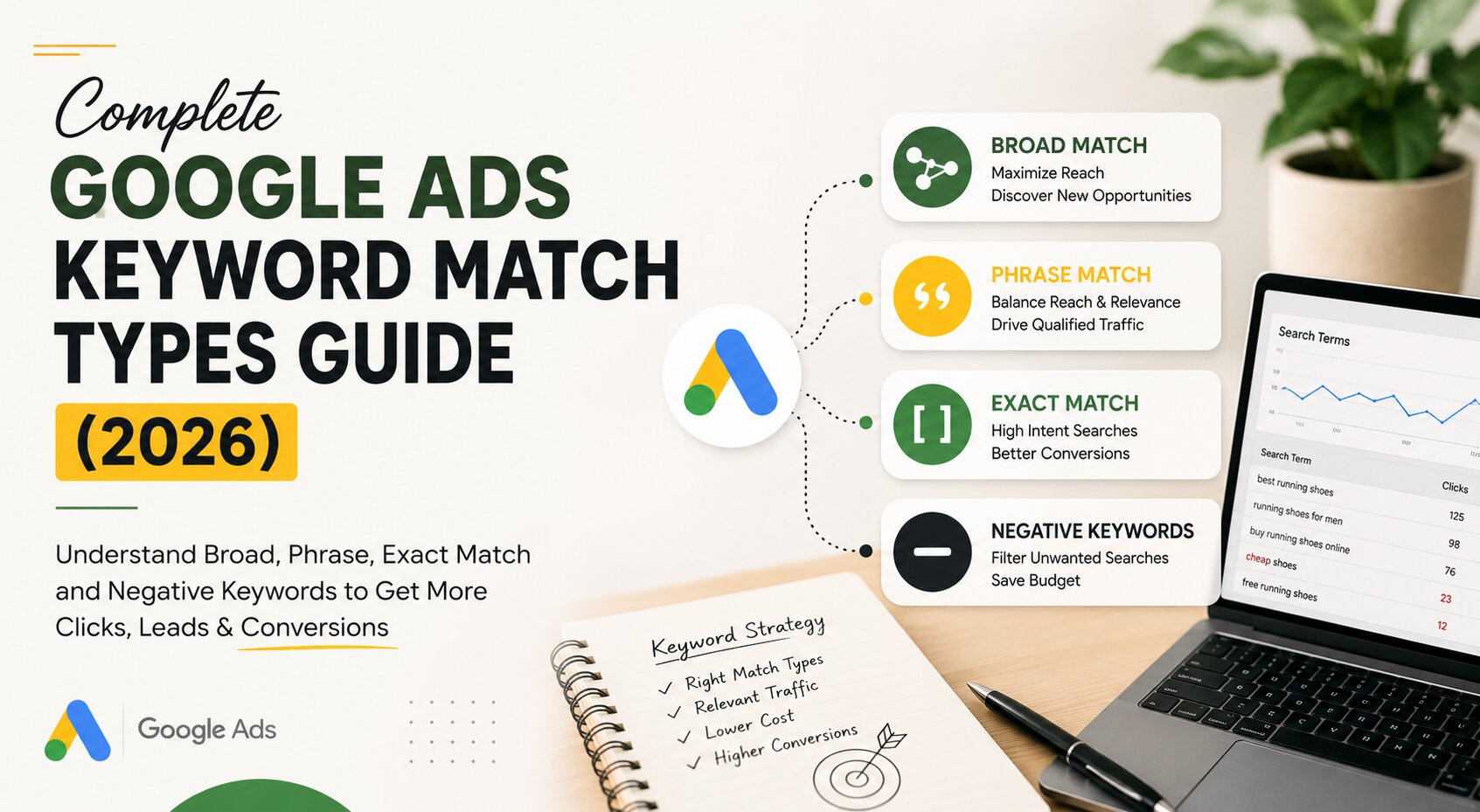
The three primary keyword match types available in 2026 are:
- Broad Match
- Phrase Match
- Exact Match
Alongside these, Negative Keywords play an equally important role by preventing unwanted searches from triggering your ads.
Why Keyword Match Types Matter
Selecting the wrong match type often leads to problems such as:
- High Cost Per Click (CPC)
- Poor Click-Through Rate (CTR)
- Low conversion rate
- Wasted ad spend
- Irrelevant search queries
Many advertisers struggling with these issues are unknowingly making the same errors covered in our guide on Google Ads mistakes that waste your budget.
Choosing the right keyword match type helps Google understand your campaign goals while ensuring your ads appear for users who are more likely to convert.
1. Broad Match
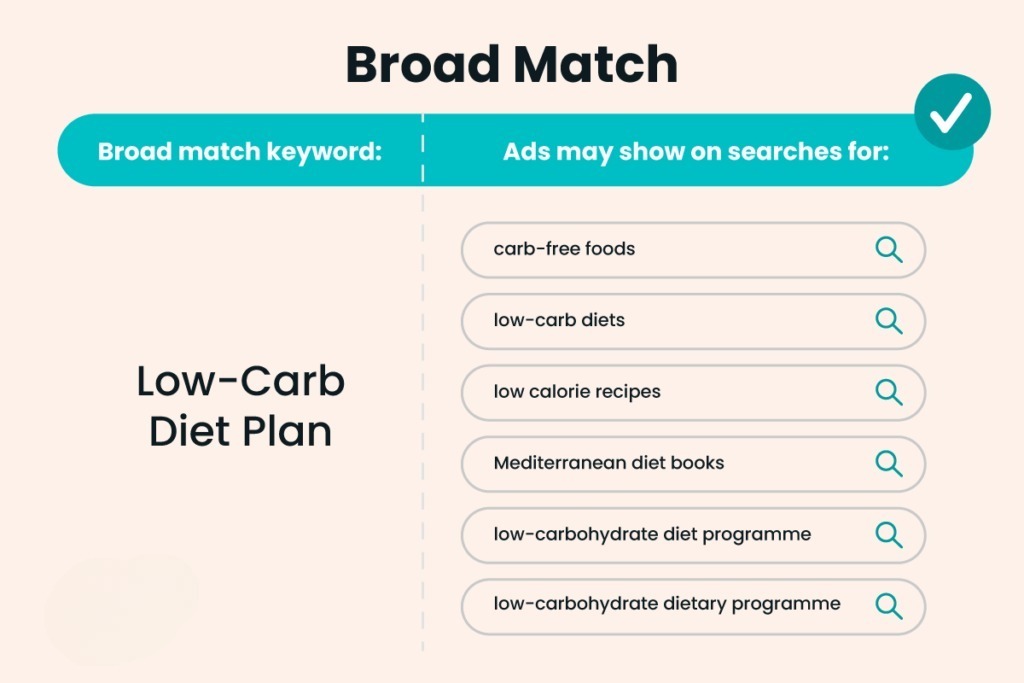
Broad Match is Google's default keyword match type.
For example:
Keyword:
running shoes
Your ad may appear for searches like:
- best running shoes
- sports shoes
- jogging footwear
- shoes for marathon
- athletic sneakers
- running shoe brands
Google uses machine learning to determine search intent rather than matching only the exact words.
Advantages
- Maximum reach
- Finds new search terms
- Great for discovering high-converting keywords
- Works well with Smart Bidding strategies
Disadvantages
- Can trigger irrelevant searches
- Requires strong negative keyword management
- May increase advertising costs if left unchecked
Broad Match works best when combined with conversion-focused bidding strategies such as Maximize Conversions or Target CPA.
2. Phrase Match
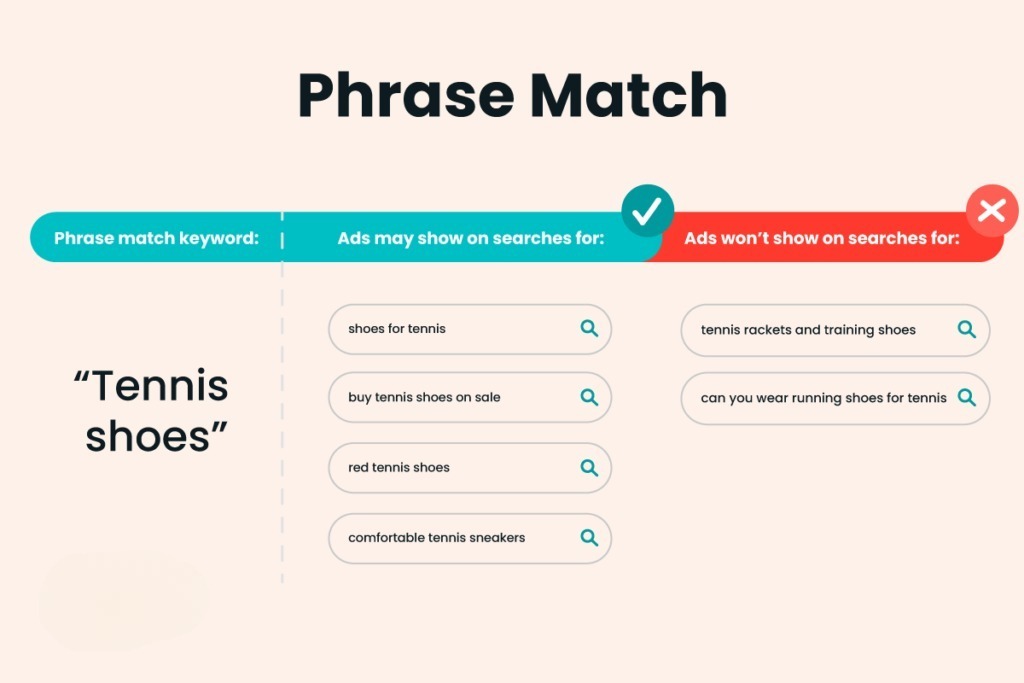
Phrase Match provides a balance between reach and control.
Example keyword:
"running shoes"
Possible searches:
- affordable running shoes
- running shoes for women
- buy running shoes online
- best running shoes
Google also considers searches with the same meaning.
Advantages
- Better control than Broad Match
- Higher relevance
- Good balance between volume and quality
- Easier optimization
Disadvantages
- Slightly lower traffic than Broad Match
- May still trigger unexpected search terms
For most advertisers, Phrase Match is an excellent starting point when launching a new campaign.
3. Exact Match
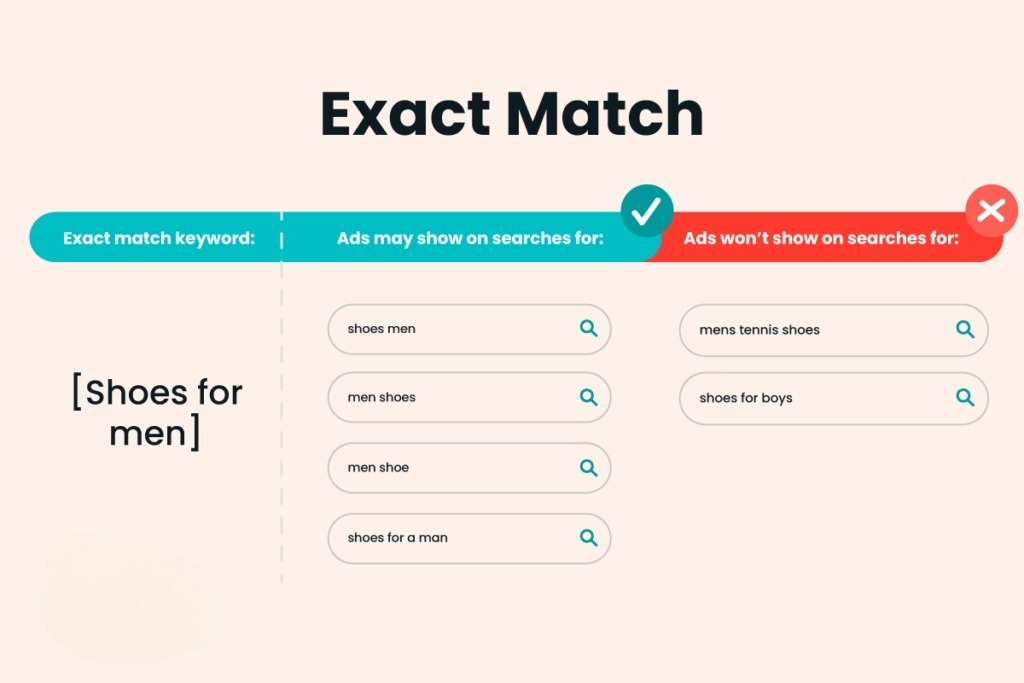
Exact Match offers the highest level of control.
Example keyword:
[running shoes]
Google can still show your ad for searches with the same meaning, intent, or close variants.
Possible searches:
- running shoes
- shoes for running
- running shoe
Advantages
- Highly targeted traffic
- Better conversion rates
- Reduced wasted spend
- Easier reporting
Disadvantages
- Lower search volume
- Slower campaign growth
- May miss new keyword opportunities
Exact Match is ideal for campaigns with proven converting keywords where profitability matters more than reach.
Broad Match vs Phrase Match vs Exact Match
| Feature | Broad | Phrase | Exact |
|---|---|---|---|
| Reach | High | Medium | Low |
| Relevance | Medium | High | Very High |
| Control | Low | Medium | High |
| Search Volume | High | Medium | Low |
| Conversion Quality | Medium | High | Very High |
| Best For | Discovery | Scaling | High-Intent Campaigns |
What About Negative Keywords?
Negative keywords prevent your ads from showing for searches that aren't relevant to your business.
For example, if you sell premium running shoes, you may want to exclude:
- free
- cheap
- used
- second hand
- repair
- DIY
Without negative keywords, Google may spend your budget on users who have no intention of purchasing.
Negative keyword optimization is one of the quickest ways to improve campaign performance.
Match Type Strategy That Works in 2026
Rather than relying on a single match type, successful advertisers combine them strategically.
A typical structure looks like this:
Campaign 1 — Broad Match
Purpose:
Discover new converting searches.
Monitor Search Terms Report regularly.
Campaign 2 — Phrase Match
Purpose:
Scale proven keywords while maintaining control.
Campaign 3 — Exact Match
Purpose:
Capture high-intent traffic using your best-performing keywords.
Don't Ignore the Search Terms Report
One of the biggest optimization opportunities lies inside the Search Terms Report.
Review it every week to:
- Find new converting keywords
- Add negative keywords
- Remove irrelevant traffic
- Build Exact Match keyword lists
This simple habit often lowers CPC while improving conversion rates.
Common Keyword Match Type Mistakes
Using Only Broad Match
Broad Match alone often brings irrelevant traffic.
Always review search terms and add negatives regularly.
Ignoring Negative Keywords
Many advertisers spend thousands on clicks that never convert simply because they haven't built a proper negative keyword list.
Mixing Different Intent Keywords
Keep separate ad groups for different user intentions.
For example:
- Buy Running Shoes
- Running Shoe Brands
- Running Shoe Reviews
Each deserves its own ads and landing page.
Not Monitoring Search Queries
Google's automation is powerful, but it still needs human oversight.
Weekly optimization is essential.
Using Exact Match for Every Keyword
While Exact Match is highly targeted, relying solely on it may limit your ability to discover new opportunities.
A balanced approach usually performs better.
Best Practices for Google Ads Keyword Match Types
- Start with Phrase Match for new campaigns.
- Use Broad Match alongside Smart Bidding and strong conversion tracking.
- Add Exact Match for proven converting keywords.
- Review Search Terms Report every week.
- Build an extensive negative keyword list.
- Group keywords based on search intent.
- Continuously test and optimize.
If you're looking to improve campaign performance beyond keyword selection, our article on How to Reduce Cost Per Click in Google Ads provides additional optimization strategies.
How Conversion Tracking Improves Keyword Performance
Keyword optimization only works effectively when conversions are tracked accurately.
Without proper tracking, it's impossible to identify which keyword match types are generating leads, purchases, or revenue.
If your Google Ads account isn't measuring conversions correctly, consider implementing Google Ads Conversion Tracking using Google Tag Manager, GA4, and enhanced conversions.
Need Help Optimizing Your Google Ads Campaigns?
Choosing the right keyword match type is only one part of running successful campaigns.
Campaign structure, bidding strategy, landing page optimization, audience targeting, ad copy, and conversion tracking all contribute to better performance.
At Scale With Clicks, we help businesses build high-performing Google Ads campaigns that generate qualified leads while maximizing return on ad spend.
Explore our Google Ads Management Services to see how we can help grow your business.
You can also visit Scale With Clicks to learn more about our digital marketing services, including SEO, Meta Ads, landing page optimization, and analytics.
Final Thoughts
Keyword match types remain one of the most important building blocks of a successful Google Ads campaign.
Broad Match helps uncover new opportunities, Phrase Match provides the ideal balance between reach and relevance, and Exact Match delivers maximum control for high-intent searches.
Instead of relying on a single match type, use them together strategically, monitor your Search Terms Report, and continuously refine your negative keyword list. Combined with accurate conversion tracking and ongoing optimization, this approach can significantly improve your campaign performance while reducing wasted ad spend.
Frequently Asked Questions (FAQs)
1. Which keyword match type is best in Google Ads?
There isn't a single best match type. Phrase Match is often the safest starting point, while Exact Match works well for high-performing keywords. Broad Match is useful for discovering new opportunities when paired with Smart Bidding.
2. Does Google still recommend Broad Match?
Yes. Google recommends Broad Match when combined with automated bidding strategies and accurate conversion tracking. However, advertisers should regularly monitor search terms and maintain a strong negative keyword list.
3. Can I use multiple match types for the same keyword?
Yes. Many advertisers use Broad, Phrase, and Exact Match versions of the same keyword to balance reach, control, and performance.
4. What is the difference between Phrase Match and Exact Match?
Phrase Match allows searches that include your keyword or have the same meaning, while Exact Match targets searches with the closest intent and provides greater control over ad visibility.
5. Are keyword match types still important in 2026?
Absolutely. Although Google's machine learning has become more advanced, keyword match types continue to influence traffic quality, campaign efficiency, and overall return on investment.
6. How often should I review my keyword performance?
It's a good practice to review the Search Terms Report at least once a week. This helps identify irrelevant searches, discover new opportunities, and improve campaign performance over time.