Google Ads
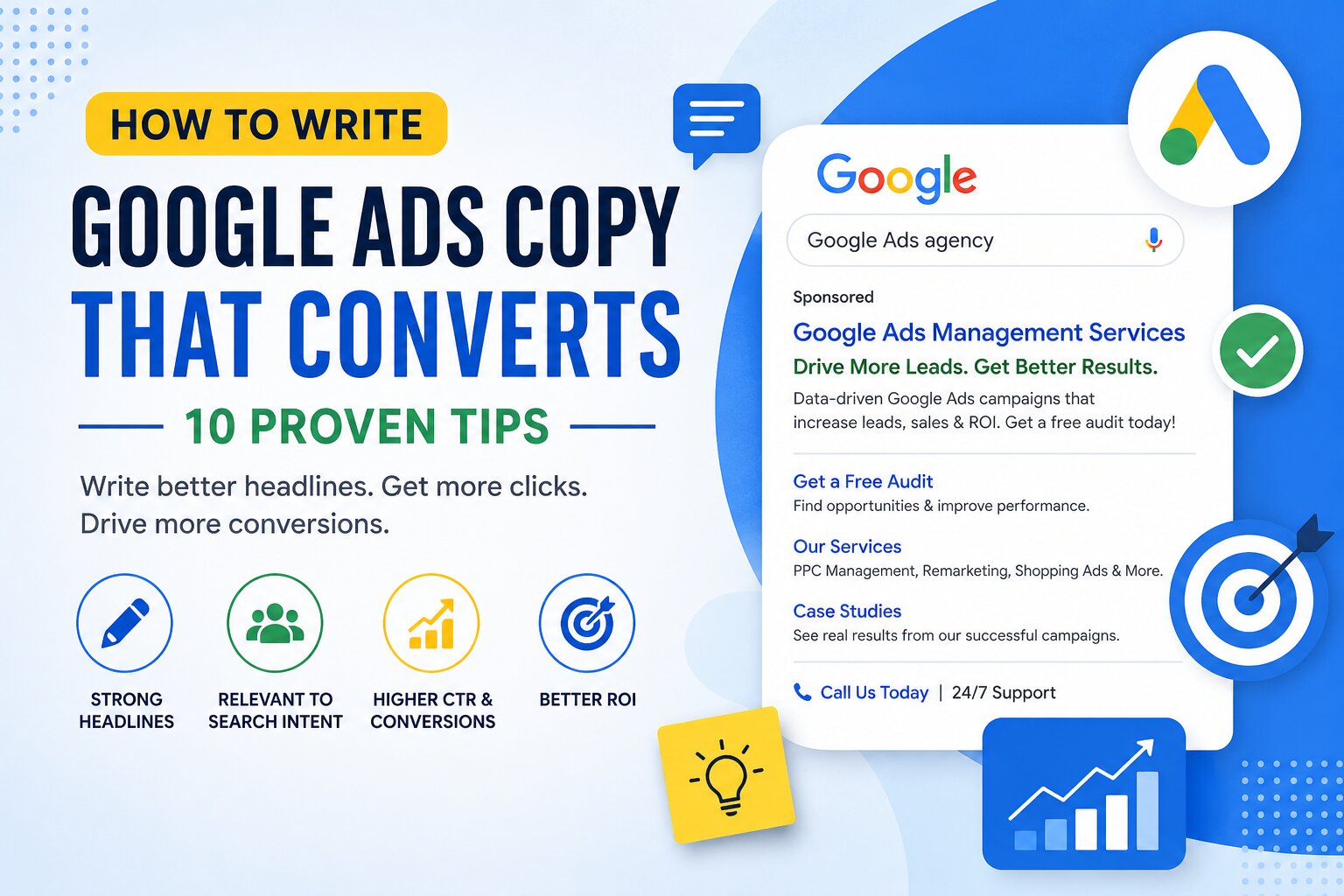
How to Write Google Ads Copy That Converts: 10 Proven Tips

Category: Google Ads
How to Write Google Ads Copy That Converts: 10 Proven Tips
Writing Google Ads copy sounds simple until you actually have to compete for attention on a crowded search results page.
You may have the right keywords, a good offer, and a well-designed landing page, but if your ad doesn't give people a reason to click, your campaign can still struggle.
The difference between an average Google Search ad and a high-performing one often comes down to the words you use.
Good Google Ads copy should do more than describe your business. It should match what the person is searching for, communicate a clear benefit, build trust, and make the next step feel easy.
In this guide, you'll learn 10 practical tips for writing Google Ads copy that can improve CTR, ad relevance, and conversions without relying on exaggerated claims or complicated copywriting formulas.
Why Google Ads Copy Matters
When someone searches on Google, they're usually looking for an answer, product, service, or solution.
Your ad has only a short amount of space to convince them that your business is worth clicking.
For example, imagine someone searches:
Google Ads agency for small business
An ad that simply says:
Digital Marketing Agency | Contact Us
doesn't give the searcher much information.
Now compare it with:
Google Ads Agency for Small Business Generate More Qualified Leads With Expert PPC Management
The second version is much more specific. It tells the user what the company does, who it serves, and what benefit they may get.
This is why ad relevance and search intent are so important.
If you're still working on your overall campaign structure, our guide on Google Ads Strategy for Small Businesses covers keyword targeting, campaign structure, landing pages, tracking, and ad copy as part of a complete strategy.
10 Proven Tips for Writing Google Ads Copy That Converts
1. Start With Search Intent
Before writing your ad, understand what the person actually wants.
This is one of the biggest differences between average PPC ad copy and effective ad copy.
Someone searching:
- "what is Google Ads"
- "Google Ads tutorial"
- "Google Ads course"
has a very different intent from someone searching:
- "hire Google Ads expert"
- "Google Ads management agency"
- "Google Ads consultant near me"
The first group may be researching.
The second group may be ready to buy.
Your ad copy should reflect that difference.
For high-intent searches, focus on:
- The specific service or product
- The user's problem
- A relevant benefit
- Your differentiator
- A clear call to action
For example:
Weak:
Digital Marketing Services | Contact Us
Better:
Google Ads Management | Generate More Qualified Leads
The second ad is much closer to the user's search intent.
If you're struggling with irrelevant clicks, take a look at our guide on 7 Costly Google Ads Mistakes That Are Wasting Your Budget.
2. Put Your Main Keyword in the Ad Naturally
Your primary keyword should appear naturally in your Google Ads headlines whenever it makes sense.
Suppose your keyword is:
Google Ads Management Services
Your headline could be:
Google Ads Management Services
Another headline could focus on the benefit:
Generate More Qualified Leads
This creates a logical connection:
Search → Keyword → Ad → Landing Page
That consistency can improve the relevance of your ad and help the user immediately understand that you've got what they're looking for.
However, don't force keywords into every headline.
Keyword stuffing can make your ads sound robotic.
Instead of:
Google Ads | Google Ads Agency | Google Ads Expert | Google Ads Services
write something more natural:
Google Ads Management That Drives Results Certified PPC Experts Get a Free Campaign Audit
The goal isn't to repeat the keyword as many times as possible.
The goal is to make the ad feel relevant.
3. Focus on Benefits, Not Just Features
One of the most common problems with Google Ads copy is that businesses talk about themselves too much.
For example:
We provide professional digital marketing services with experienced professionals.
That's a feature-based statement.
But the person searching isn't necessarily interested in your internal team structure.
They want to know what's in it for them.
Instead, write:
Generate More Leads With Data-Driven Google Ads
Or:
Reduce Wasted Spend With Expert PPC Management
The difference is simple:
Feature: What you provide.
Benefit: What the customer gets.
Benefits that can work well in Google Ads include:
- Generate more qualified leads
- Increase online sales
- Reduce wasted ad spend
- Get more calls
- Reach high-intent customers
- Improve conversion rates
- Scale profitable campaigns
- Track every conversion
Just make sure your claims are accurate and supported by your actual offer.
4. Make Your Headlines Do Different Jobs
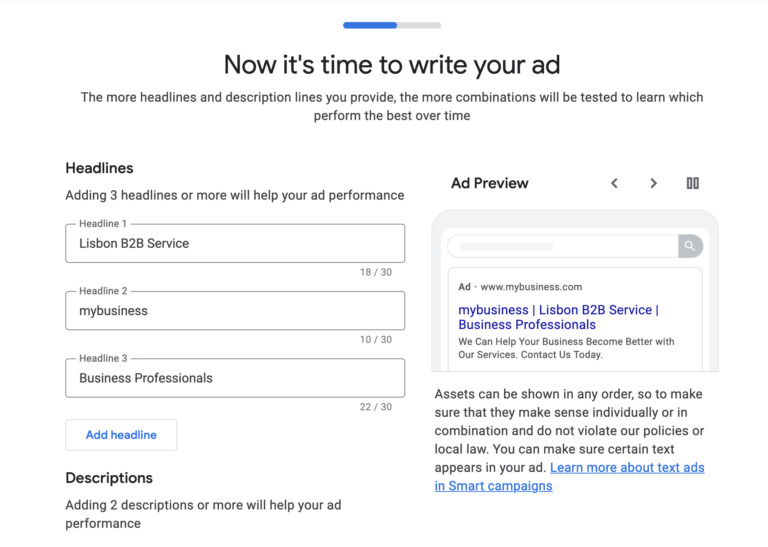
Responsive Search Ads give advertisers multiple headline and description options.
Don't write ten versions of essentially the same headline.
Instead, give each headline a purpose.
For example:
Keyword headline
Google Ads Management Services
Benefit headline
Generate More Qualified Leads
Trust headline
Experienced PPC Specialists
Offer headline
Get a Free Google Ads Audit
Differentiator headline
Data-Driven Campaign Management
CTA headline
Book Your Free Consultation
This gives Google different combinations to test while allowing your ad to communicate several important selling points.
Think of your headlines as building blocks rather than individual advertisements.
A strong combination might communicate:
What you offer + benefit + reason to trust you + CTA
5. Use Numbers When They Actually Mean Something
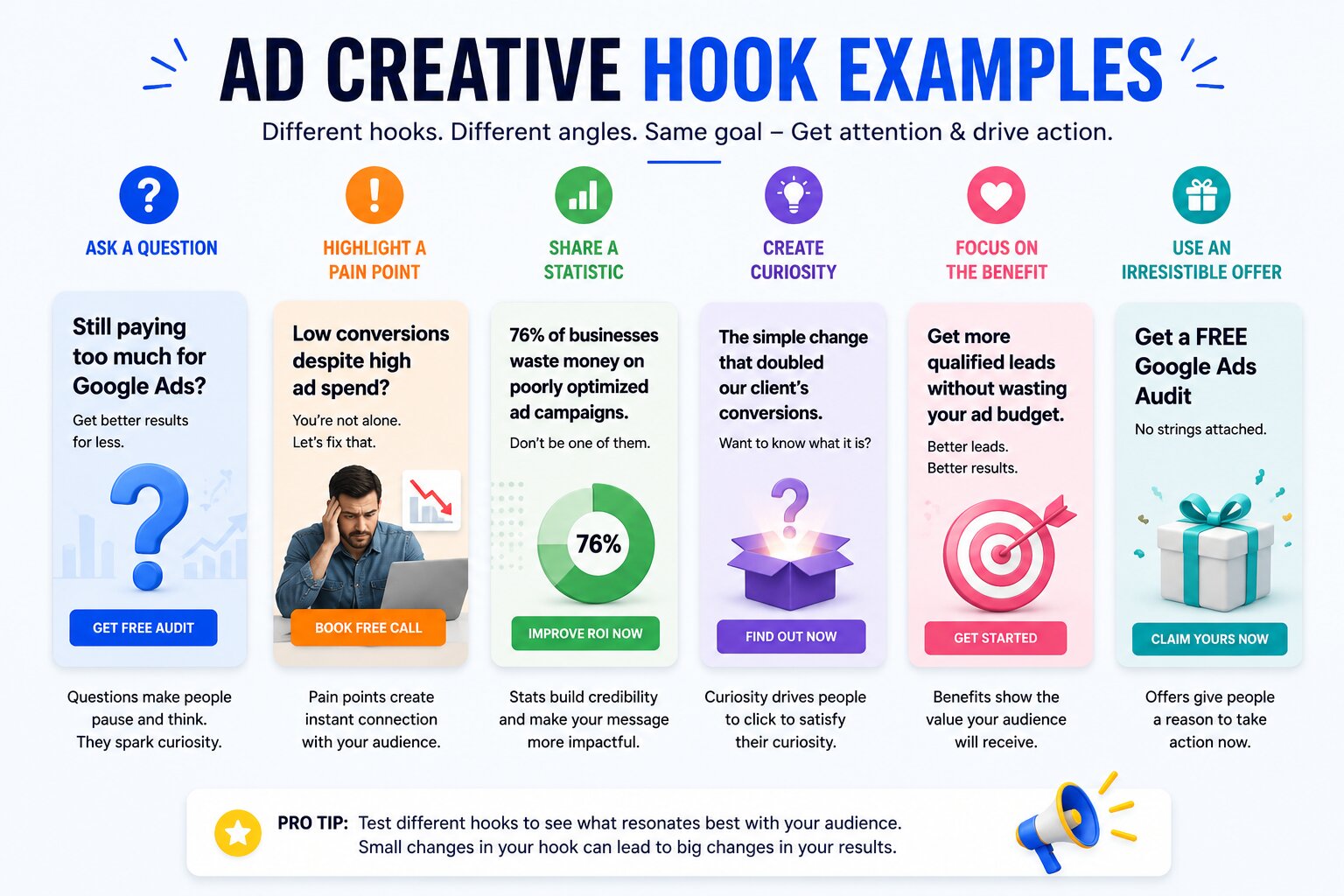
Numbers can make ad copy easier to scan and can help your message stand out.
For example:
10+ Years of PPC Experience
or:
500+ Campaigns Optimized
or:
19+ Industries Served
can communicate information quickly.
You can also use numbers to make an offer more specific:
Get Your Google Ads Audit in 24 Hours
But don't add random numbers simply because they look attractive.
Every statistic should be genuine.
For example, instead of making an unsupported claim like:
Get 10X More Leads Guaranteed
use something you can actually substantiate:
Data-Driven Google Ads Management
Trust is more valuable than a flashy headline.
6. Address the Customer's Pain Point
People don't search for businesses because they enjoy clicking ads.
They search because they have a problem.
Your ad copy should show that you understand the problem.
For example, if a business owner searches:
Google Ads not converting
they probably don't need an advertisement explaining what Google Ads is.
They're looking for a solution.
An ad could say:
Google Ads Not Converting? Find Wasted Spend & Fix Campaign Issues
Similarly, if someone searches:
expensive Google Ads CPC
your copy could focus on efficiency:
Reduce Google Ads CPC Cut Wasted Clicks & Improve Campaign Efficiency
This approach makes your ad feel more relevant because it speaks directly to the reason behind the search.
You can also read our guide on How to Reduce Cost Per Click in Google Ads for more ways to improve campaign efficiency.
7. Write a Clear Call to Action
A Google Ads user shouldn't have to figure out what happens after clicking your ad.
Give them a clear next step.
Weak CTAs include:
Learn More
There's nothing wrong with "Learn More," but it may not always be the strongest option.
Depending on your offer, consider:
- Get a Free Audit
- Request a Quote
- Book a Consultation
- Get Started Today
- Shop Now
- Get Your Free Strategy
- Schedule a Call
- Request Pricing
- Compare Plans
The CTA should match the user's level of intent.
For example, someone searching for a service may respond well to:
Book a Free Consultation
while someone searching for a product may be better served by:
Shop Now
Don't make the CTA more aggressive than the actual offer.
8. Match the Ad With the Landing Page
Getting the click is only half the job.
If your ad promises one thing and your landing page talks about something completely different, users are likely to leave.
For example:
Ad:
Google Ads Management for SaaS Companies Generate More Qualified Demo Requests
Landing page:
Digital Marketing Services for All Businesses
There's a disconnect.
Instead, the landing page should continue the same message:
Google Ads Management for SaaS Companies Generate More Qualified Demo Requests
This creates a consistent journey:
Keyword → Ad → Landing Page → Conversion
Your landing page should also have:
- A clear headline
- Relevant service information
- Strong benefits
- Trust signals
- Testimonials or case studies where available
- Clear CTA
- Fast loading speed
- Mobile-friendly design
If you need help with the broader campaign setup, you can explore Google Ads Management Services.
9. Test Different Angles Instead of Guessing
You rarely write the perfect Google Ads copy on the first attempt.
That's why testing matters.
Instead of creating five nearly identical ads, test different messaging angles.
For example:
Ad angle 1 — Results
Generate More Qualified Leads With Google Ads
Ad angle 2 — Cost
Reduce Wasted Google Ads Spend
Ad angle 3 — Expertise
Google Ads Experts Managing Your Campaign
Ad angle 4 — Offer
Get a Free Google Ads Campaign Audit
Ad angle 5 — Problem
Google Ads Not Converting? We Can Help
After collecting enough data, compare performance based on meaningful metrics.
Look beyond CTR.
Also consider:
- Conversion rate
- Cost per conversion
- Conversion volume
- Conversion value
- Search terms
- Quality Score
- Impression share
A headline can generate a high CTR but still produce poor-quality leads.
The objective isn't simply to get more clicks.
It's to get more valuable clicks.
10. Don't Forget Ad Assets
Your primary ad copy isn't the only thing that can influence how much information your search ad communicates.
Use relevant ad assets to give users additional reasons to engage.
Depending on your campaign, these may include:
- Sitelinks
- Callouts
- Structured snippets
- Call assets
- Location assets
- Image assets where applicable
- Promotion assets
- Price assets
For example, a Google Ads agency could use sitelinks such as:
- Google Ads Services
- Case Studies
- Conversion Tracking
- Contact Us
This gives users more ways to reach the most relevant page.
It also helps your search presence communicate more information without trying to cram everything into the headlines.
Google Ads Copy Example: Before vs After
Let's put the principles together.
Before
Digital Marketing Agency Best Services Available Contact Us Today Professional Marketing Solutions
The problem?
It's generic.
It doesn't clearly communicate:
- What service is being offered
- Who it's for
- What benefit the customer receives
- Why they should choose the business
- What action they should take
After
Google Ads Management Services Generate More Qualified Leads Data-Driven PPC Campaigns Get a Free Campaign Audit
This version is more specific and gives the user several reasons to consider clicking.
The exact wording should always be adapted to the actual business, keyword, offer, audience, and landing page.
A Simple Formula for High-Converting Google Ads Copy
If you're struggling to write your first version, use this simple framework:
Keyword + Benefit + Differentiator + CTA
For example:
Google Ads Management Generate More Qualified Leads Experienced PPC Specialists Book a Free Consultation
For ecommerce:
Shop Premium Running Shoes Free Shipping on Eligible Orders Multiple Styles Available Shop Now
For a local service:
Emergency Plumber in Delhi Same-Day Service Available Experienced Local Team Call for a Quick Quote
The formula isn't meant to make every ad sound identical.
It's simply a starting point.
Your final copy should reflect the actual search intent and the strongest selling point of your business.
Common Google Ads Copy Mistakes to Avoid
Even experienced advertisers can fall into these traps.
Writing generic copy
"Best quality services at affordable prices" could describe almost any business.
Using unsupported claims
Avoid claims such as "No. 1," "guaranteed results," or unrealistic performance promises unless they can genuinely be substantiated.
Ignoring search intent
An informational search and a transactional search should not receive the same message.
Focusing only on CTR
A high CTR doesn't automatically mean profitable advertising.
Sending every click to the homepage
Relevant searches deserve relevant landing pages.
Using the same copy everywhere
Different products, services, locations, and audiences may need different messaging.
Forgetting conversion tracking
Without reliable conversion data, it's difficult to know which ads are actually producing business results.
If your tracking isn't properly configured, read How to Set Up Conversion Tracking in Google Ads before making major optimization decisions.
How to Improve Google Ads Copy Over Time
Google Ads copywriting isn't a one-time task.
Search behavior changes. Competitors change their offers. Your landing pages change. Your business may introduce new services or promotions.
Review your ads regularly and ask:
- Which headlines generate the strongest engagement?
- Which ads generate actual conversions?
- Which search terms are producing qualified traffic?
- Are users responding to benefits or offers?
- Are competitors highlighting something we're missing?
- Does the ad still match the landing page?
- Are there new objections we should address?
You can also use your search terms report to discover language customers are actually using.
Those phrases can provide ideas for future headlines, descriptions, landing pages, and content.
This is one reason PPC and SEO can work well together. Paid search data can reveal commercial keywords and customer language that may also be useful for your organic strategy. If you're working on both channels, explore SEO Services as part of a broader acquisition strategy.
Final Thoughts
Great Google Ads copy isn't about using clever words.
It's about relevance.
The strongest ads usually make it obvious that the advertiser understands what the searcher wants and can provide a credible solution.
Remember the 10 principles:
- Start with search intent.
- Use your main keyword naturally.
- Focus on benefits instead of features.
- Give your headlines different jobs.
- Use meaningful numbers.
- Address the customer's pain point.
- Include a clear CTA.
- Match the ad with the landing page.
- Test different messaging angles.
- Use relevant ad assets.
Most importantly, don't judge your Google Ads copy by clicks alone.
A successful ad should attract the right people, set the right expectations, and move those people toward a valuable action.
When your keyword targeting, ad copy, landing page, conversion tracking, and campaign strategy all work together, Google Ads becomes much more than a source of traffic—it becomes a measurable acquisition channel.
If you're looking to improve your overall PPC performance, you can visit Scale With Clicks or explore its Google Ads Management Services for a more structured approach to campaign strategy, optimization, and conversion-focused advertising.
Frequently Asked Questions
What makes Google Ads copy effective?
Effective Google Ads copy is relevant to the user's search intent, communicates a clear benefit, builds trust, and provides a compelling next step. The ad should also be consistent with the landing page.
How do I improve my Google Ads CTR?
Start by improving keyword-to-ad relevance, writing stronger benefit-focused headlines, addressing search intent, testing different messaging, and using relevant ad assets. However, don't optimize for CTR alone—conversion quality matters more.
Should I include keywords in Google Ads headlines?
Yes, when it makes sense. Including relevant keywords can make your ad more closely aligned with the user's search. However, prioritize natural and persuasive language instead of keyword stuffing.
How many Google Ads headlines should I write?
For Responsive Search Ads, provide multiple distinct headlines that cover different angles such as keywords, benefits, trust, offers, pain points, and CTAs. Avoid creating several headlines that communicate exactly the same message.
Does better ad copy improve Quality Score?
Relevant and engaging ad copy can contribute to better expected CTR and ad relevance, which are components used in Google's Quality Score system. Quality Score is also influenced by landing page experience. For a deeper explanation, read Google Ads Quality Score Explained.
Should I focus on CTR or conversions?
Conversions and conversion value are generally more important than CTR alone. A high CTR is useful only when the resulting traffic is relevant and contributes to your business goals.
Can Google Ads copy improve conversion rates?
Yes, better ad copy can improve the quality and relevance of traffic reaching your website. However, conversion rate also depends heavily on the landing page, offer, pricing, user experience, targeting, and conversion tracking.