SEO
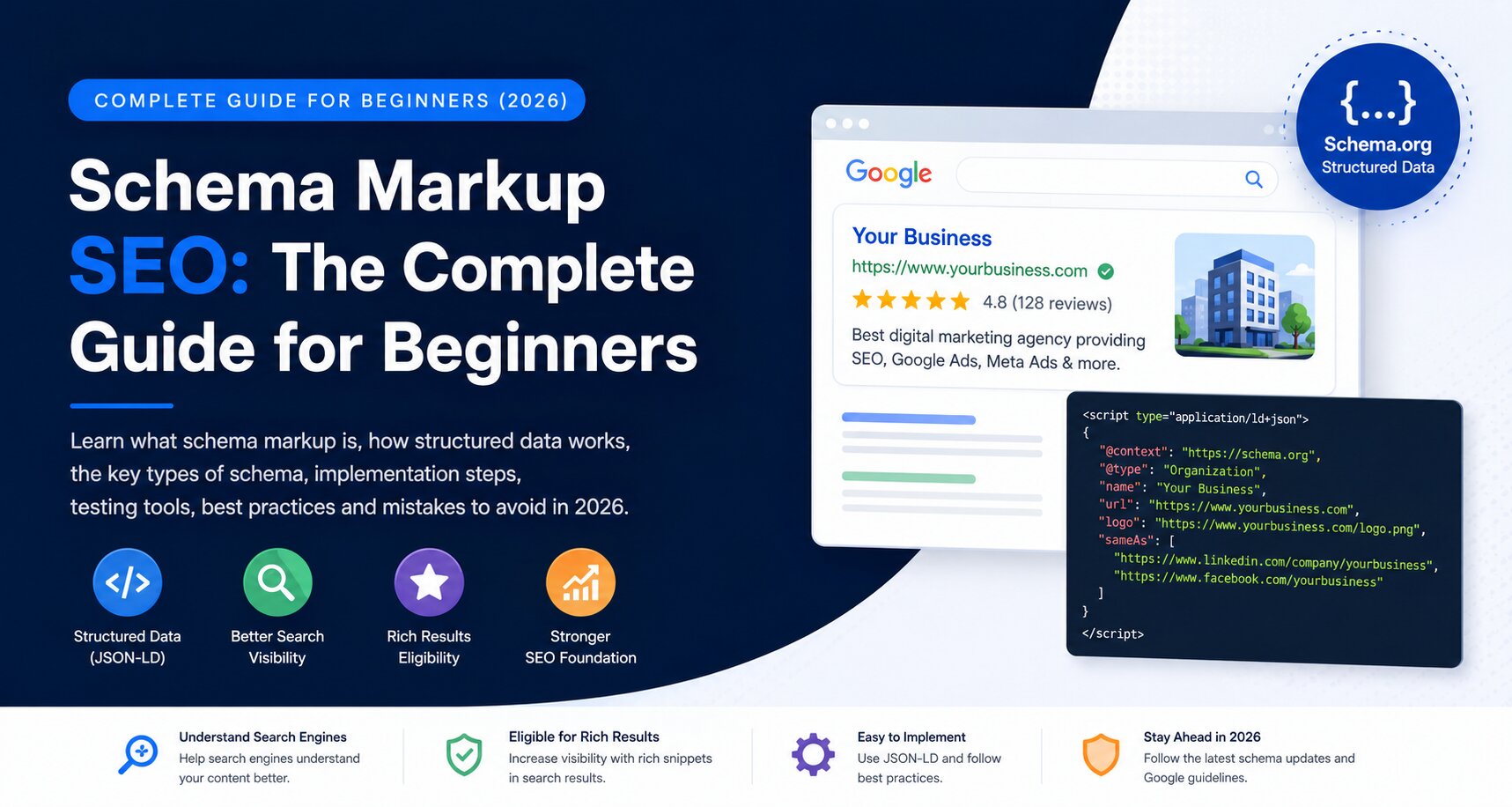
Schema Markup SEO: Complete Guide for Beginners (2026)

Category: SEO
Schema Markup SEO: Complete Guide for Beginners (2026)
Getting a website to rank on Google is no longer just about adding keywords to a page. Search engines need to understand what your content means, who created it, what your business does, and how different pieces of information on your website are connected.
This is where schema markup SEO comes into play.
Schema markup, also called structured data, helps search engines understand the meaning and context of your website content. Instead of simply seeing a collection of words and links, search engines can identify things such as an organization, article, product, service, event, person, or local business.
For businesses investing in SEO, schema markup can be an important part of a technically sound website.
However, there is a common misconception: adding schema markup does not automatically improve rankings. Its main purpose is to help search engines understand eligible content and, where supported and appropriate, potentially make pages eligible for enhanced search appearances.
In this guide, we'll explain what schema markup is, how it works, the most useful schema types, how to implement it, and the mistakes you should avoid in 2026.
What Is Schema Markup?
Schema markup is structured information added to a webpage to help search engines understand the content on that page.
The vocabulary used for this structured data comes from Schema.org, a collaborative project used to define entities and properties that describe different types of information.
For example, imagine you have a page about your digital marketing agency.
A normal webpage might contain:
Scale With Clicks is a performance marketing agency offering Google Ads, Meta Ads, SEO and conversion tracking services.
With schema markup, you can provide structured information that identifies the business as an organization and describes relevant properties such as its name, website, logo, services and contact information.
Search engines can then use this information as another source of context about your website.
This is one reason schema markup for SEO is useful as part of a broader technical SEO strategy.
If you're also working on your site's overall organic visibility, our practical guide on How to get your first 1,000 organic visitors covers the larger SEO process.
What Is Structured Data in SEO?
Structured data is a standardized format for communicating information about a webpage to search engines.
Think of it as giving search engines additional context.
For example:
Without structured data:
"This page is about a marketing agency."
With structured data:
"This page represents an organization called Scale With Clicks, which provides digital marketing services."
That distinction can help search engines better understand the entities and relationships represented on a page.
Google supports structured data for a number of search features. However, Google makes it clear that adding valid structured data doesn't guarantee that a page will receive a rich result. Eligibility, quality, relevance and other factors still matter.
So don't think of schema markup as a ranking shortcut.
Think of it as better communication between your website and search engines.
How Does Schema Markup Work?
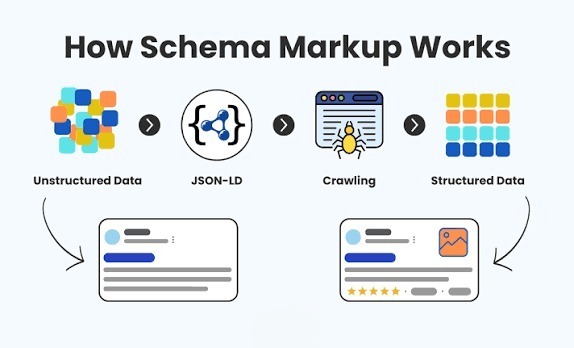
Schema markup generally works through three components:
- Schema.org vocabulary
- A structured data format
- Information describing the webpage
One of the most popular formats is JSON-LD.
JSON-LD allows structured data to be added separately from the visible HTML content of a page.
A simplified example looks like this:
{
  "@context": "https://schema.org",
  "@type": "Organization",
  "name": "Scale With Clicks",
  "url": "https://scalewithclicks.com/"
}
This tells search engines that the entity being described is an organization and provides its name and website.
For most modern websites, JSON-LD is generally the easiest schema format to maintain because it keeps structured data separate from the main page markup.
What Is Schema.org?
Schema.org is the vocabulary used to describe different entities and their properties using structured data.
It contains schemas for many different types of information, including:
- Organization
- LocalBusiness
- Person
- Article
- Product
- Event
- Service
- WebSite
- BreadcrumbList
- Review
- Recipe
- VideoObject
Not every Schema.org type is supported as a Google rich-result feature.
This distinction is important.
You can use Schema.org vocabulary to describe information, but Google's search documentation determines which structured data types can make a page eligible for particular search features.
That's why blindly adding every available schema type is not a good SEO structured data strategy.
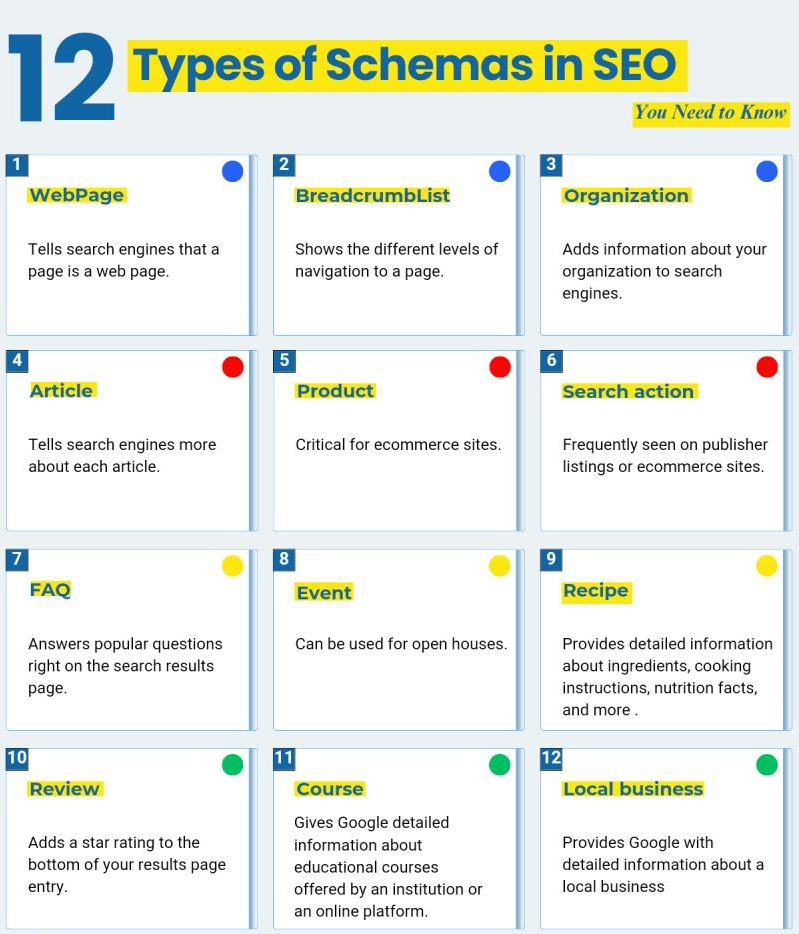
Most Important Types of Schema Markup
The right schema depends on the page and the information it contains.
Here are some of the most useful types for websites.
1. Organization Schema
Organization schema helps describe a company or organization.
It can include information such as:
- Business name
- Logo
- Website
- Contact information
- Social profiles
- Business identifiers
For a company's main website, Organization schema can be particularly useful for establishing the identity of the business.
For example, a digital marketing agency may use Organization schema on its main website to clearly identify the company behind the website.
2. LocalBusiness Schema
LocalBusiness schema is designed for businesses that operate at a physical location or serve customers locally.
Depending on the business and the applicable subtype, information may include:
- Business name
- Address
- Telephone number
- Opening hours
- Website
- Location
- Services
Local businesses should make sure the information in their structured data matches the information displayed to users.
Never add fictional locations, opening hours or other information simply because you think it might help SEO.
3. Article Schema
Article schema can be used on editorial content such as blog posts and articles.
Useful information can include:
- Headline
- Author
- Date published
- Date modified
- Main image
- Publisher
For a content-heavy website, Article schema can help search engines better understand that a particular page represents an article.
It is particularly relevant for websites that regularly publish guides, tutorials, news or educational content.
4. Product Schema
Product structured data is relevant to ecommerce websites.
Depending on the implementation, product markup can describe information such as:
- Product name
- Image
- Description
- Brand
- Offers
- Price
- Availability
- Reviews
Product structured data is more specialized than basic Organization or Article schema, so ecommerce websites should implement it carefully and keep the markup synchronized with the actual product information.
5. BreadcrumbList Schema
Breadcrumb structured data describes the hierarchy of a webpage.
For example:
Home → SEO → Technical SEO → Schema Markup
Breadcrumbs can help search engines understand where a page sits within the site's structure.
They are particularly useful for websites with many categories and content levels.
6. WebSite Schema
WebSite structured data can describe information about a website itself.
It can help search engines understand the site's identity and certain site-level information.
For larger websites, this can work alongside Organization and other relevant structured data.
Schema Markup Benefits for SEO
So, does schema markup improve SEO?
It can support your SEO strategy, but it is important to understand what it does and does not do.
Better Content Understanding
Structured data provides explicit information about the entities represented on a page.
This can help search engines understand your content more accurately.
Eligibility for Rich Results
Certain structured data implementations can make eligible pages capable of appearing with enhanced search features.
These can make a result more visually informative and potentially improve how users interact with it.
However, eligibility does not mean Google will always show the enhanced result.
Better Entity Understanding
Schema can help establish relationships between entities.
For example:
Organization → Website → Author → Article → Service
Creating a consistent structure across your website can make it easier for search engines to understand how different pages relate to one another.
Stronger Technical SEO Foundation
Schema markup is one part of technical SEO.
It should be considered alongside:
- Crawlability
- Internal linking
- Page speed
- Mobile usability
- Canonical URLs
- XML sitemaps
- Indexing
- Content quality
If you're working on the broader SEO side of your website, you can also explore our SEO Services to see how technical and content optimization can work together.
How to Add Schema Markup to a Website
Adding schema markup isn't necessarily complicated, but it needs to be done accurately.
Step 1: Identify the Page Type
First ask:
What is this page actually about?
For example:
- Homepage → Organization / WebSite
- Blog post → Article
- Product page → Product
- Local business page → LocalBusiness
- Service page → Service
- Event page → Event
Don't choose schema based solely on the keyword you're targeting.
Choose it based on the actual content of the page.
Step 2: Select Relevant Properties
Once you've selected the schema type, identify the properties that accurately describe the page.
Only include information that genuinely applies.
For example, don't add a five-star rating to a service page simply because you want review stars in Google.
Step 3: Generate JSON-LD
JSON-LD is commonly used to implement structured data.
A simple Article example could look like:
{
  "@context": "https://schema.org",
  "@type": "Article",
  "headline": "Schema Markup SEO: Complete Guide for Beginners",
  "author": {
    "@type": "Person",
    "name": "Vinay Yadav"
  },
  "publisher": {
    "@type": "Organization",
    "name": "Scale With Clicks"
  }
}
The actual implementation should contain accurate information for the specific page.
Step 4: Add It to the Website
Depending on your website technology, JSON-LD can be added directly to the HTML or generated dynamically through your CMS or website framework.
If your website is built with WordPress, plugins can simplify implementation.
For custom websites, developers can add JSON-LD directly to the page template or component.
Step 5: Test the Markup
Never assume that schema works simply because you've added the code.
Google recommends testing structured data with the Rich Results Test and checking how Google sees the page using Search Console.
After deployment, monitor your structured data reports and fix errors that appear.
This is especially important when changing website templates.

Schema Markup Testing Tools
There are several useful tools for checking structured data.
Google Rich Results Test
Google's Rich Results Test can help determine whether your structured data is eligible for supported rich-result features and identify issues.
Google Search Console
Search Console is useful after implementation because it can help you monitor structured data and rich-result-related reports where applicable.
If you are already working on analytics and tracking, it's worth making sure your Search Console, GA4 and website measurement setup are all properly connected.
Our GA4 Setup Guide for Beginners explains how to build a stronger measurement foundation.
Schema.org Validator
Schema.org also provides tools and documentation for validating and understanding schema vocabulary.
Remember that a schema being technically valid on Schema.org does not necessarily mean Google will use it for a rich result.
Common Schema Markup Mistakes
Schema markup is relatively easy to add but surprisingly easy to misuse.
1. Adding Schema That Doesn't Match the Page
If your page is about SEO services, don't mark it up as a product simply because you want product-style search features.
The markup should accurately represent the content.
2. Adding Fake Reviews
Don't manufacture ratings or reviews.
Structured data should reflect information that actually exists on the page and follows Google's guidelines.
3. Marking Up Hidden Content
Don't add structured data for information users cannot access when the relevant guidelines require that information to be visible.
4. Using Every Schema Type
More schema doesn't automatically mean better SEO.
A page doesn't need ten different schema types just because they're available.
Use the markup that genuinely describes the page.
5. Forgetting to Update Schema
If you change:
- Business name
- Author
- Product price
- Availability
- Article date
- Service information
make sure the structured data is updated too.
Outdated schema can create inconsistencies between your page and its markup.
6. Assuming Schema Guarantees Rankings
This is probably the biggest misconception.
Schema markup is not a shortcut to position one.
You still need useful content, strong internal linking, good technical SEO, relevant backlinks, a fast website and a strong overall user experience.
For example, if you're publishing SEO content regularly, updating older articles can be just as important as adding structured data. Our guide on Optimizing Existing Blog Posts covers this process in more detail.
Does Schema Markup Improve Google Rankings?
There is no simple "yes" answer.
Schema markup itself should not be treated as a direct ranking hack.
Its value is mainly in helping search engines understand your content and potentially making eligible pages available for enhanced search features.
Think about it this way:
Good content + technical SEO + structured data + strong website architecture = a better overall search foundation.
Not:
Schema markup = higher rankings.
That's an important distinction for anyone implementing schema markup SEO in 2026.
Is FAQ Schema Still Useful in 2026?
This is an area where outdated SEO advice causes confusion.
Google removed documentation for the FAQ rich result feature in 2026 because FAQ rich results are no longer shown in Google Search.
That doesn't mean you should remove useful FAQs from your website.
FAQs can still be valuable for users and can help answer common objections and questions.
The important point is that you should not add FAQ schema expecting the old FAQ rich-result treatment in Google Search.
Focus on useful content first rather than adding structured data purely to obtain a visual search enhancement.
Schema Markup and AI Search
Search is changing quickly, with AI-powered search experiences becoming a bigger part of how people discover information.
That makes clear, structured and well-organized website content increasingly important.
However, schema should not be viewed as an "AI ranking trick."
Google's current guidance around generative AI features continues to emphasize the importance of useful, original, non-commodity content and good SEO fundamentals.
Schema can contribute additional machine-readable context, but it cannot compensate for thin or unhelpful content.
For businesses, the best approach is still to build pages that clearly answer real customer questions and then use structured data where it genuinely describes those pages.
Schema Markup SEO Checklist for 2026
Before publishing structured data, run through this checklist:
- Identify the actual purpose of the page
- Choose an appropriate Schema.org type
- Use JSON-LD where practical
- Add only relevant properties
- Keep schema information accurate
- Make sure visible content matches structured data
- Don't create fake reviews or ratings
- Test the implementation
- Check Google Search Console after deployment
- Monitor errors after website/template changes
- Update structured data when page information changes
- Don't expect schema alone to improve rankings

Final Thoughts
Schema markup SEO is not about stuffing more code into your website.
It's about giving search engines better context about the content and entities already present on your pages.
For a business website, that could mean clearly identifying the organization, services and website. For a blog, it could mean helping search engines understand the article, author and publisher. For ecommerce, it can mean providing structured product information.
The key is relevance.
Don't add schema simply because someone told you that "more schema means better SEO." Start with the content, understand what the page represents, select the appropriate structured data and then validate the implementation.
And remember that schema is only one part of a successful SEO strategy.
Your website still needs useful content, strong internal links, good technical foundations, fast loading times and pages that genuinely satisfy search intent.
If you want to improve the broader performance of your website, you can explore Scale With Clicks and its SEO Services, alongside Conversion Tracking Services if you need better measurement of traffic and conversions.
For businesses using paid acquisition alongside organic search, our Google Ads Services and Meta Ads Services can also complement an SEO strategy.
The goal isn't simply to help Google understand your website.
It's to build a website that Google can understand and users actually want to visit.
Frequently Asked Questions
What is schema markup in SEO?
Schema markup is structured data added to webpages to help search engines understand the meaning and context of the content. It uses standardized vocabulary from Schema.org.
Does schema markup improve SEO?
Schema markup can support SEO by helping search engines understand page content and potentially making eligible pages available for certain enhanced search features. However, it does not guarantee higher rankings or rich results.
What is the best schema markup format?
JSON-LD is a commonly used format for implementing structured data because it keeps the structured information separate from the main HTML content and is relatively easy to maintain.
What schema should I use for a blog?
Article schema is commonly appropriate for blog articles, provided the markup accurately describes the content and follows Google's structured data guidelines.
What schema should a local business use?
A relevant LocalBusiness type can be appropriate for a local business. The exact implementation should reflect the actual business, location and information visible on the website.
Can schema markup hurt SEO?
Incorrect or misleading structured data can create problems and may make markup ineligible for search features. Always ensure that structured data accurately represents the page and follows Google's guidelines.
Is FAQ schema still useful in 2026?
Google's FAQ rich-result feature is no longer shown in Google Search as of 2026. FAQs can still be useful for users, but you shouldn't implement FAQ schema expecting the previous FAQ rich-result treatment.