Facebook Ads
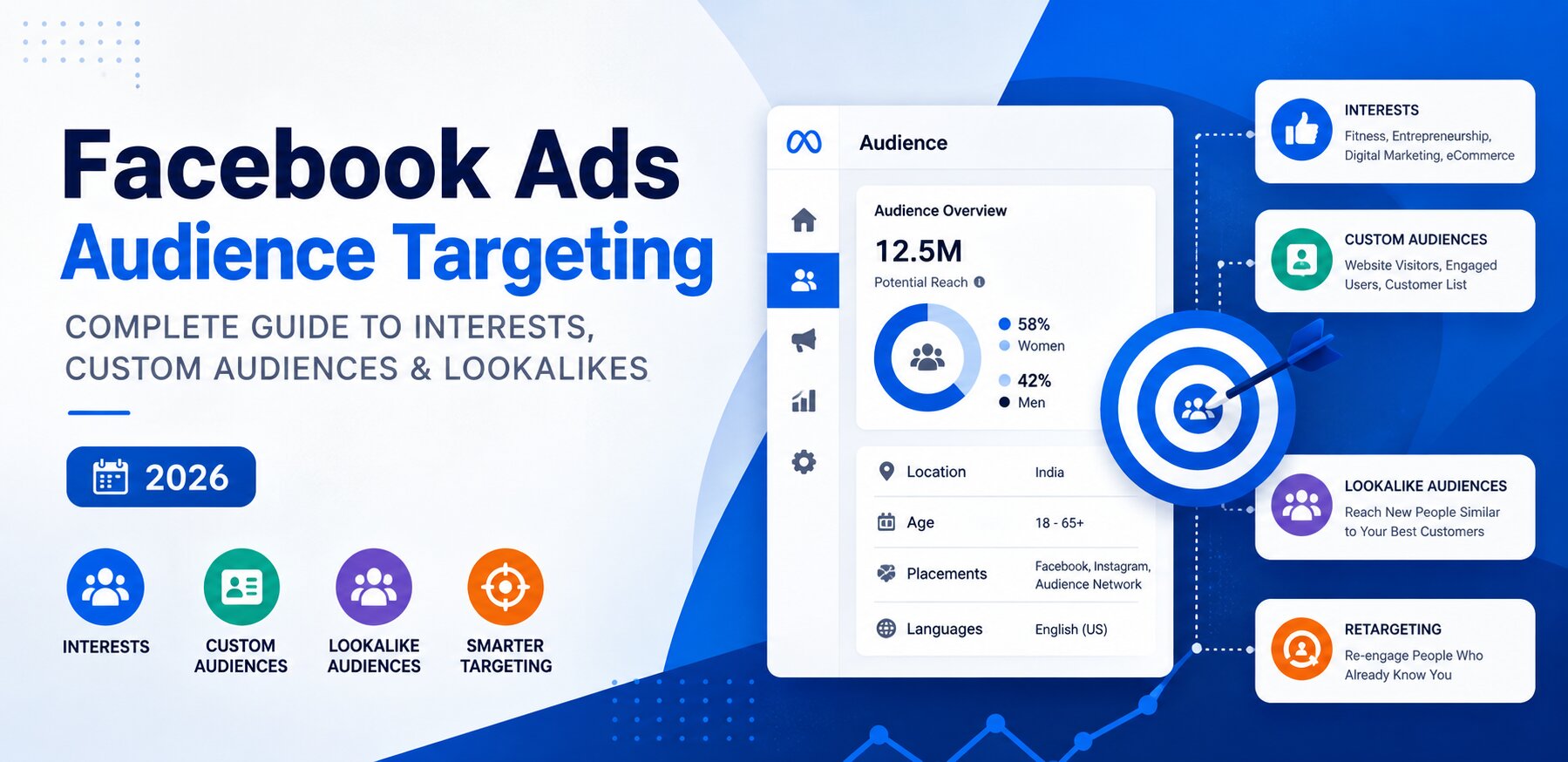
Facebook Ads Audience Targeting - Complete Guide (2026)

Category: Facebook Ads
Facebook Ads can put your business in front of thousands—or even millions—of potential customers. But reaching a large audience doesn't automatically mean you'll get good leads or sales.
The real challenge is finding people who are likely to take the action you want.
That's where Facebook Ads audience targeting comes in.
In 2026, audience targeting on Meta is very different from the old approach of simply selecting a few interests and narrowing the audience as much as possible. Meta's machine learning now plays a much bigger role in finding people likely to convert, which means advertisers need to balance manual targeting with algorithmic optimization.
You can still use Facebook interest targeting, Custom Audiences, Lookalike Audiences, retargeting, exclusions, and demographic targeting. However, the best strategy is usually not to use all of them at once.
This guide explains how Facebook Ads audience targeting works in 2026 and how to choose the right audience for your campaigns.
What Is Facebook Ads Audience Targeting?
Facebook Ads audience targeting is the process of defining who should see your advertisements on Facebook, Instagram, and other Meta placements.
Depending on the campaign and available settings, you can use factors such as:
- Location
- Age
- Gender
- Interests
- Behaviors
- Custom Audiences
- Lookalike Audiences
- Website activity
- Customer lists
- Facebook and Instagram engagement
- App activity
- Demographic characteristics
Meta also uses its machine-learning systems to determine which people within an eligible audience are most likely to complete the optimization event.
This is why targeting should not be treated as a simple "find an audience and leave it alone" exercise.
Your campaign objective, conversion data, creative, offer, landing page, and tracking setup all influence the quality of the results.
If your campaigns are getting clicks but not conversions, our guide on why Facebook Ads are not converting covers the most common problems and how to fix them.
The 4 Main Types of Facebook Ad Audiences
Most Facebook Ads audience targeting strategies can be divided into four major categories:
- Broad audiences
- Interest-based audiences
- Custom Audiences
- Lookalike Audiences
Each serves a different purpose.
1. Broad Audiences
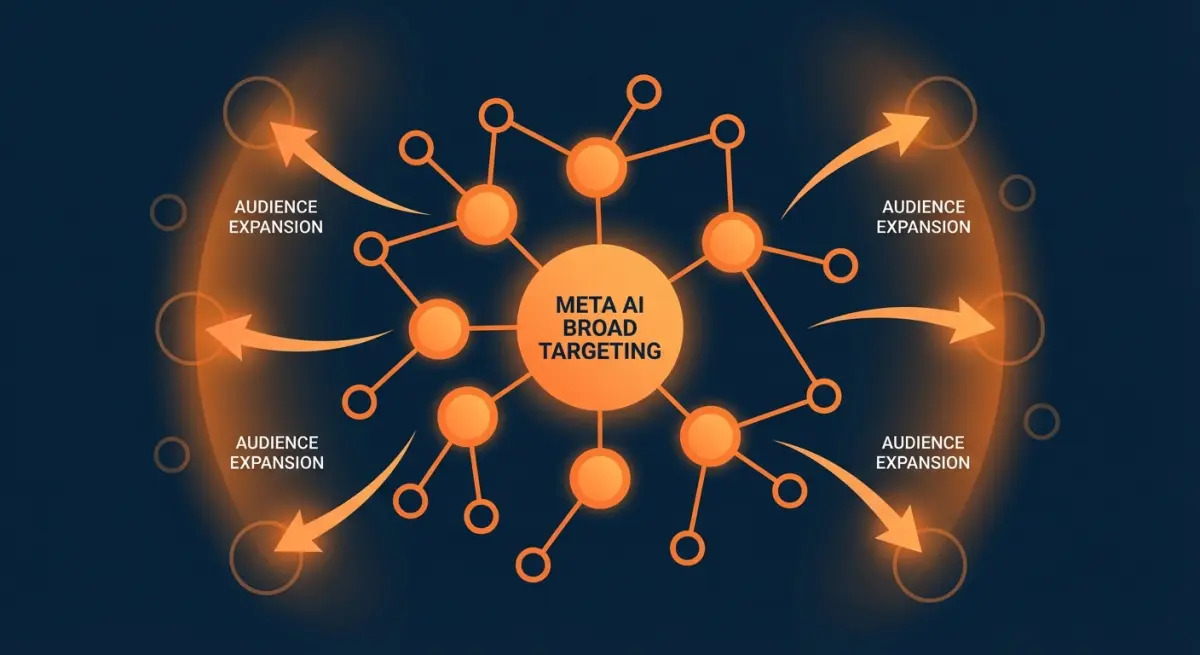
Broad targeting means giving Meta relatively few audience restrictions and allowing its system to identify potential customers.
For example, instead of targeting:
Digital Marketing + Google Ads + Facebook Ads + Business Owners + Entrepreneurship
you might simply select your location, appropriate age range, and other essential restrictions.
Meta then has considerably more room to identify people who are likely to respond to your advertising.
Broad targeting has become increasingly important because Meta's optimization systems can use signals from your campaign, creative and conversion activity to find potential customers.
However, broad targeting does not mean "target everyone."
You should still define genuine business constraints such as geography, age where relevant, language where necessary, and exclusions.
When Should You Test Broad Targeting?
Broad audiences are particularly useful when you have:
- Reliable conversion tracking
- Enough conversion data
- Strong creatives
- A clear offer
- A reasonably large potential market
- A sufficient advertising budget
For eCommerce brands, broad targeting can be particularly effective when combined with strong product creatives and accurate purchase tracking.
Our Meta Ads for eCommerce scaling strategy goes deeper into this approach.
2. Facebook Interest Targeting
Interest targeting is one of the oldest and most recognizable forms of Facebook Ads targeting.
You select interests that may indicate what users are interested in or what type of content they engage with.
For example, a fitness business might test interests related to:
- Fitness
- Weight training
- Yoga
- Running
- Healthy eating
- Personal training
A digital marketing agency could test:
- Digital marketing
- Online advertising
- Entrepreneurship
- Small business
- E-commerce
- Business management
The important point is that an interest should have a logical connection to your potential customer.
Should You Still Use Facebook Interest Targeting in 2026?
Yes—but don't automatically assume that more interests mean better targeting.
One common mistake is creating an ad set containing 20–30 unrelated interests.
For example:
Digital Marketing + Real Estate + Fitness + Travel + Photography + Fashion + Entrepreneurship
This doesn't create a sophisticated audience. It creates a confusing audience that is difficult to analyze.
Instead, create logical audience groups and test them against broader targeting.
For example:
Ad Set A: Broad Ad Set B: Digital Marketing interests Ad Set C: Entrepreneurship interests
This gives you cleaner performance data.
3. Facebook Custom Audiences
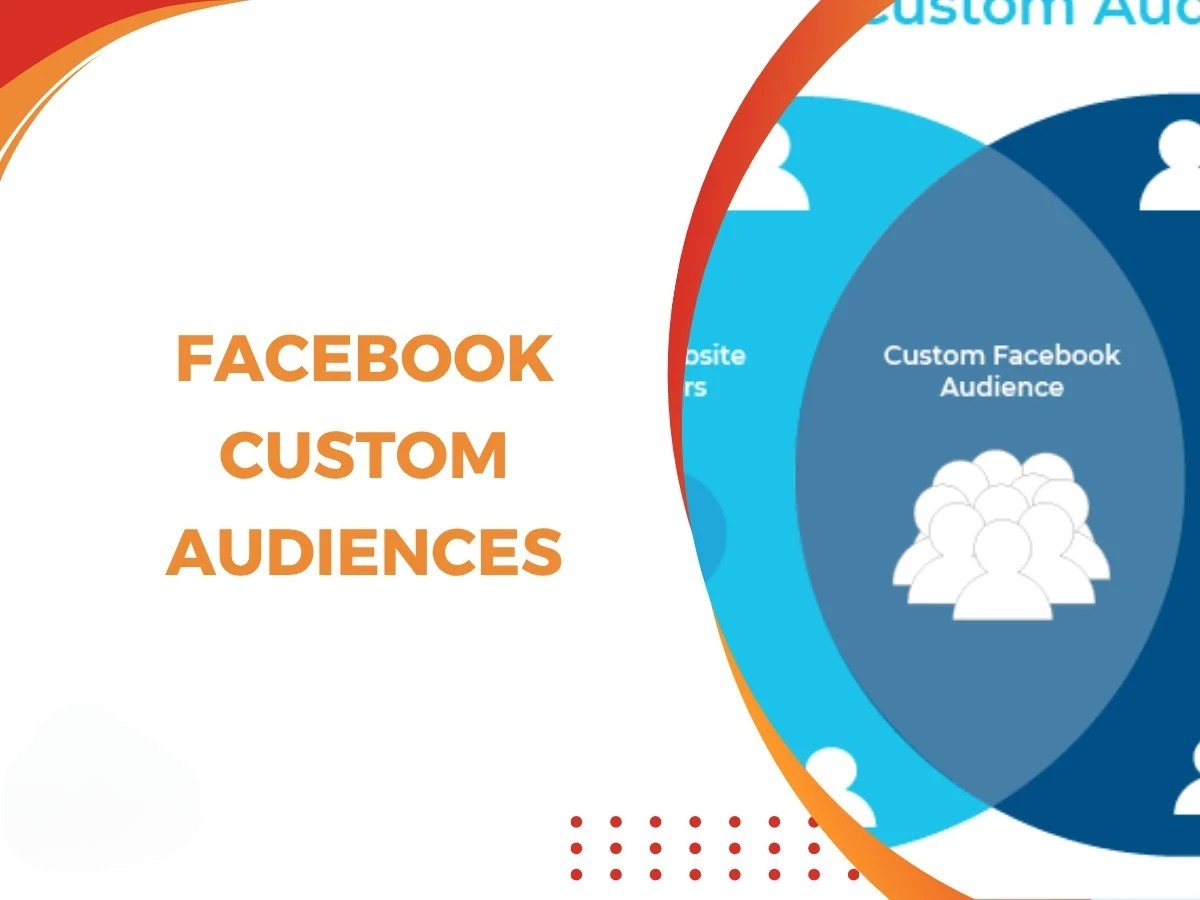
Custom Audiences are built from people who have already interacted with your business or whose information you are permitted to use for advertising.
They are particularly useful for retargeting and customer retention.
Depending on your available data and Meta's current audience options, Custom Audiences can be created from sources such as:
- Website visitors
- Customer lists
- App activity
- Facebook engagement
- Instagram engagement
- Video engagement
- Lead forms
- Other Meta interactions
For example, an eCommerce business could create:
Website Visitors – 30 Days
Then create another:
Add to Cart – 30 Days
And another:
Purchasers – 180 Days
These audiences can be used differently depending on the campaign.
Website Visitor Audiences
Website visitors are one of the most useful retargeting audiences.
You can target people who visited your website but didn't complete the desired action.
For example:
Website visitors – 30 days Exclude purchasers – 180 days
This lets you show a follow-up message to people who already know your brand.
However, your website activity data is only as useful as your tracking setup.
Before relying heavily on website audiences, make sure your Meta Pixel is properly configured.
For more advanced tracking, you can also implement Meta Conversion API (CAPI).
4. Facebook Lookalike Audiences
A Lookalike Audience allows advertisers to reach new people who are similar to an existing source audience.
Meta describes Lookalike Audiences as a way to find people similar to an existing audience, such as current users or customers.
The important part is the quality of the source audience.
A Lookalike built from random website visitors may not perform as well as one built from high-quality customers.
Potential source audiences include:
- Purchasers
- Qualified leads
- High-value customers
- Website converters
- Customer databases
- App users
- Engaged users
- People who completed important actions
1% vs 3% vs 5% Lookalike Audiences
A smaller Lookalike percentage generally aims for greater similarity to the source audience, while a larger percentage provides more potential reach.
A practical testing structure could be:
- 1% Lookalike – highest similarity test
- 2% Lookalike – moderate expansion
- 3–5% Lookalike – broader scale
Don't assume that 1% will always win.
For some businesses, a broader Lookalike can generate significantly more volume while maintaining acceptable acquisition costs.
The right percentage depends on your market size, source quality, budget and conversion volume.
What Makes a Good Lookalike Source?
This is one of the most important parts of Facebook audience targeting.
Suppose you have 10,000 website visitors but only 100 actual customers.
Creating a Lookalike from all website visitors may give Meta a much noisier signal than creating one from your customers.
Whenever possible, prioritize quality over quantity.
For example:
Best: Purchasers Very good: Qualified leads Good: High-intent website converters Useful: Website visitors Less valuable: Generic page engagement
The exact hierarchy will depend on your business model.
For lead generation, a database of qualified customers can be much more useful than a list containing every form submission.
Facebook Retargeting Audiences
Retargeting focuses on people who have already interacted with your business.
Typical retargeting audiences include:
- Website visitors
- Product viewers
- Add-to-cart users
- Instagram engagers
- Facebook engagers
- Video viewers
- Lead form openers
- Previous customers
The message should also change according to where the user is in the buying journey.
For example:
Website visitor: "See how our service works."
Product viewer: "Still considering this product?"
Add to cart: "Complete your order."
Existing customer: "Try our newest product."
This is much more effective than showing exactly the same advertisement to everyone.
Audience Exclusions Matter
Good targeting isn't only about deciding who to include.
It's also about deciding who should not see your ads.
For example, a prospecting campaign might exclude:
- Existing customers
- Recent leads
- Website visitors
- Previous converters
This prevents your cold audience campaign from repeatedly targeting people who are already in your funnel.
Exclusions can also reduce unnecessary audience overlap.
However, don't create excessive exclusions simply because you can. Overly restrictive targeting can make your audience unnecessarily small.
Broad vs Interest vs Custom vs Lookalike
Here's a simple way to think about the four approaches:
| Audience | Best Use | Main Advantage |
|---|---|---|
| Broad | Prospecting | Maximum algorithmic flexibility |
| Interests | Testing/niche markets | Useful when you need an initial audience hypothesis |
| Custom | Retargeting | Uses existing interactions |
| Lookalike | Prospecting | Finds new users similar to valuable sources |
The best Facebook Ads strategy often combines several of these rather than relying on one audience type.
A Practical Facebook Audience Targeting Strategy for 2026
If you're launching a new campaign, don't create 10–15 ad sets immediately.
Start with a simple testing structure.
Ad Set 1 – Broad
Use:
- Target location
- Appropriate age
- Relevant gender restrictions if genuinely required
- Minimal additional restrictions
Ad Set 2 – Interest
Choose a small group of closely related interests.
Ad Set 3 – Lookalike
Use a high-quality customer or lead source if enough data is available.
Ad Set 4 – Retargeting
Target people who have already interacted with your business.
This type of structure also fits into a broader campaign framework. Our Facebook Ads campaign structure guide for 2026 explains how to organize campaigns, ad sets, budgets and creatives.
Don't Over-Segment Your Audiences
One of the biggest mistakes advertisers make is creating too many ad sets.
Imagine you have a ₹2,000/day budget and create 10 audiences.
Now each audience may receive only a small amount of spend.
This creates several problems:
- Insufficient conversion data
- Slower learning
- Difficult performance comparison
- Budget fragmentation
- Audience overlap
- More manual management
A smaller number of well-designed audiences often makes more sense.
Meta's current systems are designed to use machine learning to identify people likely to take an action, so unnecessarily restricting delivery can work against the optimization process.
Audience Targeting Is Only One Part of Performance
Even a perfectly constructed audience won't save a weak campaign.
If your ad has a poor hook, your landing page is slow, your offer is unclear or your tracking is broken, changing the audience may not solve the problem.
Think about the entire funnel:
Audience → Creative → Offer → Landing Page → Conversion → Tracking
For example, if you are getting plenty of clicks but few leads, the problem may be your landing page rather than your targeting.
Similarly, if Meta reports conversions but your CRM shows poor-quality leads, you may need to improve your optimization event and lead qualification process.
For a broader view of campaign problems, read Why Your Facebook Ads Are Not Converting.
How to Improve Facebook Audience Targeting
Here are practical steps you can use when optimizing an existing campaign.
1. Start With Your Best Customer
Before choosing interests, understand who actually buys from you.
Look at:
- Customer location
- Age range
- Purchase behavior
- Product preferences
- Customer value
- Lead quality
- Sales cycle
2. Test Broad Against Manual Targeting
Don't assume either broad or interest targeting will win.
Run a controlled test and compare:
- Cost per lead
- Cost per purchase
- Conversion rate
- ROAS
- Lead quality
- Revenue
3. Build Better Custom Audiences
Instead of creating only a general website visitor audience, create audiences around meaningful actions.
For example:
- Viewed product
- Added to cart
- Initiated checkout
- Purchased
- Submitted lead form
4. Use High-Quality Lookalike Sources
If you have customer data, start there.
A Lookalike based on high-value customers can be considerably more useful than one based on generic engagement.
5. Review Audience Overlap
If multiple ad sets are targeting similar users, consider consolidating them.
A complicated account isn't automatically a better account.
6. Refresh Your Creatives
Sometimes advertisers blame the audience when the real problem is creative fatigue.
If frequency rises and performance declines, test new creative angles before completely rebuilding your targeting.
Facebook Ads Audience Targeting Mistakes to Avoid
Mistake 1: Adding Too Many Interests
More interests don't automatically mean better targeting.
Mistake 2: Targeting an Extremely Small Audience
A tiny audience can restrict Meta's ability to optimize.
Mistake 3: Creating Too Many Ad Sets
This fragments your budget and data.
Mistake 4: Using Poor Lookalike Sources
A Lookalike is only as useful as the source data behind it.
Mistake 5: Ignoring Retargeting
People who already know your business can be valuable prospects.
Mistake 6: Forgetting Exclusions
Existing customers don't always need to see acquisition ads.
Mistake 7: Changing Audiences Every Few Days
Constant changes make it difficult to determine what is actually working.
Mistake 8: Ignoring Tracking
If your conversion data is inaccurate, Meta has less reliable information to optimize against.
How Tracking Improves Audience Optimization
Audience targeting and conversion tracking are closely connected.
Meta needs useful signals to understand what a valuable customer looks like.
For example, suppose you're running a lead generation campaign.
If every form submission is treated equally, Meta may optimize toward people who submit forms easily—even if they rarely become customers.
But if your tracking and CRM process can identify qualified leads, you can build better audiences and provide stronger signals for optimization.
This is why Meta Pixel and Conversion API are important parts of a modern Facebook Ads strategy.
Our Conversion Tracking Services can help businesses build more reliable tracking across advertising platforms.
Final Thoughts
Facebook Ads audience targeting in 2026 is less about finding one perfect interest and more about building a system that gives Meta useful data while maintaining control over the parts that matter.
For most businesses, a sensible strategy is to test:
- Broad audiences
- Relevant interests
- High-quality Custom Audiences
- Lookalike Audiences
- Retargeting
- Appropriate exclusions
But don't stop at audience targeting.
Your creative, offer, landing page, conversion tracking and campaign structure all influence the final result.
If you're managing a growing account, simplify where possible, test systematically and judge audiences based on qualified leads, purchases, revenue and ROAS—not just clicks or CTR.
If you need help building or optimizing your Facebook and Instagram advertising strategy, explore Scale With Clicks and our Meta Ads Management Services.
Frequently Asked Questions
What is Facebook Ads audience targeting?
Facebook Ads audience targeting is the process of defining which people Meta should be eligible to show your advertisements to based on factors such as location, demographics, interests, behaviors and first-party audience data.
Is interest targeting still effective in 2026?
Yes. Interest targeting can still be useful, particularly for niche markets, new accounts and structured audience testing. However, broad and algorithm-assisted targeting should also be tested.
What is the difference between Custom and Lookalike Audiences?
A Custom Audience generally targets people who have already interacted with your business or are included in an eligible customer data source. A Lookalike Audience is used to find new people who resemble a source audience.
What is the best Lookalike Audience for Facebook Ads?
There isn't one universal answer. Purchasers, high-value customers and qualified leads are often strong sources because they represent valuable business outcomes.
Should I use broad targeting or interests?
Test both when appropriate. Broad targeting gives Meta more freedom, while interests can provide a useful manual targeting hypothesis. The winner should be determined by actual conversion performance.
How many audiences should I test?
Avoid testing too many audiences at once. Start with a small number of meaningful audience groups so your budget and conversion data aren't fragmented.
Does audience targeting guarantee better Facebook Ads results?
No. Targeting is only one part of campaign performance. Creative quality, offer, landing page, campaign objective, conversion tracking and sales follow-up also matter.