Facebook Ads
Broad vs Interest Targeting in Meta Ads - Which Is Better?

Category: Facebook Ads
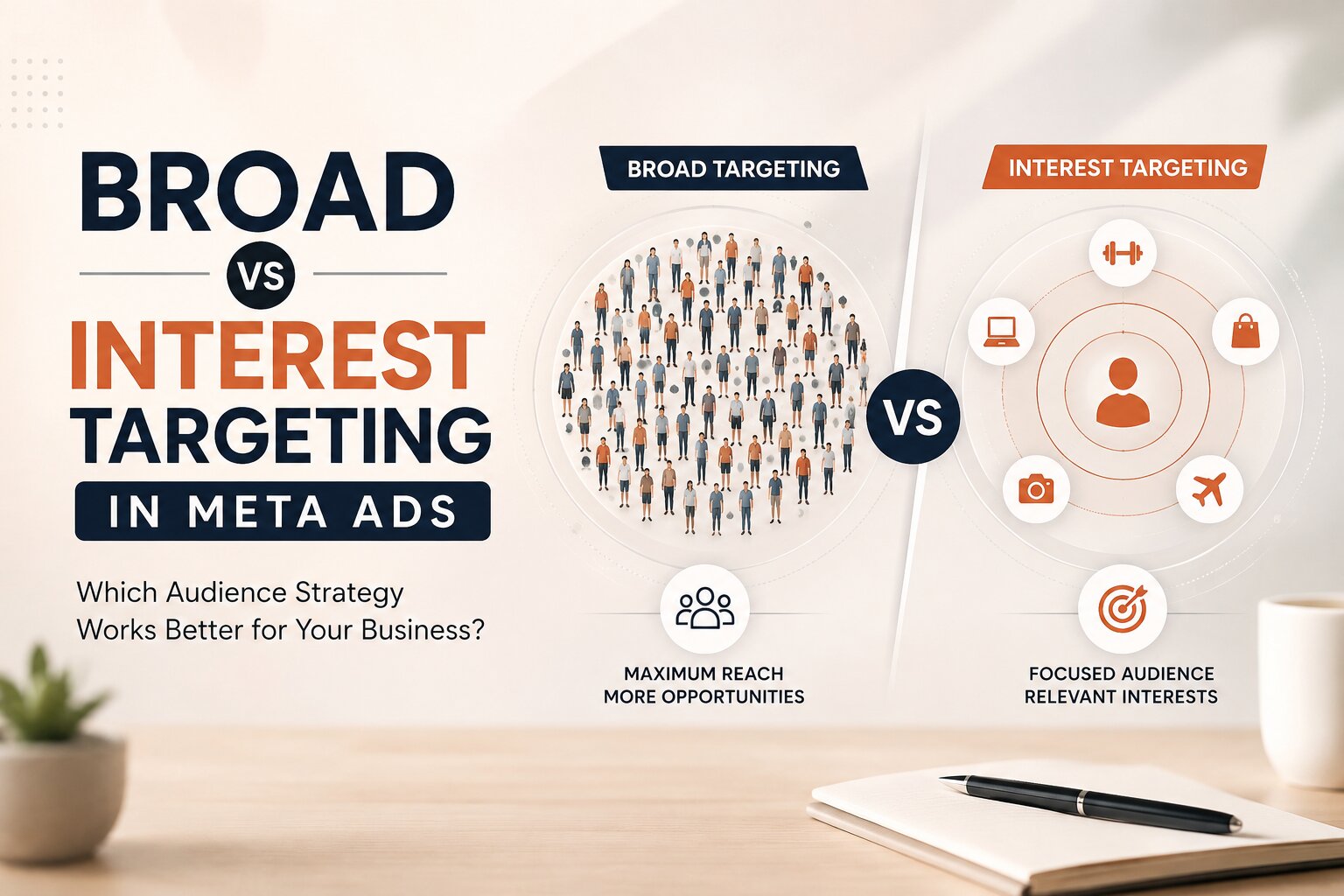
Broad vs Interest Targeting in Meta Ads: Which Is Better?
If you've been running Meta Ads for a while, you've probably come across the same question again and again:
Should you use broad targeting or interest targeting?
For years, interest targeting was one of the easiest ways to tell Facebook and Instagram exactly who you wanted to reach. You could target people interested in fitness, digital marketing, real estate, fashion, technology, or hundreds of other categories.
But Meta Ads have changed significantly.
With increasingly powerful machine learning, automated audience expansion, Advantage+ features, better conversion signals, and more sophisticated delivery systems, advertisers are relying less on manually defining every characteristic of their audience.
That doesn't mean interest targeting is dead.
It simply means that broad targeting has become much more competitive than it used to be.
So, which one should you choose?
The answer depends on your campaign objective, conversion volume, product or service, budget, creative quality, and how much data Meta has available.
In this guide, we'll compare broad vs interest targeting in Meta Ads, explain the advantages and disadvantages of both, and show you when each approach makes sense.
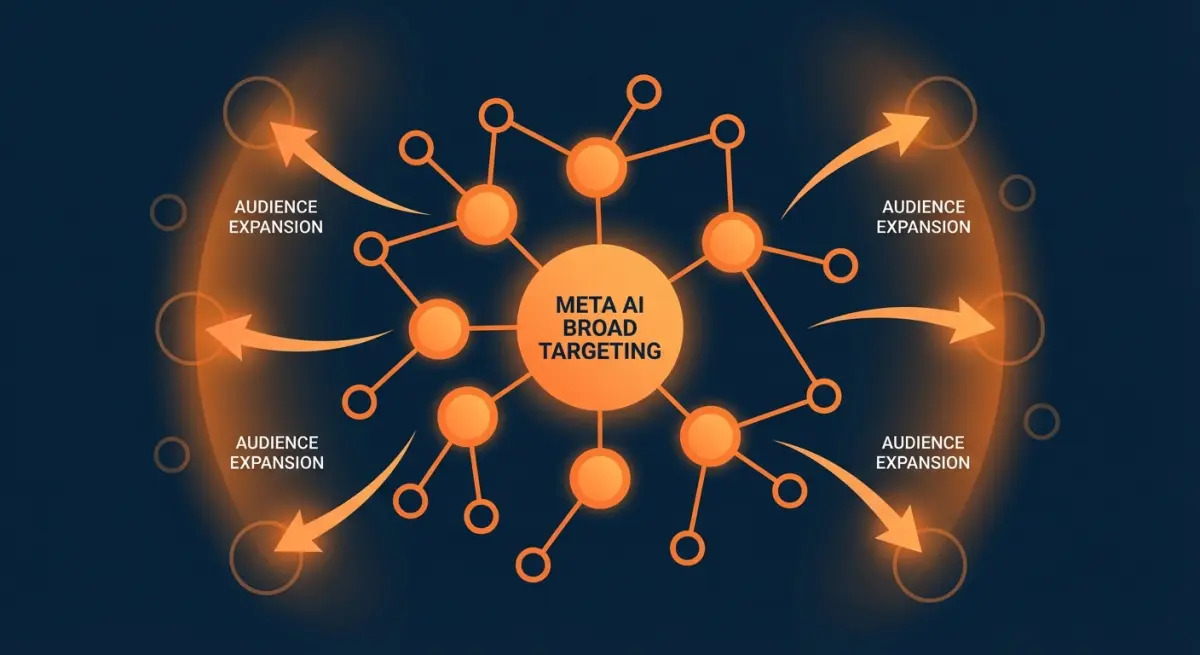
What Is Broad Targeting in Meta Ads?
Broad targeting means giving Meta relatively few audience restrictions and allowing its algorithm to decide which people are most likely to take your desired action.
Instead of selecting multiple interests, behaviours, and detailed targeting options, you might simply define:
- Location
- Age range
- Gender, where relevant
- Language, where relevant
And then allow Meta to find the people most likely to convert.
For example, suppose you're advertising a digital marketing service in India.
An interest-based audience might target people interested in:
- Digital marketing
- Facebook advertising
- Google Ads
- Entrepreneurship
- Online advertising
- Small business
A broad audience might simply target:
India → Age 25–55 → All genders
The algorithm then uses available signals such as previous interactions, conversion behaviour, creative engagement, and other platform signals to determine who should see the ads.
This approach is becoming increasingly popular among advertisers because it gives Meta more room to optimize delivery.
If you're building your campaigns from scratch, it's also worth understanding the overall Facebook Ads campaign structure before deciding how many audiences you actually need.
What Is Interest Targeting in Meta Ads?
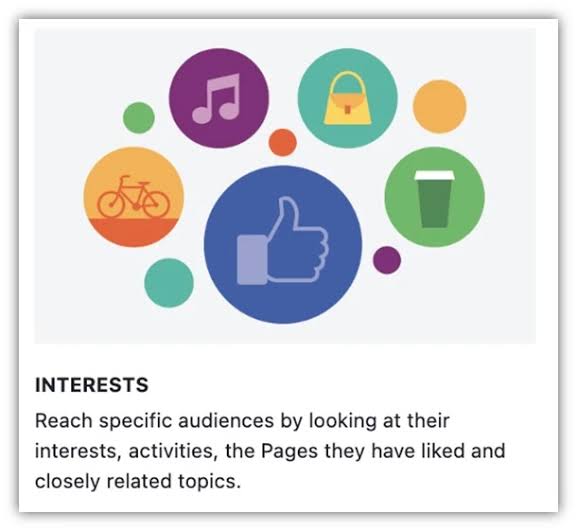
Interest targeting involves manually selecting topics, interests, or behaviours that you believe are relevant to your ideal customer.
For example, a fitness equipment company might target people interested in:
- Fitness
- Weight training
- Gym
- Personal training
- Bodybuilding
- Running
A real estate company might target:
- Real estate investing
- Property
- Home ownership
- Mortgage loans
- Interior design
The idea is straightforward:
Find people who appear to have an interest in the category you're selling.
Interest targeting can still be useful, especially when you're entering a new market, working with a new Meta Ads account, or promoting a product with a very specific audience.
However, there is one important limitation.
Someone having an interest in a topic doesn't necessarily mean they're ready to buy something related to that topic.
A person interested in "digital marketing" isn't automatically looking for a digital marketing agency.
That's where conversion data becomes important.
Broad vs Interest Targeting: What's the Difference?
The biggest difference is who makes the audience selection.
With interest targeting, you provide more of the initial audience definition.
With broad targeting, you give Meta more freedom to identify potential customers.
| Factor | Broad Targeting | Interest Targeting |
|---|---|---|
| Audience size | Usually larger | Usually smaller |
| Manual control | Lower | Higher |
| Algorithm flexibility | High | More restricted |
| Data requirement | Generally higher | Can work with less data |
| Scalability | Excellent | Can become limited |
| Testing | Creative-focused | Audience + creative focused |
| Best for | Established campaigns | New/niche campaigns |
| Audience restrictions | Minimal | More defined |
Neither approach is automatically better for every business.
The goal is to determine which strategy produces better business results, not simply a lower CPM or CPC.
Advantages of Broad Targeting
1. More Freedom for Meta's Algorithm
One of the biggest advantages of broad targeting is flexibility.
When you don't unnecessarily restrict your audience, Meta has more potential users to evaluate.
This can help the platform identify patterns that aren't obvious from traditional audience research.
For example, you may believe your ideal customers are people aged 30–45 who are interested in entrepreneurship.
Meta's data may discover that a completely different group is converting at a lower cost.
Broad targeting allows the system to find those users.
2. Better Scalability
Broad audiences are generally easier to scale because you're not limited by a small interest pool.
This becomes especially important when you're increasing budgets.
A campaign targeting a very narrow audience can quickly experience:
- Rising frequency
- Higher CPM
- Audience saturation
- Increasing CPA
- Creative fatigue
Broad targeting provides a much larger pool of potential users.
This is one reason broad audiences are frequently used in Meta Ads eCommerce scaling strategies.
3. Less Audience Fragmentation
One common mistake in Meta Ads is creating too many ad sets.
For example:
- Interest A
- Interest B
- Interest C
- Interest D
- Interest E
- Broad
- Lookalike 1%
- Lookalike 2%
If the budget is small, each audience may receive insufficient spend.
Instead of learning which audience actually works, you're spreading the budget too thin.
A simpler structure can provide Meta with more conversion data per ad set.
4. Useful for Scaling Winning Campaigns
Once you've identified winning creatives and offers, broad targeting can be particularly useful for scaling.
Rather than constantly searching for another interest, you can allow the algorithm to find additional customers.
This shifts the focus from:
"Which interest should I target?"
to:
"Which creative and offer can convince the right people to convert?"
That is a much more scalable approach.
Disadvantages of Broad Targeting
Broad targeting isn't a magic button.
It can perform poorly when the campaign doesn't have enough useful signals.
1. It Can Struggle With New Accounts
A brand-new Meta Ads account may not have much conversion history.
If you're launching your first campaign with little or no historical data, giving Meta a massive audience may not immediately produce excellent results.
This is where interest targeting can sometimes provide a useful testing layer.
2. Strong Creative Becomes More Important
Broad targeting puts more responsibility on your creative.
Your ad needs to communicate:
- Who the product is for
- What problem it solves
- Why someone should care
- What makes the offer different
- What action the user should take
A weak ad shown to a broad audience doesn't suddenly become successful because of the targeting.
In fact, poor creative can make broad campaigns expensive very quickly.
3. Poor Tracking Can Hurt Performance
Broad targeting works best when Meta receives accurate conversion signals.
If your Pixel isn't working correctly, events are duplicated, or important conversion events aren't being sent, the algorithm has less reliable information to work with.
Before testing broad targeting, make sure your Meta Pixel is correctly configured.
For more advanced tracking setups, implementing Meta Conversion API can also improve the quality of conversion signals being sent to Meta.
Advantages of Interest Targeting
1. Useful for New Campaigns
Interest targeting can give advertisers a starting point when there isn't enough historical data.
For example, a new business selling professional photography equipment could test interests such as:
- Photography
- DSLR
- Camera
- Photo editing
- Professional photography
This gives the campaign a more controlled testing environment.
2. Helpful for Niche Products
Some products have very specific audiences.
If you're selling an extremely specialized product, broad targeting may initially reach many people who have little relevance to the offer.
Interest targeting can help create a more focused testing environment.
For example:
Product: Professional scuba diving equipment
Possible interests:
- Scuba diving
- Diving
- Underwater photography
- PADI
- Marine biology
The audience may still be large enough to test while remaining relevant to the product.
3. Easier to Understand During Initial Testing
Interest targeting can help advertisers understand which audience themes appear to respond to their offer.
For example, a SaaS company might test:
Ad Set 1: Entrepreneurship
Ad Set 2: Small business
Ad Set 3: Digital marketing
Ad Set 4: Broad
After collecting enough data, the advertiser can determine whether interest-based targeting actually adds value.
Disadvantages of Interest Targeting
1. Smaller Audiences Can Limit Scale
The biggest problem with interest targeting is that audiences can become restrictive.
Adding too many interests doesn't necessarily improve targeting.
Sometimes it simply reduces the number of people Meta can reach.
2. Interest Doesn't Equal Purchase Intent
This is probably the most important point to understand.
Someone interested in:
"Digital Marketing"
may be:
- A student
- A freelancer
- A business owner
- A marketer
- Someone watching educational videos
- Someone simply browsing content
Only a small percentage may actually want to purchase your service.
Meta's algorithm may be better at identifying buying behaviour than a manually selected interest.
3. Audience Overlap Can Become a Problem
If you create multiple interest-based ad sets, users can fall into several audiences.
For example:
Someone interested in both:
- Entrepreneurship
- Digital marketing
- Small business
could potentially qualify for multiple ad sets.
This can make campaign analysis more complicated and potentially fragment your budget.
If your campaigns aren't generating results, review our guide on why Facebook Ads are not converting before assuming the audience itself is the problem.
Broad vs Interest Targeting: Which Is Better?
For many advertisers in 2026, broad targeting is the better starting point for scaling, provided the campaign has good creative, accurate conversion tracking, an appropriate optimization event, and enough data.
But that doesn't mean you should completely eliminate interest targeting.
A better approach is to test both when your budget allows it.
For example:
Ad Set 1 — Broad
- Location: India
- Age: 25–55
- All genders
- No detailed interests
Ad Set 2 — Interest
- Digital marketing
- Entrepreneurship
- Small business
Use similar creatives and the same conversion event.
Then compare:
- Cost per result
- Conversion rate
- CTR
- CPM
- CPA
- Lead quality
- Revenue
- ROAS
The winner should be judged on business outcomes, not simply audience size.
When Should You Use Broad Targeting?
Broad targeting is usually worth testing when:
- Your account has conversion history
- You have reliable Pixel tracking
- Conversion API is implemented where appropriate
- Your creative is strong
- Your offer is clear
- Your audience is naturally large
- You're looking to scale
- You're running eCommerce campaigns
- You're getting consistent conversion volume
For eCommerce brands in particular, broad audiences can work extremely well when Meta has enough purchase data to identify high-value users.
However, targeting isn't the only factor.
Your product page, checkout experience, creative, pricing, offer, and tracking all affect the final result.
When Should You Use Interest Targeting?
Interest targeting can make more sense when:
- Your account is new
- You have limited conversion data
- Your product is highly specialized
- You're entering a new market
- You want to test different audience themes
- Your broad campaign is not finding qualified users
- You need additional audience testing
However, avoid creating 10–20 interest ad sets just because the interests are available.
More targeting options don't automatically mean better performance.
What About Advantage+ Audience?
This is where the traditional broad-vs-interest debate becomes less straightforward.
Meta's Advantage+ audience tools can use audience suggestions while allowing the system to expand beyond those suggestions when it believes doing so can improve performance.
In practical terms, this means your interest selection may no longer behave like the rigid targeting system advertisers were accustomed to years ago.
Instead of asking:
"Which five interests should I select?"
the better question is:
"What information can I give Meta while still allowing the algorithm enough flexibility to find converters?"
For many campaigns, this means starting with broader targeting and using strong creative and conversion signals.
How Creative Quality Changes the Targeting Equation
One of the biggest mistakes advertisers make is spending hours researching interests while spending very little time developing their ads.
Think about the difference.
Creative A
"Get professional digital marketing services."
Creative B
"Spending ₹50,000/month on Meta Ads but still getting low-quality leads? Here's what may be going wrong."
Creative B tells Meta more about the problem and gives the right user a reason to stop scrolling.
When your messaging is highly specific, broad targeting becomes much more powerful.
Your creative can effectively act as a filter.
The people who relate to the message are more likely to engage, click, and convert.
This is why modern Meta Ads strategies increasingly focus on creative testing rather than endlessly building audiences.
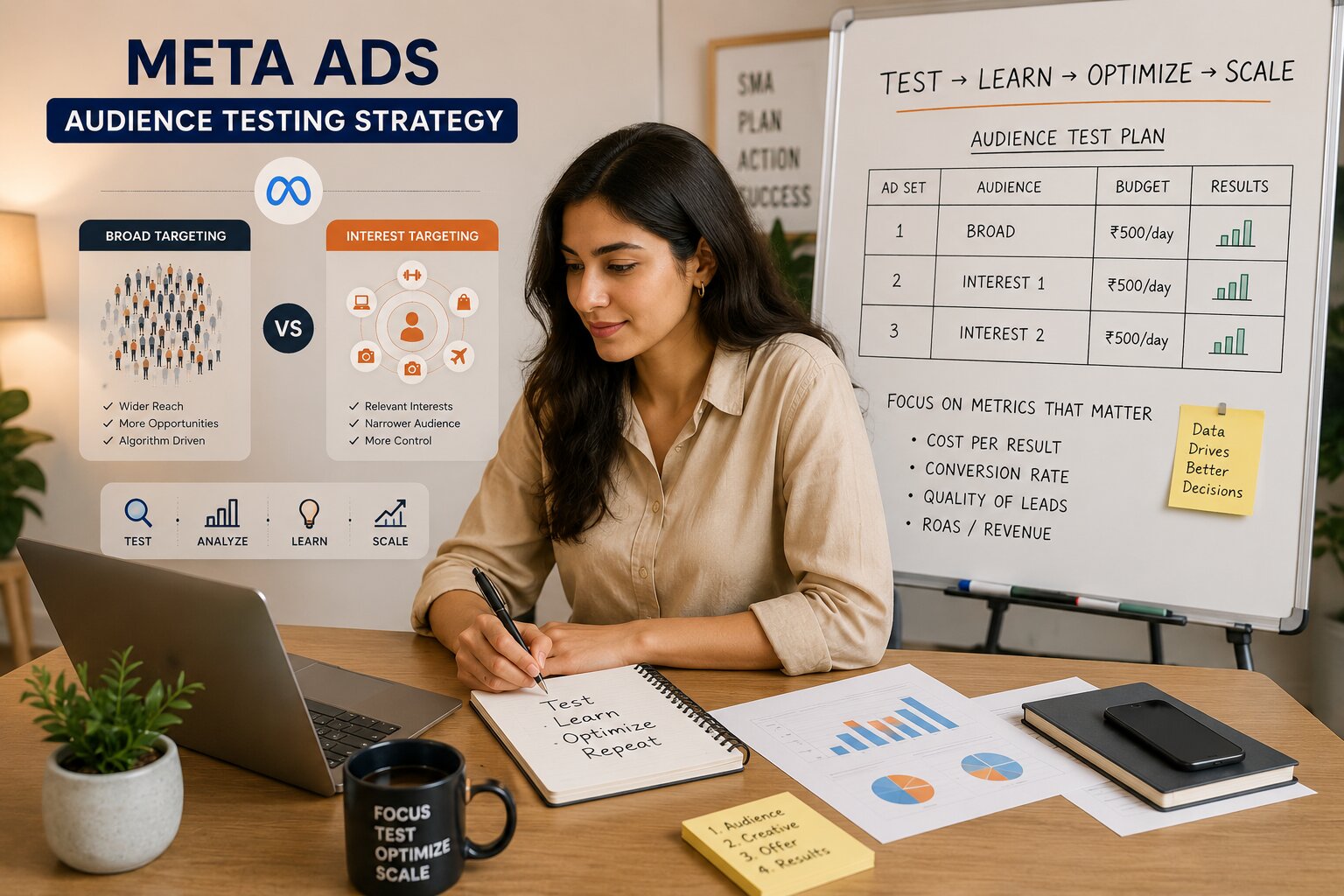
A Practical Testing Strategy
If you aren't sure whether broad or interest targeting works better for your business, don't guess.
Run a controlled test.
Step 1: Keep the Campaign Objective the Same
For example:
Leads → Website Conversion
or
Sales → Purchase
Don't compare different objectives.
Step 2: Keep the Creative Similar
Use the same primary text, headline, offer, and creative wherever possible.
This reduces variables.
Step 3: Test Broad vs Interest
Create:
Ad Set A: Broad
Ad Set B: Interest
Step 4: Give Both Enough Data
Don't switch off an audience because it has one expensive lead after six hours.
Meta campaigns need enough data to reveal a pattern.
Step 5: Evaluate Quality
For lead generation, don't stop at CPL.
Look at:
- Qualified leads
- Appointments
- Sales
- Cost per qualified lead
- Customer acquisition cost
For eCommerce:
- Purchases
- CPA
- Revenue
- ROAS
- Average order value
- New customer acquisition cost
A ₹300 lead that turns into a customer can be more valuable than a ₹100 lead that never answers the phone.
This principle is also covered in our guide on how to lower cost per lead in Meta Ads.
Common Broad Targeting Mistakes
Mistake 1: Going Broad Without Conversion Tracking
Broad targeting depends heavily on useful signals.
Fix your tracking first.
Mistake 2: Using Weak Creatives
Broad targeting cannot compensate for an irrelevant advertisement.
Mistake 3: Making Constant Changes
Changing audiences every day prevents meaningful performance analysis.
Mistake 4: Judging Performance Only by CPM
A cheap CPM doesn't necessarily mean a profitable campaign.
Mistake 5: Scaling Too Quickly
If a broad campaign starts performing well, don't immediately multiply the budget several times overnight.
Scale gradually while monitoring performance.
Common Interest Targeting Mistakes
Mistake 1: Adding Too Many Interests
Ten interests don't necessarily create a better audience than two.
Mistake 2: Stacking Unrelated Interests
Avoid combining unrelated interests simply to increase audience size.
Mistake 3: Creating Too Many Ad Sets
This fragments your budget and makes optimization harder.
Mistake 4: Assuming Interest Means Intent
Someone can be interested in a topic without ever becoming a customer.
Mistake 5: Never Testing Broad
If you always use interests, you may never discover that Meta can find better customers without those restrictions.
Broad vs Interest Targeting: Final Verdict
So, which is better: broad targeting or interest targeting?
For many Meta Ads campaigns today, broad targeting deserves to be your first test, especially when you have reliable conversion tracking, strong creatives, a clear offer, and enough conversion data.
Interest targeting still has a place.
It can be particularly useful for new accounts, niche products, market testing, and situations where you don't yet have enough data for Meta's algorithm to work effectively.
The biggest mistake is treating targeting as the only factor that determines campaign performance.
A successful Meta Ads campaign usually depends on several pieces working together:
Targeting + Creative + Offer + Landing Page + Tracking + Conversion Data + Optimization
If one of those pieces is weak, changing from interests to broad targeting may not solve the problem.
Instead of asking:
"Which audience is guaranteed to perform better?"
Ask:
"Which targeting approach gives Meta the best opportunity to find profitable customers?"
That mindset leads to better testing and better campaigns.
If you want help building, testing, and optimizing your Meta advertising campaigns, explore our Meta Ads Management Services or visit Scale With Clicks to learn more about our performance marketing approach.
Frequently Asked Questions
Is broad targeting better than interest targeting on Meta Ads?
Broad targeting can outperform interest targeting when Meta has enough conversion data and the campaign has strong creatives and accurate tracking. However, results vary by business, offer, budget, and campaign objective.
Should beginners use broad targeting on Facebook Ads?
Beginners can test broad targeting, but a new account with limited conversion data may benefit from testing a relevant interest audience alongside broad targeting.
Is interest targeting dead on Meta Ads?
No. Interest targeting is still useful for niche products, new markets, audience research, and testing. However, advertisers don't necessarily need to rely on it as heavily as they did in the past.
Does broad targeting increase Meta Ads costs?
Not necessarily. Broad targeting can sometimes reduce costs by giving Meta more flexibility to find users likely to convert. But performance depends on the quality of the campaign and conversion signals.
Should I use broad targeting for eCommerce?
Broad targeting is often worth testing for eCommerce because purchase data gives Meta valuable signals. Strong product creatives, accurate purchase tracking, and a good website are still essential.
Should I use broad targeting for lead generation?
Yes, broad targeting can work well for lead generation. However, advertisers should optimize for qualified leads rather than simply chasing the lowest possible cost per lead.
How long should I test broad vs interest targeting?
There isn't a universal number of days. Let the campaign collect enough meaningful data before making a decision, and avoid judging an audience based on very limited spend or a handful of conversions.
Can I use broad and interest targeting in the same Meta Ads campaign?
Yes. Testing both can be useful when the budget is sufficient. Just make sure you're not creating unnecessary audience fragmentation.