Facebook Ads
Facebook Ads CBO vs ABO - Which Budget Strategy Is Better?

Category: Facebook Ads
Facebook Ads CBO vs ABO: Which Budget Strategy Is Better?
One of the first decisions you make when setting up a Facebook or Meta Ads campaign is how you want to manage the budget.
Should you put the budget at the campaign level and let Meta distribute it automatically? Or should you assign a separate budget to every ad set and control exactly how much each audience receives?
This is where the debate around Facebook Ads CBO vs ABO starts.
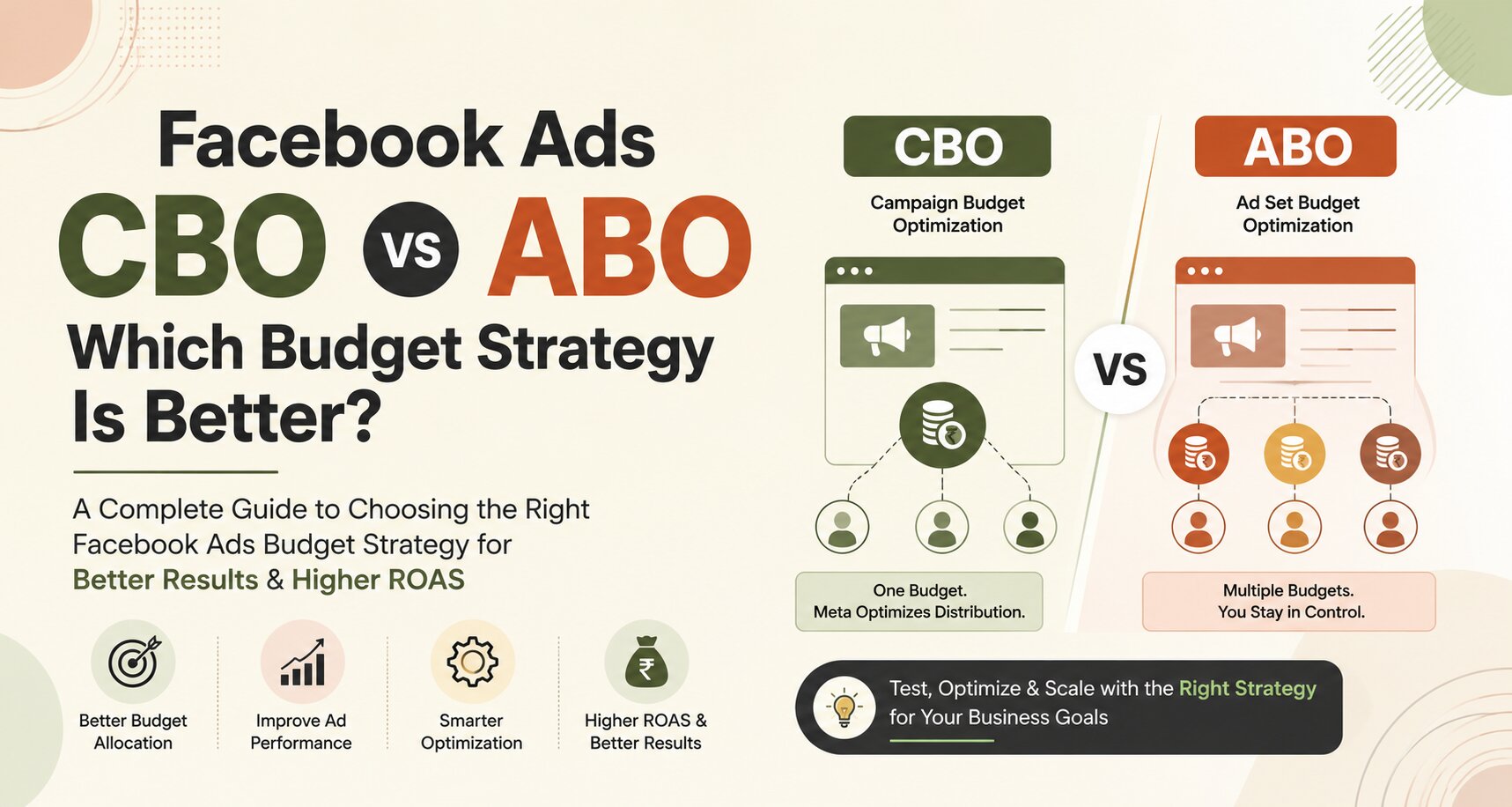
CBO, or Campaign Budget Optimization, gives Meta more control over budget distribution. ABO, or Ad Set Budget Optimization, gives the advertiser more control over how much each audience or ad set spends.
Neither option is automatically better.
The right choice depends on what you are trying to achieve, how much conversion data your account has, your campaign budget, the number of ad sets you're running, and whether you're testing or scaling.
In this guide, we'll break down CBO vs ABO, explain the advantages and disadvantages of each, and show you when to use them.

What Is CBO in Facebook Ads?
CBO stands for Campaign Budget Optimization.
With CBO, you set the budget at the campaign level instead of assigning a separate budget to every ad set.
For example, imagine you create a lead generation campaign with three ad sets:
- Broad audience
- Interest audience
- Lookalike audience
Instead of giving each ad set ₹1,000 per day, you could set a campaign budget of ₹3,000 per day.
Meta can then distribute that ₹3,000 between the ad sets based on where it believes the best opportunities are.
For example:
| Ad Set | Possible Spend |
|---|---|
| Broad | ₹1,500 |
| Interest | ₹900 |
| Lookalike | ₹600 |
| Total | ₹3,000 |
The distribution doesn't have to remain the same every day.
If Meta sees that the Broad audience is producing better conversion opportunities, it may allocate more of the campaign budget toward that ad set.
This is the main advantage of CBO: you give Meta flexibility to move money toward opportunities it believes are more likely to generate results.
What Is ABO in Facebook Ads?
ABO stands for Ad Set Budget Optimization.
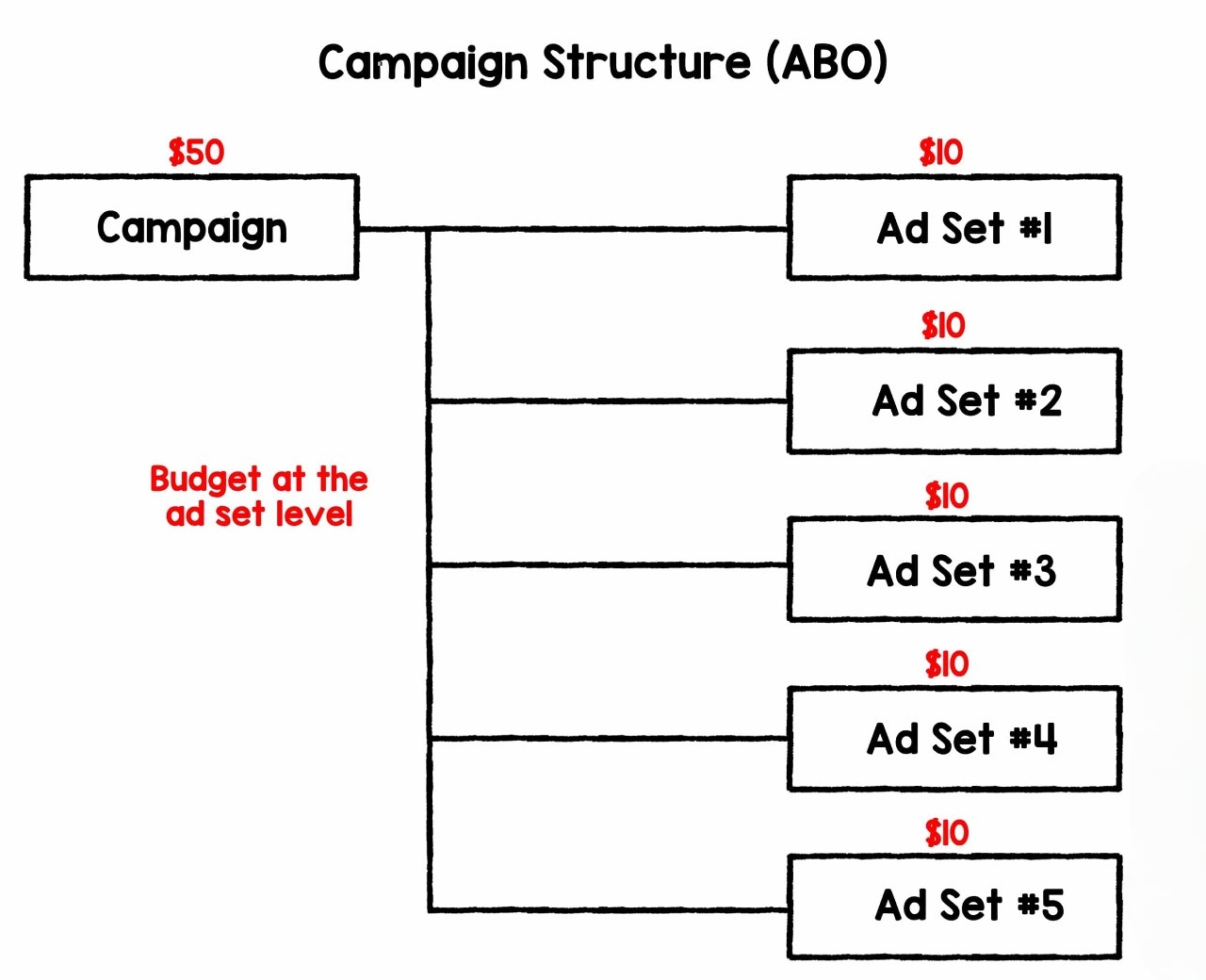
With ABO, you assign a separate budget to each ad set.
For example:
- Broad audience → ₹1,000/day
- Interest audience → ₹1,000/day
- Lookalike audience → ₹1,000/day
Each ad set gets its own budget.
This gives you much greater control over testing.
If your goal is to compare three audiences fairly, ABO can make the analysis easier because you know each audience has been given a specific amount of budget.
CBO vs ABO: The Main Difference
The simplest way to understand the difference is this:
CBO = Campaign-level budget control
ABO = Ad-set-level budget control
Here's a quick comparison:
| Factor | CBO | ABO |
|---|---|---|
| Budget control | Campaign level | Ad set level |
| Meta's control | Higher | Lower |
| Advertiser control | Lower | Higher |
| Audience testing | Less controlled | More controlled |
| Scaling | Usually easier | Requires more manual management |
| Budget distribution | Automatic | Manual |
| Best for | Scaling | Testing |
| Budget fragmentation | Lower | Higher if many ad sets are used |
| Performance optimization | Algorithm-driven | Advertiser-driven |
The important thing is not to treat CBO and ABO as competing strategies where one must always win.
They solve different problems.
Advantages of CBO
1. Better Budget Distribution
One of the biggest benefits of CBO is that Meta can move the campaign budget toward ad sets that appear more promising.
Suppose you have three audiences and one starts generating significantly cheaper conversions.
With ABO, that ad set may remain stuck at its assigned budget unless you manually increase it.
With CBO, Meta can automatically allocate more campaign budget toward the stronger opportunity.
This can be particularly useful when you're running larger campaigns.
2. Easier Scaling
CBO is often useful when you already have winning audiences and creatives.
Instead of constantly adjusting individual ad set budgets, you can manage the campaign from one budget.
This makes campaign management easier as the account grows.
If you're interested in scaling Meta campaigns without simply increasing spending aggressively, our guide on Meta Ads for eCommerce covers additional scaling strategies.
3. Less Budget Fragmentation
Imagine you have a ₹5,000/day budget.
If you create 10 ad sets using ABO, you could end up allocating only ₹500/day to each ad set.
That can become a problem.
Each ad set may not receive enough spend or conversions to generate meaningful performance data.
CBO can help consolidate the budget rather than forcing you to divide it equally across numerous ad sets.
4. More Automation
Meta's machine learning can make budget allocation decisions based on available performance signals.
This is especially useful for advertisers who don't want to manually adjust budgets several times every day.
However, automation does not mean you should stop monitoring the campaign.
You still need to watch:
- Cost per result
- Conversion volume
- CTR
- CPM
- CPA
- ROAS
- Lead quality
- Frequency
- Creative performance
Disadvantages of CBO
CBO isn't perfect.
There are situations where it can make testing more difficult.
1. One Ad Set Can Consume Most of the Budget
Suppose you have three audiences:
- Broad
- Interest
- Lookalike
Meta may decide that the Broad audience has the strongest opportunity and allocate a large percentage of your budget there.
That may be great for overall results.
But if you're trying to test all three audiences equally, it creates a problem.
You may not get enough spend on the other audiences to determine whether they could perform well with more budget.
2. Less Testing Control
If your primary objective is to compare audiences or creative concepts, CBO can make the test less controlled.
You might want every audience to receive ₹1,000.
Meta might decide otherwise.
That's where ABO can be more useful.
3. Performance Can Be Misleading During Early Testing
An ad set that spends more isn't necessarily the best long-term performer.
Sometimes Meta simply finds an easier early opportunity.
A proper evaluation should consider enough data and meaningful business metrics rather than deciding that the highest-spending ad set is automatically the winner.
Advantages of ABO
1. Better Control During Testing
This is probably the biggest reason advertisers continue to use ABO.
If you're testing different audiences, you can give each audience a specific budget.
For example:
Ad Set 1
Broad → ₹500/day
Ad Set 2
Interest → ₹500/day
Ad Set 3
Lookalike → ₹500/day
Now each audience receives a similar opportunity to spend.
This makes your testing process easier to understand.
Our Facebook Ads Audience Targeting Guide goes deeper into broad, interest, custom, lookalike, and retargeting audiences.
2. Useful for New Campaigns
ABO can be particularly useful when you don't yet know which audience or offer will perform best.
For example, a new business might test:
- Broad audience
- Interest targeting
- Lookalike audience
- Retargeting
Giving each ad set a controlled budget lets you gather initial performance data.
3. Easier Audience Comparison
If your objective is audience testing, ABO provides a cleaner framework.
You can compare:
- CPA
- CPL
- CTR
- Conversion rate
- Lead quality
- Purchase value
- ROAS
This is more useful than simply looking at which ad set spent the most.
Disadvantages of ABO
1. Budget Can Be Wasted on Weak Ad Sets
Let's say you have three ad sets receiving ₹1,000 each.
One produces excellent results.
One produces average results.
One produces almost nothing.
ABO can continue giving all three their assigned budgets unless you intervene.
This means you need to monitor performance and make decisions manually.
2. More Manual Optimization
ABO generally requires more hands-on management.
You may need to:
- Increase budgets
- Reduce budgets
- Pause weak ad sets
- Duplicate winners
- Reallocate spend
- Monitor audience overlap
For larger accounts, this can become time-consuming.
3. Too Many Ad Sets Can Fragment Data
This is one of the biggest mistakes advertisers make.
Suppose your total budget is ₹2,000/day.
Creating 10 ad sets doesn't magically create 10 times more opportunities.
Instead, you may spread the budget so thin that individual ad sets don't generate enough conversion data.
A simpler campaign structure is often easier for Meta to optimize.
When Should You Use CBO?
CBO generally makes more sense when:
- You have multiple proven ad sets.
- You want to scale a campaign.
- You have enough conversion data.
- You don't need equal spending across audiences.
- Your audiences are relatively stable.
- You want Meta to optimize budget distribution.
- Your campaign has sufficient budget.
For example, suppose you already know that three audience groups consistently generate leads.
Instead of manually giving each audience the same amount, you can allow Meta to allocate more budget to the opportunities producing better results.
When Should You Use ABO?
ABO can be a better option when:
- You're testing new audiences.
- You're testing different offers.
- You're comparing audience segments.
- You're launching a new campaign.
- You want controlled spending.
- You have a smaller budget.
- You don't want Meta to heavily favor one ad set during the initial test.
For example, if you're testing Broad vs Interest targeting, ABO can give both audiences a controlled opportunity to spend.
Once you have enough data, you can decide which setup deserves more budget.
CBO vs ABO for Lead Generation
For lead generation campaigns, the answer depends heavily on the testing stage.
New Lead Generation Campaign
ABO can be useful.
For example:
- Broad → ₹750/day
- Interest → ₹750/day
- Lookalike → ₹750/day
This allows you to compare:
- CPL
- Lead quality
- Conversion rate
- Sales-qualified leads
Don't judge the campaign purely on CPL.
A ₹300 lead that never answers the phone may be much worse than a ₹500 lead that becomes a customer.
Our guide on How to lower Cost Per Lead in Meta Ads explains why lead quality, creatives, targeting, landing pages, and tracking all affect campaign efficiency.
Scaling Lead Generation
Once you identify strong performers, CBO can become more attractive.
You can consolidate winning ad sets and allow Meta to distribute the campaign budget based on performance.
CBO vs ABO for eCommerce
For eCommerce, CBO can be particularly useful when you already have sufficient conversion data and multiple viable ad sets.
For example:
- Broad prospecting
- Lookalike purchasers
- Product-focused audience
- Retargeting
If the campaign is mature, giving Meta flexibility to allocate budget toward stronger opportunities can make scaling easier.
However, testing new products, audiences, or creative concepts may still benefit from controlled ABO campaigns.
If you're running an eCommerce business, read our Meta Ads eCommerce Scaling Strategy for a broader approach to profitable scaling.
CBO vs ABO for Small Budgets
This is where advertisers often make things unnecessarily complicated.
Suppose your total budget is only ₹1,000/day.
Creating five ad sets at ₹200/day each may not be the best approach.
You're spreading a relatively small budget across too many variables.
With a small budget, consider starting with:
- Fewer ad sets
- Fewer audiences
- Strong creatives
- Clear conversion tracking
- A focused campaign objective
The exact structure depends on the business, but budget fragmentation should always be considered.
A Practical CBO + ABO Strategy
You don't necessarily have to choose one forever.
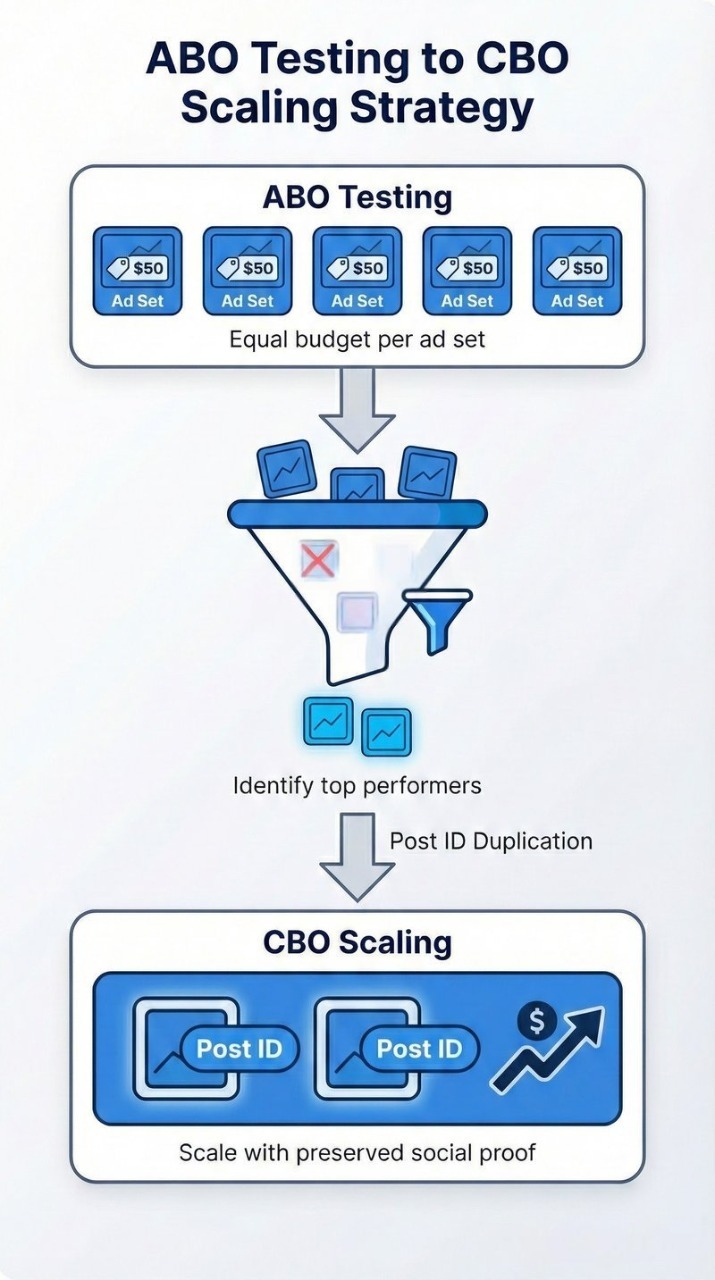
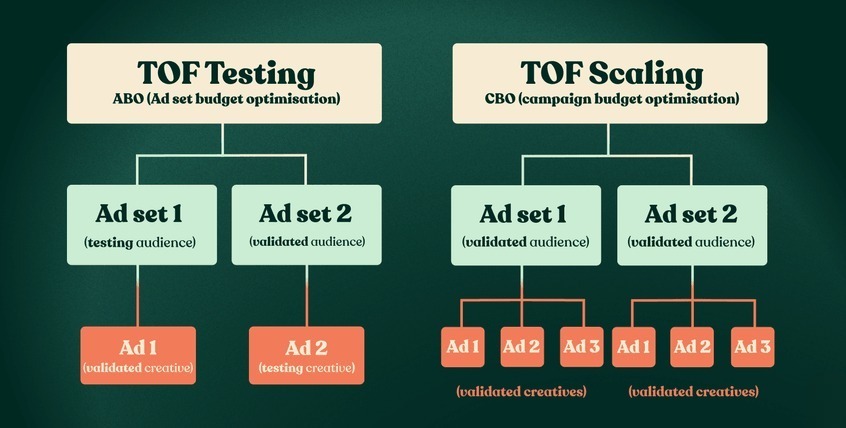
A practical approach is:
Phase 1: Testing
Use ABO.
Test:
- Audiences
- Offers
- Creative angles
- Landing pages
Give each test enough budget to generate useful data.
Phase 2: Optimization
Identify the combinations that are producing meaningful results.
Don't just look at CTR or cheap clicks.
Look at actual business outcomes.
Phase 3: Scaling
Move proven combinations into a CBO campaign.
Allow Meta to distribute more of the budget toward stronger opportunities.
Phase 4: Creative Refresh
Continue introducing new creatives.
Scaling a campaign doesn't mean running the same advertisement forever.
Creative fatigue can eventually increase CPM and CPA.
Common Mistakes When Using CBO and ABO
Mistake 1: Changing Budgets Too Frequently
Constantly changing budgets can make it difficult to understand what actually caused performance changes.
Make deliberate adjustments based on data rather than reacting to every daily fluctuation.
Mistake 2: Creating Too Many Ad Sets
More ad sets don't automatically mean better targeting.
Too many ad sets can fragment budget and conversion data.
Mistake 3: Choosing Winners Too Quickly
An ad set generating one conversion isn't necessarily a winner.
Look for meaningful patterns across sufficient data.
Mistake 4: Optimizing Only for Cheap Results
The cheapest lead isn't always the most valuable lead.
Track what happens after the conversion.
For lead generation, connect Meta Ads data with your CRM or sales process whenever possible.
Mistake 5: Ignoring Conversion Tracking
If Meta receives poor conversion signals, neither CBO nor ABO can magically fix the problem.
Accurate tracking gives the algorithm better information to optimize against.
If your tracking isn't properly configured, our Meta Pixel Setup Guide can help you understand the fundamentals. You can also explore our Conversion Tracking Services.
For more advanced tracking, Meta Conversion API (CAPI) can complement browser-based Pixel tracking.
CBO vs ABO: Which One Is Better?
There isn't one universal answer.
ABO is usually better for controlled testing.
CBO is usually better for optimization and scaling.
But the decision should be based on the campaign's current stage rather than following a fixed rule.
A simple framework is:
| Campaign Stage | Recommended Approach |
|---|---|
| New campaign | ABO |
| Audience testing | ABO |
| Creative testing | ABO or controlled testing |
| Proven audiences | CBO |
| Scaling | CBO |
| Stable conversion campaign | CBO |
| Very small budget | Keep structure simple |
| Complex testing requirements | ABO |
The best advertisers don't choose CBO or ABO because one is trendy.
They choose the structure that gives them the right level of control, data, and scalability for the situation.
Final Thoughts
The debate around Facebook Ads CBO vs ABO is often presented as if one budget strategy is always superior.
In reality, both have a place in a well-managed Meta Ads account.
ABO gives you control. It's useful when you're testing audiences, offers, creatives, or campaign ideas and want to make sure each test receives enough budget.
CBO gives Meta more freedom to distribute money based on performance. This makes it particularly useful when you're working with proven ad sets and want to scale without constantly managing individual budgets.
A practical approach for many advertisers is to test with controlled budgets, identify winners, and then use campaign-level optimization to scale them.
But budget structure is only one part of the equation.
Your results also depend on targeting, creative quality, offer strength, landing page experience, conversion tracking, and the quality of the data you're sending back to Meta.
If you want a complete Meta advertising strategy rather than simply choosing between CBO and ABO, explore our Meta Ads Management Services or visit Scale With Clicks to learn more about our performance marketing services.
Frequently Asked Questions
Is CBO better than ABO on Facebook Ads?
Not always. CBO is generally more useful for scaling and allowing Meta to distribute budget automatically, while ABO provides greater control during testing.
Is ABO better for testing audiences?
Usually, yes. ABO allows you to assign specific budgets to individual ad sets, making it easier to compare different audiences under controlled conditions.
Should I use CBO for a new Facebook Ads campaign?
It depends on the campaign. If you have several proven ad sets, CBO can work well. For new audience or offer testing, ABO often provides better control.
Can I switch from ABO to CBO?
Yes. Many advertisers test audiences with ABO and later consolidate winning ad sets into a CBO campaign for scaling.
Does CBO reduce Facebook Ads costs?
CBO can improve budget efficiency by allowing Meta to allocate more budget toward stronger opportunities, but it does not guarantee a lower CPA or CPL.
What is the biggest mistake with ABO?
The biggest mistake is creating too many ad sets and spreading the budget too thin. A small number of well-designed tests is usually easier to optimize.
What is the biggest mistake with CBO?
The biggest mistake is assuming that the ad set receiving the most budget is automatically the best long-term performer. Performance should be evaluated using meaningful conversion and business data.
Should small businesses use CBO or ABO?
Small businesses should focus first on keeping the campaign structure simple. ABO can be useful for controlled testing, while CBO can become more useful once winning audiences and creatives have been identified.