Google Ads
Google Ads Bidding Strategies - Maximize Conversions vs CPA

Category: Google Ads
Google Ads Bidding Strategies: Maximize Conversions vs CPA
Choosing the right Google Ads bidding strategy can have a major impact on how quickly a campaign generates conversions and how efficiently it uses its budget.
Two strategies that often create confusion are Maximize Conversions and Target CPA.
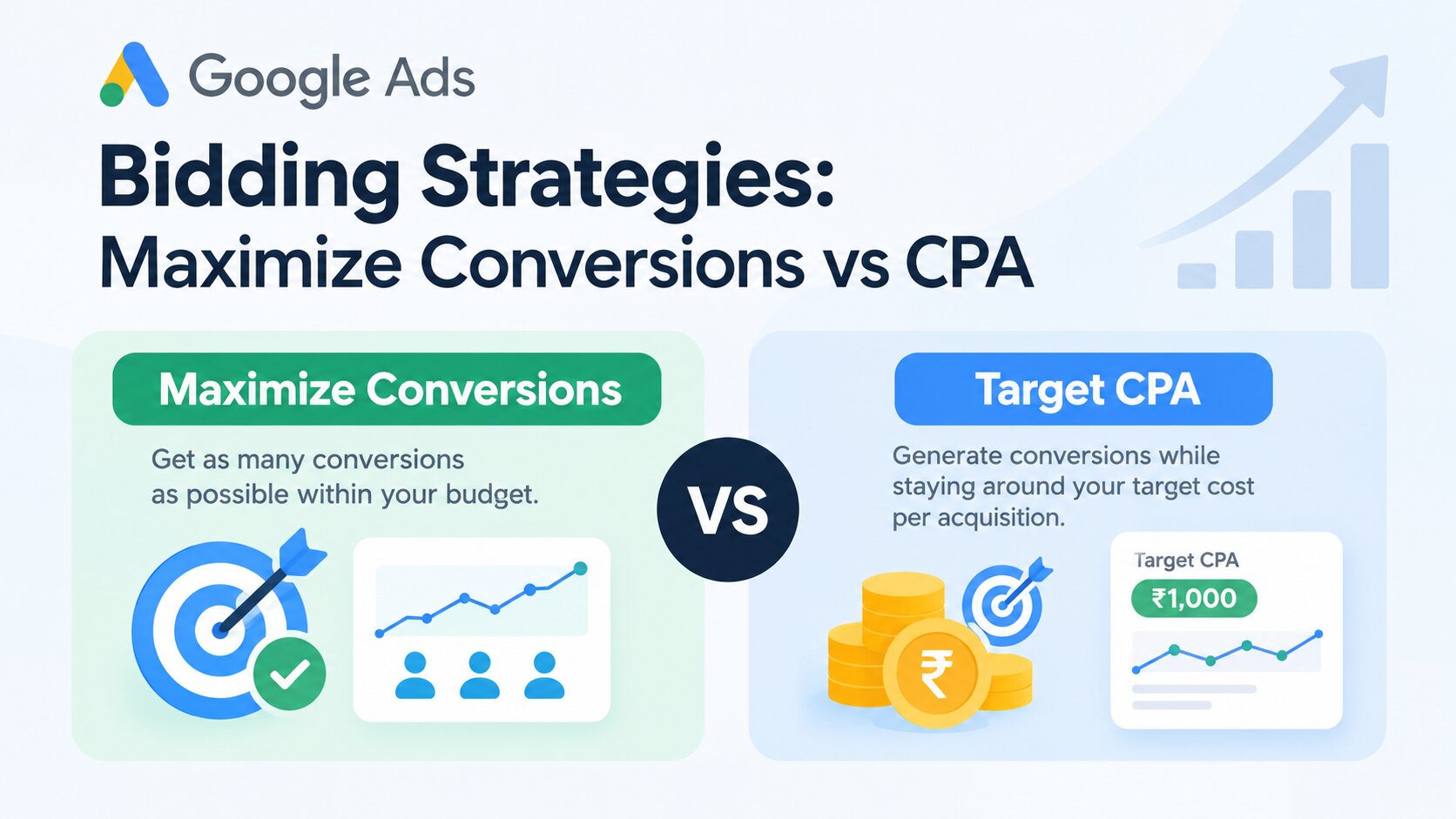
They may look similar because both focus on conversions, but they approach the problem differently. Maximize Conversions focuses primarily on getting as many conversions as possible within the available budget, while Target CPA focuses on generating conversions around a specific cost-per-acquisition goal.
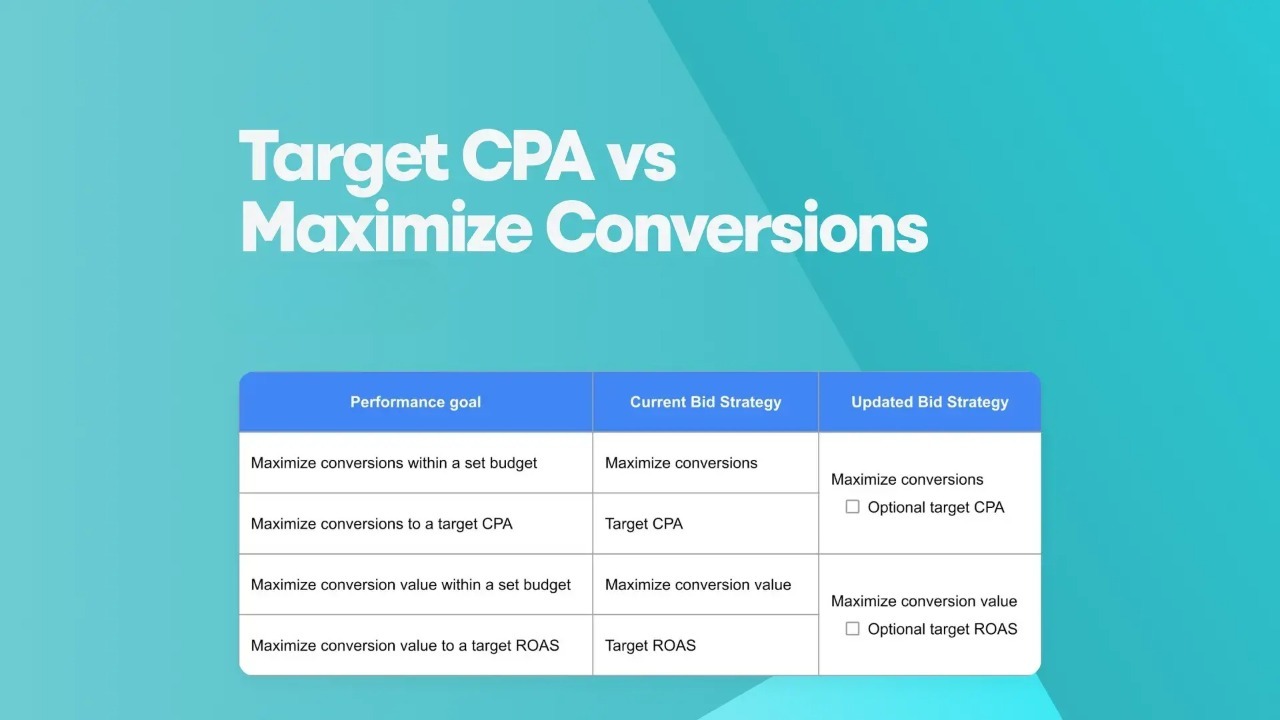
Google has also changed the way these strategies are labelled in 2026. The previous option often shown as “Maximize conversions with a Target CPA” is now being separated and labelled Target CPA. Google says the underlying bidding behaviour has not changed as a result of this naming update. ([Google Help][1])
So, which one should you use?
The answer depends on your conversion volume, budget, profitability requirements and the quality of your conversion tracking.
What Is Google Ads Smart Bidding?
Before comparing the two strategies, it helps to understand Google Ads Smart Bidding.
Smart Bidding uses Google's machine learning to automatically set bids at auction time. Instead of manually deciding how much to bid for every search, Google evaluates signals such as the search query, device, location, time of day and other contextual information to determine an appropriate bid. ([Google Help][2])
The main conversion-focused Smart Bidding strategies include:
- Maximize Conversions
- Target CPA
- Maximize Conversion Value
- Target ROAS
Maximize Conversions and Target CPA are particularly relevant for businesses whose primary goal is lead generation or a higher number of conversions.
However, automated bidding is only as useful as the data it receives. If Google is optimizing toward the wrong conversion action, the bidding system can make decisions that look good inside the Google Ads dashboard but don't necessarily produce valuable customers.
That's why proper conversion tracking should come before aggressive bidding optimization.
What Is Maximize Conversions in Google Ads?
Maximize Conversions tells Google to use the available campaign budget to generate as many conversions as possible.
You don't specify a particular CPA target.
Instead, Google's system evaluates each auction and adjusts bids according to the likelihood of conversion.
For example, suppose you have a daily budget of ₹2,000.
Your campaign could potentially generate:
- 10 conversions at ₹200 CPA
- 15 conversions at ₹133 CPA
- 20 conversions at ₹100 CPA
Maximize Conversions will attempt to find the opportunities that allow it to generate the highest possible number of conversions within the available budget.
Google describes Maximize Conversions as a strategy designed to get as many conversions as possible while spending the campaign budget. ([WebFiddle][3])
When Maximize Conversions Makes Sense
It can be particularly useful when:
- You want to increase conversion volume
- Your budget is relatively fixed
- You don't have a reliable CPA target yet
- The campaign is still collecting conversion data
- You are willing to allow CPA to fluctuate
- You want Google to find additional conversion opportunities
For example, imagine a B2B company launching a new Google Search campaign.
The company knows that generating leads is important, but it doesn't yet have enough historical data to confidently say:
"We need every lead to cost exactly ₹1,000."
Starting with Maximize Conversions can give the system room to learn.
Once the campaign develops a reliable performance history, Target CPA can become a more attractive option.
What Is Target CPA in Google Ads?
Target CPA, or Target Cost Per Acquisition, tells Google that you want to generate conversions around a specific average acquisition cost.
For example, suppose your target is:
Target CPA = ₹1,000
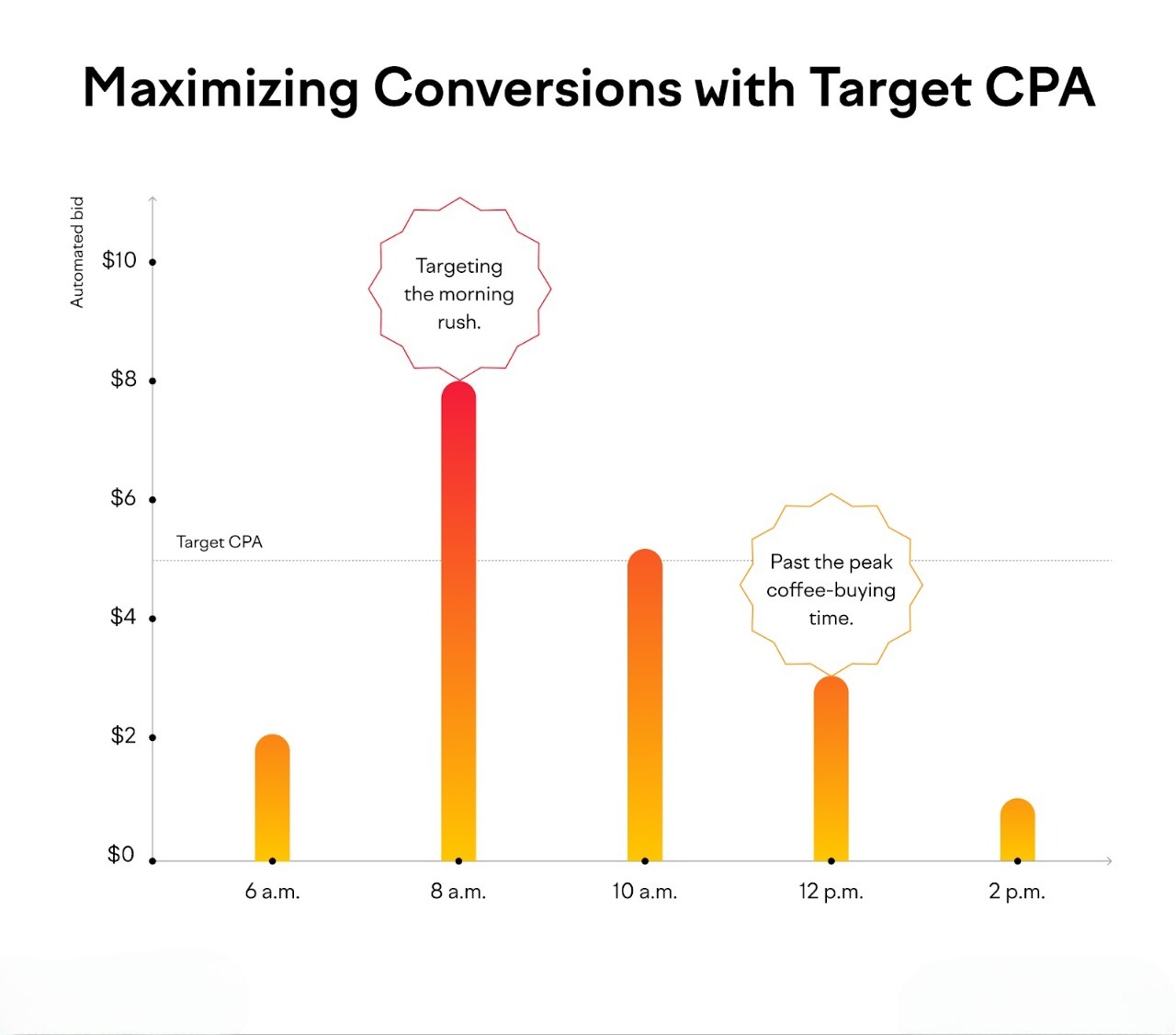
Google will use auction-time bidding to look for conversion opportunities while attempting to maintain an average CPA around your target.
This doesn't mean every conversion will cost exactly ₹1,000.
You may see individual conversions costing ₹600, ₹800, ₹1,200 or even more. The system is working toward the target as an average rather than guaranteeing an identical cost for every conversion.
Google's documentation describes Target CPA as a strategy designed to get conversions while maintaining the specified target cost per action. ([Google for Developers][4])
When Target CPA Makes Sense
Target CPA is generally more appropriate when:
- You have consistent conversion data
- You understand your acceptable acquisition cost
- Your campaign has relatively stable performance
- You want greater cost efficiency
- You have a clear business-level CPA target
- Lead or customer acquisition costs matter more than simply increasing conversion volume
For example, if a business knows that a qualified lead is worth ₹5,000 and its sales process typically converts 20% of qualified leads into customers, it may have a reasonable CPA ceiling to work with.
That gives Google a meaningful target instead of asking it to simply find as many conversions as possible.
Maximize Conversions vs Target CPA: What's the Difference?
The simplest way to understand the difference is:
Maximize Conversions = "Get me as many conversions as possible."
Target CPA = "Get me conversions while aiming for this acquisition cost."
Here's a quick comparison:
| Feature | Maximize Conversions | Target CPA |
|---|---|---|
| Main objective | Maximize conversion volume | Generate conversions around a CPA target |
| CPA target | Not required | Required |
| Budget focus | Strong | Secondary to target efficiency |
| Best for | Growth and data collection | Efficiency and predictable acquisition costs |
| CPA fluctuation | Can be higher or lower | Attempts to stay around target |
| Flexibility | Higher | Lower |
| Suitable for mature campaigns | Yes | Yes |
| Suitable when CPA is unknown | Better choice | Usually not ideal |
| Main risk | CPA may increase | Too-low target can restrict volume |
The important point is that neither strategy is automatically better.
The right choice depends on what you are trying to achieve.
Which Is Better for a New Google Ads Campaign?
For a brand-new campaign, Maximize Conversions can often be easier to work with than immediately imposing an aggressive Target CPA.
A new campaign doesn't necessarily know what a realistic CPA looks like.
Suppose you launch a campaign with a Target CPA of ₹500, but your historical conversion cost is actually closer to ₹1,200.
The system has been given a target that may be unrealistic.
This can limit the number of auctions where Google is willing to bid aggressively.
Instead, you might allow the campaign to collect conversion data and understand which searches, audiences, devices and locations are producing results.
Once performance becomes more stable, you can evaluate whether Target CPA makes sense.
Google notes that Smart Bidding performance can benefit from sufficient historical conversion data and recommends evaluating performance over longer periods rather than making decisions from very small amounts of data. ([Google Help][1])
That doesn't mean every new campaign must avoid Smart Bidding. It means you should consider the campaign's data quality and volume before setting an aggressive target.
When Should You Switch From Maximize Conversions to Target CPA?
There isn't a universal conversion number that guarantees it is time to switch.
Instead, look for consistency.
For example, suppose your campaign has been generating:
- Month 1: 32 conversions at ₹1,180 CPA
- Month 2: 41 conversions at ₹1,050 CPA
- Month 3: 45 conversions at ₹1,020 CPA
Now you have a much clearer understanding of what the campaign can realistically achieve.
You might decide that a Target CPA of ₹1,000–₹1,100 is reasonable.
That's very different from launching the campaign on day one with a ₹500 target simply because ₹500 sounds attractive.
The target should be based on actual campaign economics, not wishful thinking.
Don't Set an Unrealistically Low Target CPA
One of the most common mistakes with Google Ads CPA bidding is setting the target too low.
Imagine your campaign historically generates conversions at an average CPA of ₹1,500.
You suddenly change the Target CPA to ₹700.
You might expect Google to "work harder" to reduce costs.
Instead, the campaign may struggle to spend its budget or lose conversion volume because the bidding system becomes more selective.
A better approach is to start with a realistic target based on recent performance.
If your current CPA is ₹1,500 and your business needs improvement, moving toward ₹1,300 or ₹1,200 may be more realistic than immediately demanding ₹700.
Your Conversion Tracking Matters More Than Your Bidding Strategy
This is one area advertisers often overlook.
Smart Bidding learns from the conversion actions you tell Google Ads to optimize toward.
If you're optimizing for the wrong event, changing from Maximize Conversions to Target CPA won't solve the underlying problem.
For example, suppose a lead-generation business tracks:
- Page views
- Button clicks
- Form starts
- Form submissions
- Phone calls
- Qualified leads
If every button click is treated as a primary conversion, Google may learn to find people who click buttons rather than people who actually become leads.
Before changing bidding strategies, review which conversion actions are included in campaign optimization.
Google specifically recommends ensuring that the appropriate conversion actions are included in the Conversions column when using Smart Bidding. ([Google Services][5])
If your tracking needs work, start with this Google Ads conversion tracking guide.
You can also review your GA4 setup and conversion tracking to make sure the data flowing between platforms makes sense.
Maximize Conversions vs Target CPA for Lead Generation
For lead-generation campaigns, the choice usually comes down to volume versus cost control.
Choose Maximize Conversions when:
You want to generate more leads and are comfortable allowing CPA to move around.
This can work well for:
- Local businesses
- Service companies
- New lead-generation campaigns
- Businesses testing new markets
- Campaigns with uncertain CPA benchmarks
Choose Target CPA when:
You already understand your acquisition economics and need greater cost control.
This can work well for:
- Established lead-generation campaigns
- Businesses with consistent conversion volume
- Companies with defined customer acquisition targets
- Campaigns where profitability depends heavily on acquisition cost
But don't judge either strategy solely by the number shown in the Google Ads interface.
For lead generation, lead quality matters.
Ten cheap leads that never answer the phone may be worse than five expensive leads that become customers.
Maximize Conversions vs Target CPA for eCommerce
For eCommerce, the decision can be slightly different.
If every conversion has approximately the same value, Maximize Conversions can make sense when your objective is simply to generate more purchases.
However, if product values vary significantly, consider value-based bidding strategies such as Maximize Conversion Value or Target ROAS.
For example:
- Product A = ₹1,000
- Product B = ₹5,000
- Product C = ₹15,000
Treating every purchase equally may not be the best way to optimize revenue.
Google recommends value-based bidding when conversion values are available and meaningful. ([Google][6])
For more information, see our guide on Google Ads for eCommerce.
How Budget Affects Your Bidding Strategy
Your budget and bidding strategy should work together.
Suppose your campaign has:
Daily budget: ₹1,000 Target CPA: ₹2,000
That's a difficult setup because your daily budget doesn't even cover one target acquisition.
Now imagine:
Daily budget: ₹10,000 Target CPA: ₹2,000
There is considerably more room for the system to find and test conversion opportunities.
This is why you shouldn't look at the bidding strategy in isolation.
Consider:
- Daily budget
- Average CPC
- Conversion rate
- Historical CPA
- Conversion volume
- Search volume
- Lead quality
- Customer value
- Profit margin
Your Google Ads budget should be realistic relative to your expected CPC and conversion rate.
What About Broad Match and Smart Bidding?
Broad Match and Smart Bidding are often discussed together because Google's systems can use conversion data to evaluate a much wider range of searches.
Google states that broad match keywords pair particularly well with Smart Bidding strategies such as Maximize Conversions and Target CPA. ([Google Help][7])
However, broad match doesn't mean you can stop monitoring search terms.
You still need to watch for:
- Irrelevant searches
- Poor-quality traffic
- Unwanted locations
- Informational queries
- Job searches
- Free/cheap searches
- Competitor traffic where appropriate
Our Google Ads keyword match types guide covers how Broad, Phrase and Exact Match can be used within a conversion-focused campaign structure.
Common Mistakes With Maximize Conversions and Target CPA
1. Changing strategies too frequently
Constantly switching between bidding strategies makes it difficult to understand what is actually improving performance.
Give changes enough time to produce meaningful data before making another major change.
2. Setting the Target CPA too aggressively
A low target doesn't automatically produce a low CPA.
If the target isn't realistic, conversion volume can suffer.
3. Optimizing for poor-quality conversions
More conversions are not necessarily better conversions.
Make sure Google is learning from meaningful business outcomes.
4. Ignoring landing page performance
A bidding strategy cannot compensate for a landing page that doesn't convert.
Your ads can generate highly relevant traffic, but if the landing page is slow, confusing or poorly structured, acquisition costs will remain high.
Our guide on Google Ads Quality Score also explains why ad relevance and landing page experience matter.
5. Judging performance too quickly
Daily fluctuations are normal.
Instead of reacting to every day's CPA, look at trends over a meaningful period and consider conversion volume, lead quality and business results.
A Simple Decision Framework
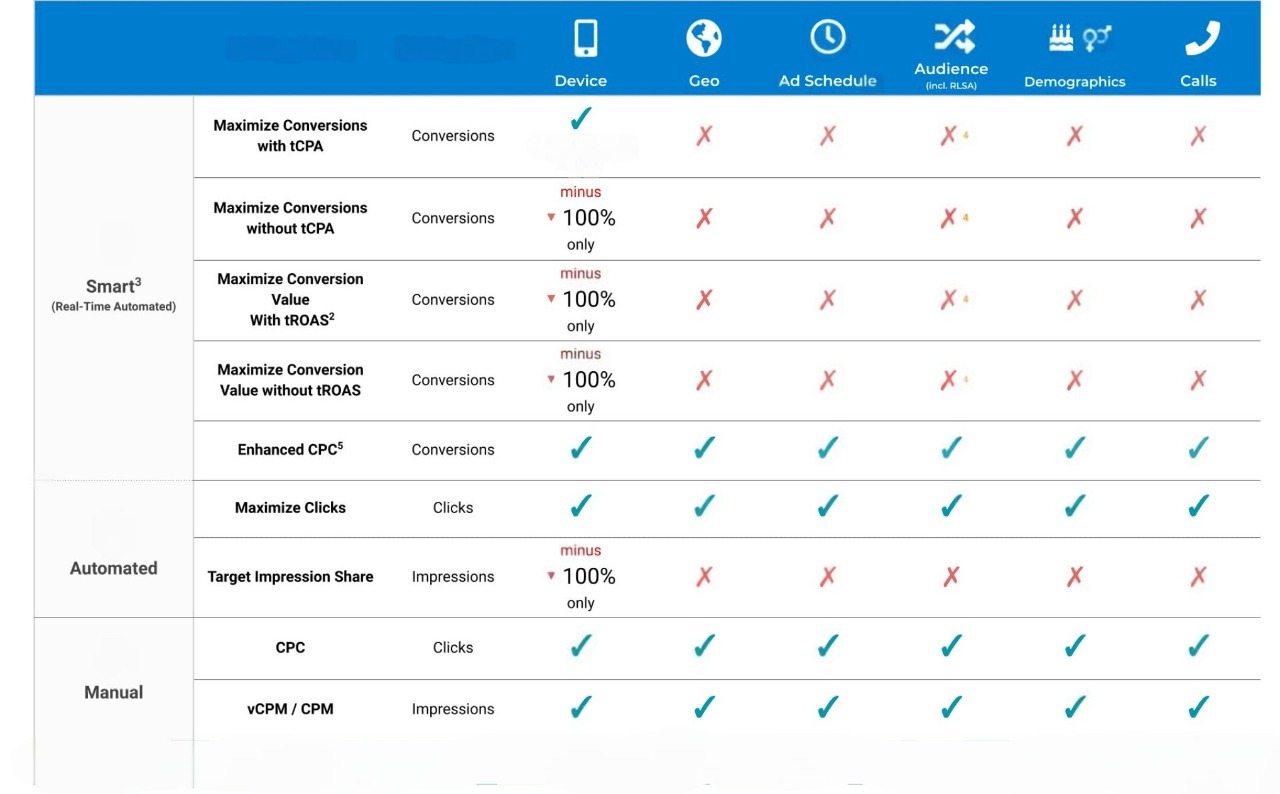
Use this framework when deciding between the two strategies:
New campaign + limited historical data → Start cautiously and focus on collecting reliable conversion data.
Consistent conversions + CPA is not yet clear → Maximize Conversions can provide room for the system to find opportunities.
Consistent conversions + clear acceptable CPA → Consider Target CPA.
CPA target is unrealistic or far below historical performance → Reconsider the target before switching.
eCommerce + different product values → Consider value-based bidding instead of focusing only on conversion volume.
Poor tracking → Fix conversion tracking before changing bidding strategies.
This approach is more reliable than following a fixed rule such as "always use Target CPA after 30 conversions."
Final Verdict: Maximize Conversions or Target CPA?
There is no universal winner.
Maximize Conversions is generally the better choice when your priority is conversion volume and flexibility.
Target CPA is generally better when you have stable conversion data and a realistic acquisition-cost target.
The bigger mistake is choosing a strategy based only on what sounds better.
A campaign with perfect Smart Bidding but inaccurate conversion tracking can perform worse than a campaign with a simpler bidding strategy and clean data.
Your bidding strategy should therefore be built around three things:
Accurate tracking + realistic targets + sufficient data.
Once those three pieces are in place, Google Ads Smart Bidding has much better information to work with.
If you're running campaigns that generate traffic but aren't producing enough qualified leads or sales, the issue may not be the bidding strategy alone. Campaign structure, keyword targeting, ad relevance, landing pages, tracking and follow-up all play a role.
You can learn more about Google Ads campaign structure, or explore Google Ads management services if you want help auditing and optimizing an existing account.
For businesses looking at Google Ads as part of a wider acquisition strategy, you can also visit Scale With Clicks to explore the broader performance marketing services available.
FAQs
Is Maximize Conversions better than Target CPA?
Not necessarily. Maximize Conversions prioritizes conversion volume within the budget, while Target CPA works toward a specified acquisition-cost target. The better option depends on your campaign's data and business objective.
Can I use Target CPA on a new Google Ads campaign?
You can, but setting a Target CPA without reliable historical performance can make it difficult to establish a realistic target. New campaigns often benefit from having room to collect meaningful conversion data first.
What is a good Target CPA?
A good Target CPA is one that works with your business economics. It should consider your profit margin, customer value, conversion rate, sales close rate and historical advertising performance rather than being chosen arbitrarily.
Does Target CPA guarantee the exact CPA?
No. Target CPA is an average performance target, not a guarantee that every conversion will cost the exact amount you specify.
Should I use Maximize Conversions for lead generation?
It can be a strong option when your primary objective is generating more leads and you don't yet have a reliable CPA target. Make sure the campaign is optimizing toward genuine lead conversions rather than low-value actions.
What is the difference between Maximize Conversions and CPA bidding?
Maximize Conversions aims to maximize the number of conversions within the available budget. Target CPA adds a specific acquisition-cost objective to the bidding process.